

2 Theoretical Background
Prices mirror values, somehow. This is one of the reasons why economists began
pricing the nature (cf. Costanza et al. 1997; May 2017). Without a price, the living
world could not easily be valued. There was hope to open the eyes for natural values
by showing benefits of ecosystem services translated in dollars. However, there are
strong concerns on pricing of ecosystems and ecosystem services. The natural
capital agenda might be interpreted as nature has no value unless it could be
translated into money.
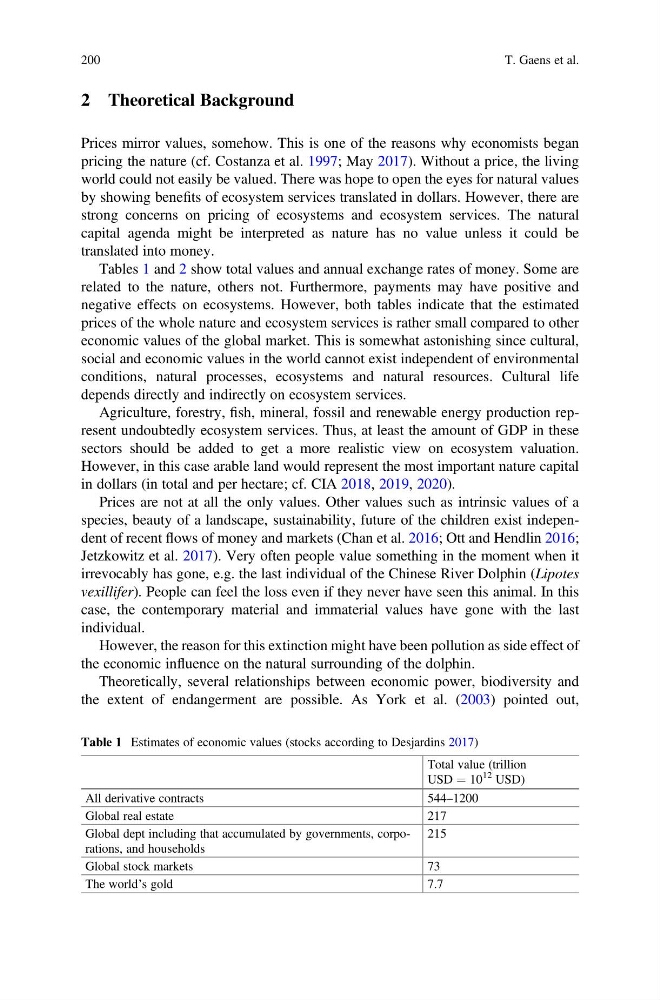
Tables 1 and 2 show total values and annual exchange rates of money. Some are
related to the nature, others not. Furthermore, payments may have positive and
negative effects on ecosystems. However, both tables indicate that the estimated
prices of the whole nature and ecosystem services is rather small compared to other
economic values of the global market. This is somewhat astonishing since cultural,
social and economic values in the world cannot exist independent of environmental
conditions, natural processes, ecosystems and natural resources. Cultural life
depends directly and indirectly on ecosystem services.
Agriculture, forestry, fish, mineral, fossil and renewable energy production represent undoubtedly ecosystem services. Thus, at least the amount of GDP in these
sectors should be added to get a more realistic view on ecosystem valuation.
However, in this case arable land would represent the most important nature capital
in dollars (in total and per hectare; cf. CIA 2018, 2019, 2020).
Prices are not at all the only values. Other values such as intrinsic values of a
species, beauty of a landscape, sustainability, future of the children exist independent of recent flows of money and markets (Chan et al. 2016; Ott and Hendlin 2016;
Jetzkowitz et al. 2017). Very often people value something in the moment when it
irrevocably has gone, e.g. the last individual of the Chinese River Dolphin (Lipotes
vexillifer). People can feel the loss even if they never have seen this animal. In this
case, the contemporary material and immaterial values have gone with the last
individual.
However, the reason for this extinction might have been pollution as side effect of
the economic influence on the natural surrounding of the dolphin.
Theoretically, several relationships between economic power, biodiversity and
the extent of endangerment are possible. As York et al. (2003) pointed out,
Table 1 Estimates of economic values (stocks according to Desjardins 2017)
Total value (trillion
USD ¼ 10
12 USD)
All derivative contracts
544–1200
Global real estate
217
Global dept including that accumulated by governments, corporations, and households
215
Global stock markets
73
The world’s gold
7.7
200
T. Gaens et al.
Prices mirror values, somehow. This is one of the reasons why economists began
pricing the nature (cf. Costanza et al. 1997; May 2017). Without a price, the living
world could not easily be valued. There was hope to open the eyes for natural values
by showing benefits of ecosystem services translated in dollars. However, there are
strong concerns on pricing of ecosystems and ecosystem services. The natural
capital agenda might be interpreted as nature has no value unless it could be
translated into money.
Tables 1 and 2 show total values and annual exchange rates of money. Some are
related to the nature, others not. Furthermore, payments may have positive and
negative effects on ecosystems. However, both tables indicate that the estimated
prices of the whole nature and ecosystem services is rather small compared to other
economic values of the global market. This is somewhat astonishing since cultural,
social and economic values in the world cannot exist independent of environmental
conditions, natural processes, ecosystems and natural resources. Cultural life
depends directly and indirectly on ecosystem services.
Agriculture, forestry, fish, mineral, fossil and renewable energy production represent undoubtedly ecosystem services. Thus, at least the amount of GDP in these
sectors should be added to get a more realistic view on ecosystem valuation.
However, in this case arable land would represent the most important nature capital
in dollars (in total and per hectare; cf. CIA 2018, 2019, 2020).
Prices are not at all the only values. Other values such as intrinsic values of a
species, beauty of a landscape, sustainability, future of the children exist independent of recent flows of money and markets (Chan et al. 2016; Ott and Hendlin 2016;
Jetzkowitz et al. 2017). Very often people value something in the moment when it
irrevocably has gone, e.g. the last individual of the Chinese River Dolphin (Lipotes
vexillifer). People can feel the loss even if they never have seen this animal. In this
case, the contemporary material and immaterial values have gone with the last
individual.
However, the reason for this extinction might have been pollution as side effect of
the economic influence on the natural surrounding of the dolphin.
Theoretically, several relationships between economic power, biodiversity and
the extent of endangerment are possible. As York et al. (2003) pointed out,
Table 1 Estimates of economic values (stocks according to Desjardins 2017)
Total value (trillion
USD ¼ 10
12 USD)
All derivative contracts
544–1200
Global real estate
217
Global dept including that accumulated by governments, corporations, and households
215
Global stock markets
73
The world’s gold
7.7
200
T. Gaens et al.