

60
J. Abe et al.
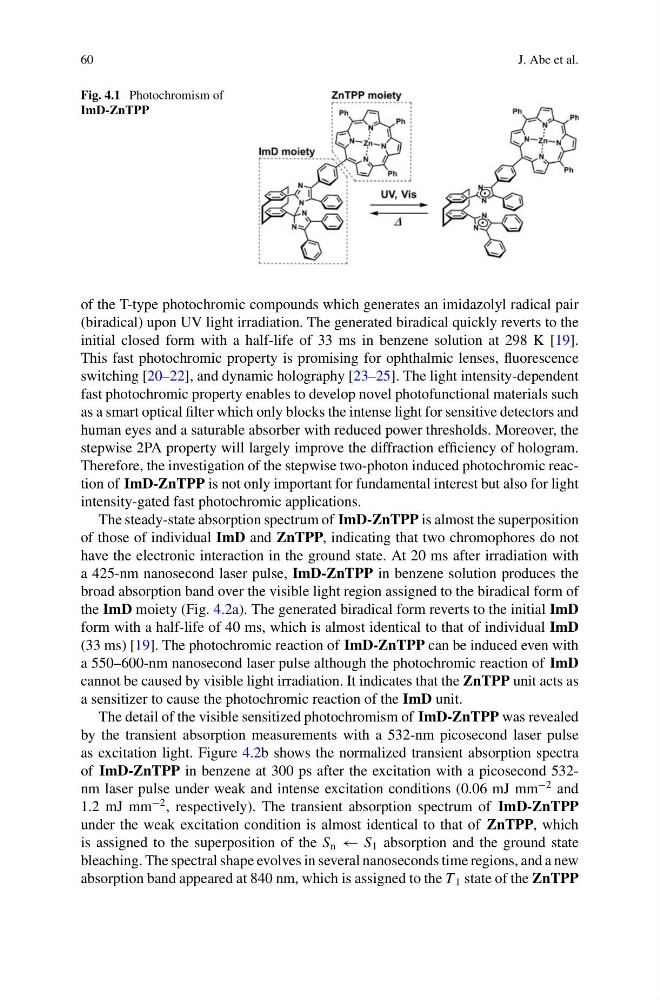
Fig. 4.1 Photochromism of
ImD-ZnTPP
of the T-type photochromic compounds which generates an imidazolyl radical pair
(biradical) upon UV light irradiation. The generated biradical quickly reverts to the
initial closed form with a half-life of 33 ms in benzene solution at 298 K [19].
This fast photochromic property is promising for ophthalmic lenses, fluorescence
switching [20–22], and dynamic holography [23–25]. The light intensity-dependent
fast photochromic property enables to develop novel photofunctional materials such
as a smart optical filter which only blocks the intense light for sensitive detectors and
human eyes and a saturable absorber with reduced power thresholds. Moreover, the
stepwise 2PA property will largely improve the diffraction efficiency of hologram.
Therefore, the investigation of the stepwise two-photon induced photochromic reaction of ImD-ZnTPP is not only important for fundamental interest but also for light
intensity-gated fast photochromic applications.
The steady-state absorption spectrum of ImD-ZnTPP is almost the superposition
of those of individual ImD and ZnTPP, indicating that two chromophores do not
have the electronic interaction in the ground state. At 20 ms after irradiation with
a 425-nm nanosecond laser pulse, ImD-ZnTPP in benzene solution produces the
broad absorption band over the visible light region assigned to the biradical form of
the ImD moiety (Fig. 4.2a). The generated biradical form reverts to the initial ImD
form with a half-life of 40 ms, which is almost identical to that of individual ImD
(33 ms) [19]. The photochromic reaction of ImD-ZnTPP can be induced even with
a 550–600-nm nanosecond laser pulse although the photochromic reaction of ImD
cannot be caused by visible light irradiation. It indicates that the ZnTPP unit acts as
a sensitizer to cause the photochromic reaction of the ImD unit.
The detail of the visible sensitized photochromism of ImD-ZnTPP was revealed
by the transient absorption measurements with a 532-nm picosecond laser pulse
as excitation light. Figure 4.2b shows the normalized transient absorption spectra
of ImD-ZnTPP in benzene at 300 ps after the excitation with a picosecond 532nm laser pulse under weak and intense excitation conditions (0.06 mJ mm
−2 and
1.2 mJ mm
−2 , respectively). The transient absorption spectrum of ImD-ZnTPP
under the weak excitation condition is almost identical to that of ZnTPP, which
is assigned to the superposition of the S n ← S 1 absorption and the ground state
bleaching. The spectral shape evolves in several nanoseconds time regions, and a new
absorption band appeared at 840 nm, which is assigned to the T 1 state of the ZnTPP
J. Abe et al.
Fig. 4.1 Photochromism of
ImD-ZnTPP
of the T-type photochromic compounds which generates an imidazolyl radical pair
(biradical) upon UV light irradiation. The generated biradical quickly reverts to the
initial closed form with a half-life of 33 ms in benzene solution at 298 K [19].
This fast photochromic property is promising for ophthalmic lenses, fluorescence
switching [20–22], and dynamic holography [23–25]. The light intensity-dependent
fast photochromic property enables to develop novel photofunctional materials such
as a smart optical filter which only blocks the intense light for sensitive detectors and
human eyes and a saturable absorber with reduced power thresholds. Moreover, the
stepwise 2PA property will largely improve the diffraction efficiency of hologram.
Therefore, the investigation of the stepwise two-photon induced photochromic reaction of ImD-ZnTPP is not only important for fundamental interest but also for light
intensity-gated fast photochromic applications.
The steady-state absorption spectrum of ImD-ZnTPP is almost the superposition
of those of individual ImD and ZnTPP, indicating that two chromophores do not
have the electronic interaction in the ground state. At 20 ms after irradiation with
a 425-nm nanosecond laser pulse, ImD-ZnTPP in benzene solution produces the
broad absorption band over the visible light region assigned to the biradical form of
the ImD moiety (Fig. 4.2a). The generated biradical form reverts to the initial ImD
form with a half-life of 40 ms, which is almost identical to that of individual ImD
(33 ms) [19]. The photochromic reaction of ImD-ZnTPP can be induced even with
a 550–600-nm nanosecond laser pulse although the photochromic reaction of ImD
cannot be caused by visible light irradiation. It indicates that the ZnTPP unit acts as
a sensitizer to cause the photochromic reaction of the ImD unit.
The detail of the visible sensitized photochromism of ImD-ZnTPP was revealed
by the transient absorption measurements with a 532-nm picosecond laser pulse
as excitation light. Figure 4.2b shows the normalized transient absorption spectra
of ImD-ZnTPP in benzene at 300 ps after the excitation with a picosecond 532nm laser pulse under weak and intense excitation conditions (0.06 mJ mm
−2 and
1.2 mJ mm
−2 , respectively). The transient absorption spectrum of ImD-ZnTPP
under the weak excitation condition is almost identical to that of ZnTPP, which
is assigned to the superposition of the S n ← S 1 absorption and the ground state
bleaching. The spectral shape evolves in several nanoseconds time regions, and a new
absorption band appeared at 840 nm, which is assigned to the T 1 state of the ZnTPP