

31 Cooperative and Hierarchal Photoresponses of Molecular …
547
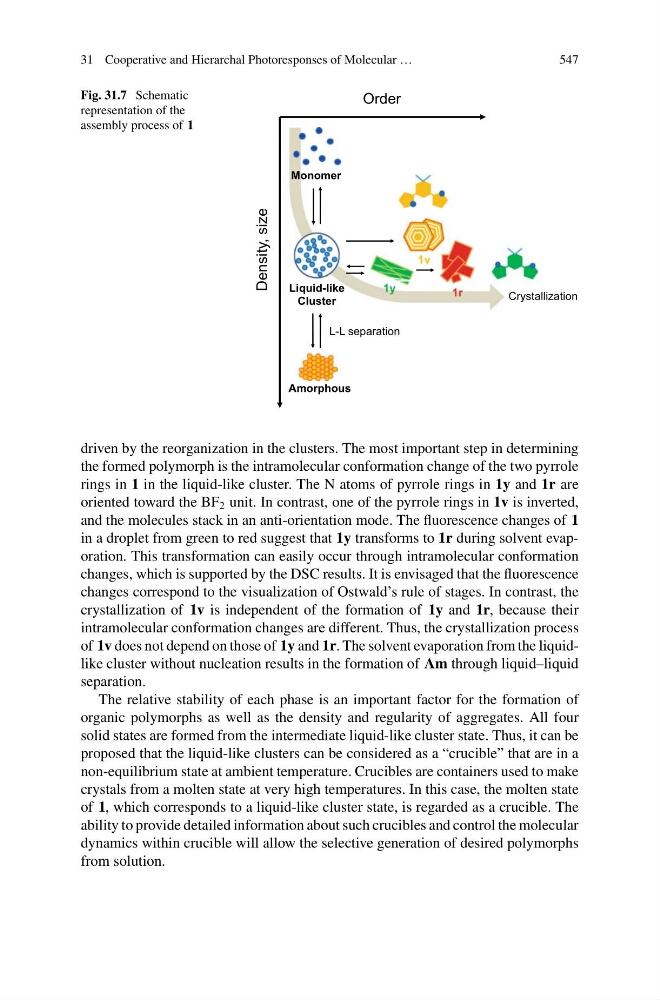
Fig. 31.7 Schematic
representation of the
assembly process of 1
Monomer
Liquid-like
Cluster
Amorphous
Density, size
Order
Crystallization
L-L separation
driven by the reorganization in the clusters. The most important step in determining
the formed polymorph is the intramolecular conformation change of the two pyrrole
rings in 1 in the liquid-like cluster. The N atoms of pyrrole rings in 1y and 1r are
oriented toward the BF 2 unit. In contrast, one of the pyrrole rings in 1v is inverted,
and the molecules stack in an anti-orientation mode. The fluorescence changes of 1
in a droplet from green to red suggest that 1y transforms to 1r during solvent evaporation. This transformation can easily occur through intramolecular conformation
changes, which is supported by the DSC results. It is envisaged that the fluorescence
changes correspond to the visualization of Ostwald’s rule of stages. In contrast, the
crystallization of 1v is independent of the formation of 1y and 1r, because their
intramolecular conformation changes are different. Thus, the crystallization process
of 1v does not depend on those of 1y and 1r. The solvent evaporation from the liquidlike cluster without nucleation results in the formation of Am through liquid–liquid
separation.
The relative stability of each phase is an important factor for the formation of
organic polymorphs as well as the density and regularity of aggregates. All four
solid states are formed from the intermediate liquid-like cluster state. Thus, it can be
proposed that the liquid-like clusters can be considered as a “crucible” that are in a
non-equilibrium state at ambient temperature. Crucibles are containers used to make
crystals from a molten state at very high temperatures. In this case, the molten state
of 1, which corresponds to a liquid-like cluster state, is regarded as a crucible. The
ability to provide detailed information about such crucibles and control the molecular
dynamics within crucible will allow the selective generation of desired polymorphs
from solution.
547
Fig. 31.7 Schematic
representation of the
assembly process of 1
Monomer
Liquid-like
Cluster
Amorphous
Density, size
Order
Crystallization
L-L separation
driven by the reorganization in the clusters. The most important step in determining
the formed polymorph is the intramolecular conformation change of the two pyrrole
rings in 1 in the liquid-like cluster. The N atoms of pyrrole rings in 1y and 1r are
oriented toward the BF 2 unit. In contrast, one of the pyrrole rings in 1v is inverted,
and the molecules stack in an anti-orientation mode. The fluorescence changes of 1
in a droplet from green to red suggest that 1y transforms to 1r during solvent evaporation. This transformation can easily occur through intramolecular conformation
changes, which is supported by the DSC results. It is envisaged that the fluorescence
changes correspond to the visualization of Ostwald’s rule of stages. In contrast, the
crystallization of 1v is independent of the formation of 1y and 1r, because their
intramolecular conformation changes are different. Thus, the crystallization process
of 1v does not depend on those of 1y and 1r. The solvent evaporation from the liquidlike cluster without nucleation results in the formation of Am through liquid–liquid
separation.
The relative stability of each phase is an important factor for the formation of
organic polymorphs as well as the density and regularity of aggregates. All four
solid states are formed from the intermediate liquid-like cluster state. Thus, it can be
proposed that the liquid-like clusters can be considered as a “crucible” that are in a
non-equilibrium state at ambient temperature. Crucibles are containers used to make
crystals from a molten state at very high temperatures. In this case, the molten state
of 1, which corresponds to a liquid-like cluster state, is regarded as a crucible. The
ability to provide detailed information about such crucibles and control the molecular
dynamics within crucible will allow the selective generation of desired polymorphs
from solution.