

518
M. Vacha and S. Hirata
eh +
h +
h +
eNC aggregate EL
h
light
NC aggregate PL
e
3 µm
PL
a
3 µm
EL
b
3000
2000
1000
20
0
Time (s)
10
30
0
PL (counts/10 ms)
c
3000
2000
1000
20
0
Time (s)
10
30
0
EL (counts/10 ms)
d
g
f
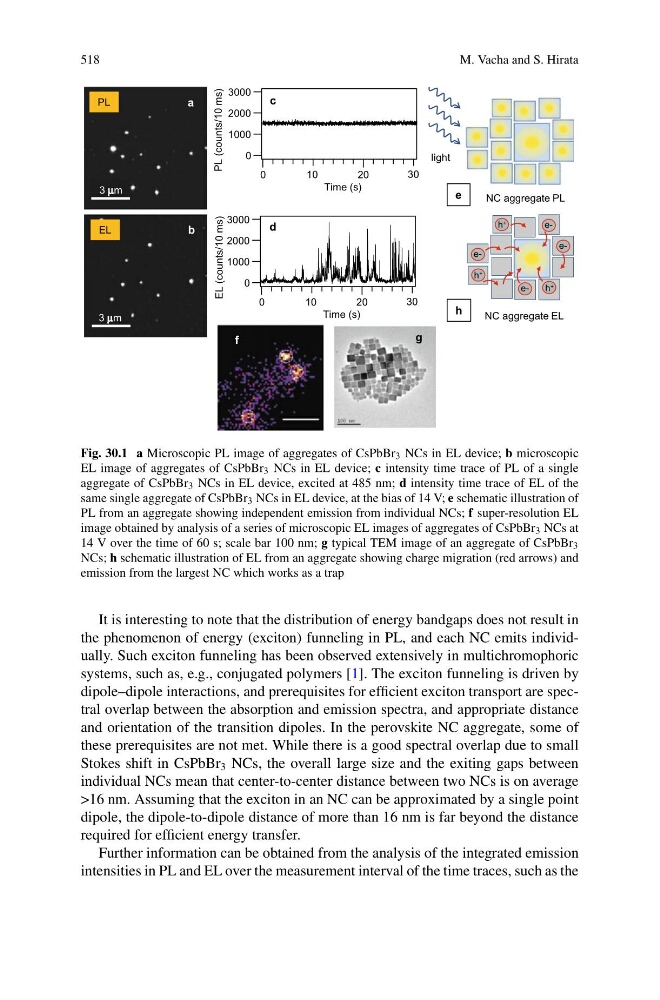
Fig. 30.1 a Microscopic PL image of aggregates of CsPbBr 3 NCs in EL device; b microscopic
EL image of aggregates of CsPbBr 3 NCs in EL device; c intensity time trace of PL of a single
aggregate of CsPbBr 3 NCs in EL device, excited at 485 nm; d intensity time trace of EL of the
same single aggregate of CsPbBr 3 NCs in EL device, at the bias of 14 V; e schematic illustration of
PL from an aggregate showing independent emission from individual NCs; f super-resolution EL
image obtained by analysis of a series of microscopic EL images of aggregates of CsPbBr 3 NCs at
14 V over the time of 60 s; scale bar 100 nm; g typical TEM image of an aggregate of CsPbBr 3
NCs; h schematic illustration of EL from an aggregate showing charge migration (red arrows) and
emission from the largest NC which works as a trap
It is interesting to note that the distribution of energy bandgaps does not result in
the phenomenon of energy (exciton) funneling in PL, and each NC emits individually. Such exciton funneling has been observed extensively in multichromophoric
systems, such as, e.g., conjugated polymers [1]. The exciton funneling is driven by
dipole–dipole interactions, and prerequisites for efficient exciton transport are spectral overlap between the absorption and emission spectra, and appropriate distance
and orientation of the transition dipoles. In the perovskite NC aggregate, some of
these prerequisites are not met. While there is a good spectral overlap due to small
Stokes shift in CsPbBr 3 NCs, the overall large size and the exiting gaps between
individual NCs mean that center-to-center distance between two NCs is on average
>16 nm. Assuming that the exciton in an NC can be approximated by a single point
dipole, the dipole-to-dipole distance of more than 16 nm is far beyond the distance
required for efficient energy transfer.
Further information can be obtained from the analysis of the integrated emission
intensities in PL and EL over the measurement interval of the time traces, such as the
M. Vacha and S. Hirata
eh +
h +
h +
eNC aggregate EL
h
light
NC aggregate PL
e
3 µm
PL
a
3 µm
EL
b
3000
2000
1000
20
0
Time (s)
10
30
0
PL (counts/10 ms)
c
3000
2000
1000
20
0
Time (s)
10
30
0
EL (counts/10 ms)
d
g
f
Fig. 30.1 a Microscopic PL image of aggregates of CsPbBr 3 NCs in EL device; b microscopic
EL image of aggregates of CsPbBr 3 NCs in EL device; c intensity time trace of PL of a single
aggregate of CsPbBr 3 NCs in EL device, excited at 485 nm; d intensity time trace of EL of the
same single aggregate of CsPbBr 3 NCs in EL device, at the bias of 14 V; e schematic illustration of
PL from an aggregate showing independent emission from individual NCs; f super-resolution EL
image obtained by analysis of a series of microscopic EL images of aggregates of CsPbBr 3 NCs at
14 V over the time of 60 s; scale bar 100 nm; g typical TEM image of an aggregate of CsPbBr 3
NCs; h schematic illustration of EL from an aggregate showing charge migration (red arrows) and
emission from the largest NC which works as a trap
It is interesting to note that the distribution of energy bandgaps does not result in
the phenomenon of energy (exciton) funneling in PL, and each NC emits individually. Such exciton funneling has been observed extensively in multichromophoric
systems, such as, e.g., conjugated polymers [1]. The exciton funneling is driven by
dipole–dipole interactions, and prerequisites for efficient exciton transport are spectral overlap between the absorption and emission spectra, and appropriate distance
and orientation of the transition dipoles. In the perovskite NC aggregate, some of
these prerequisites are not met. While there is a good spectral overlap due to small
Stokes shift in CsPbBr 3 NCs, the overall large size and the exiting gaps between
individual NCs mean that center-to-center distance between two NCs is on average
>16 nm. Assuming that the exciton in an NC can be approximated by a single point
dipole, the dipole-to-dipole distance of more than 16 nm is far beyond the distance
required for efficient energy transfer.
Further information can be obtained from the analysis of the integrated emission
intensities in PL and EL over the measurement interval of the time traces, such as the