

482
T. Ube and T. Ikeda
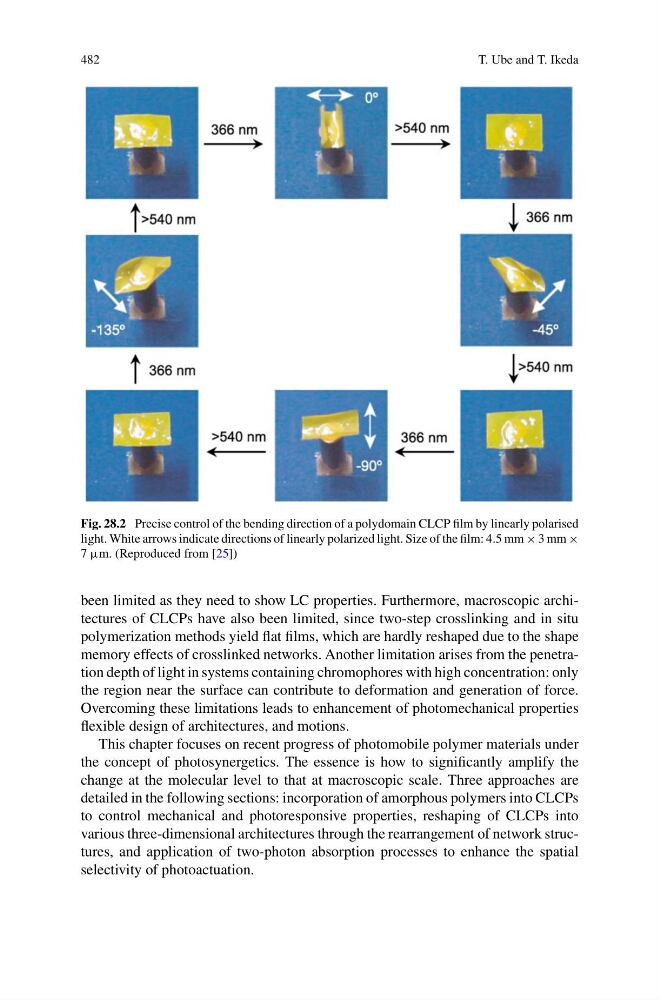
Fig. 28.2 Precise control of the bending direction of a polydomain CLCP film by linearly polarised
light. White arrows indicate directions of linearly polarized light. Size of the film: 4.5 mm × 3 mm ×
7 µm. (Reproduced from [25])
been limited as they need to show LC properties. Furthermore, macroscopic architectures of CLCPs have also been limited, since two-step crosslinking and in situ
polymerization methods yield flat films, which are hardly reshaped due to the shape
memory effects of crosslinked networks. Another limitation arises from the penetration depth of light in systems containing chromophores with high concentration: only
the region near the surface can contribute to deformation and generation of force.
Overcoming these limitations leads to enhancement of photomechanical properties
flexible design of architectures, and motions.
This chapter focuses on recent progress of photomobile polymer materials under
the concept of photosynergetics. The essence is how to significantly amplify the
change at the molecular level to that at macroscopic scale. Three approaches are
detailed in the following sections: incorporation of amorphous polymers into CLCPs
to control mechanical and photoresponsive properties, reshaping of CLCPs into
various three-dimensional architectures through the rearrangement of network structures, and application of two-photon absorption processes to enhance the spatial
selectivity of photoactuation.
T. Ube and T. Ikeda
Fig. 28.2 Precise control of the bending direction of a polydomain CLCP film by linearly polarised
light. White arrows indicate directions of linearly polarized light. Size of the film: 4.5 mm × 3 mm ×
7 µm. (Reproduced from [25])
been limited as they need to show LC properties. Furthermore, macroscopic architectures of CLCPs have also been limited, since two-step crosslinking and in situ
polymerization methods yield flat films, which are hardly reshaped due to the shape
memory effects of crosslinked networks. Another limitation arises from the penetration depth of light in systems containing chromophores with high concentration: only
the region near the surface can contribute to deformation and generation of force.
Overcoming these limitations leads to enhancement of photomechanical properties
flexible design of architectures, and motions.
This chapter focuses on recent progress of photomobile polymer materials under
the concept of photosynergetics. The essence is how to significantly amplify the
change at the molecular level to that at macroscopic scale. Three approaches are
detailed in the following sections: incorporation of amorphous polymers into CLCPs
to control mechanical and photoresponsive properties, reshaping of CLCPs into
various three-dimensional architectures through the rearrangement of network structures, and application of two-photon absorption processes to enhance the spatial
selectivity of photoactuation.