

480
T. Ube and T. Ikeda
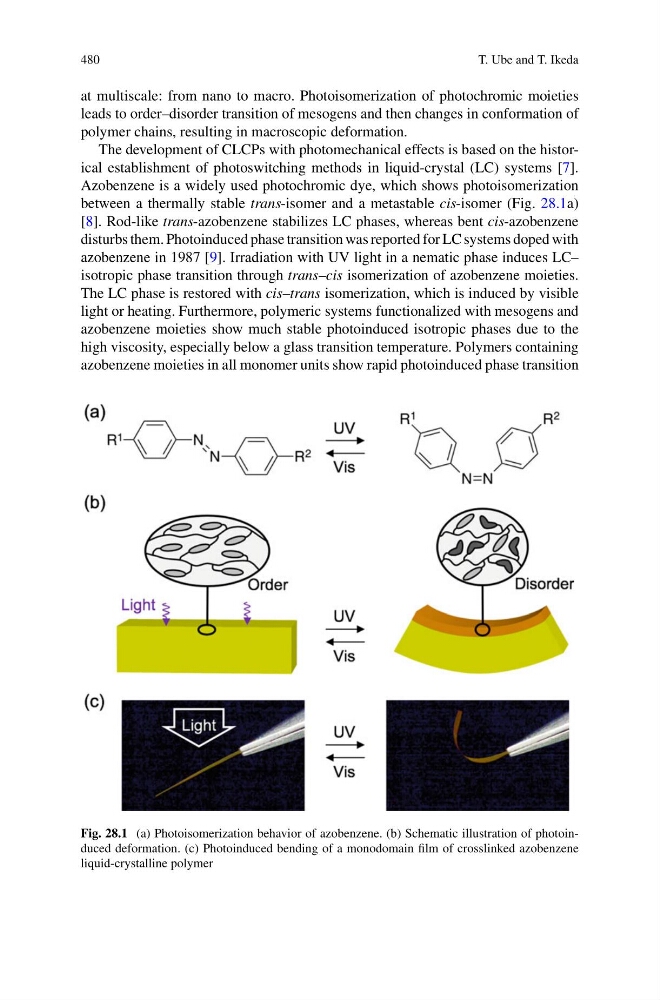
at multiscale: from nano to macro. Photoisomerization of photochromic moieties
leads to order–disorder transition of mesogens and then changes in conformation of
polymer chains, resulting in macroscopic deformation.
The development of CLCPs with photomechanical effects is based on the historical establishment of photoswitching methods in liquid-crystal (LC) systems [7].
Azobenzene is a widely used photochromic dye, which shows photoisomerization
between a thermally stable trans-isomer and a metastable cis-isomer (Fig. 28.1a)
[8]. Rod-like trans-azobenzene stabilizes LC phases, whereas bent cis-azobenzene
disturbs them. Photoinduced phase transition was reported for LC systems doped with
azobenzene in 1987 [9]. Irradiation with UV light in a nematic phase induces LC–
isotropic phase transition through trans–cis isomerization of azobenzene moieties.
The LC phase is restored with cis–trans isomerization, which is induced by visible
light or heating. Furthermore, polymeric systems functionalized with mesogens and
azobenzene moieties show much stable photoinduced isotropic phases due to the
high viscosity, especially below a glass transition temperature. Polymers containing
azobenzene moieties in all monomer units show rapid photoinduced phase transition
Fig. 28.1 (a) Photoisomerization behavior of azobenzene. (b) Schematic illustration of photoinduced deformation. (c) Photoinduced bending of a monodomain film of crosslinked azobenzene
liquid-crystalline polymer
T. Ube and T. Ikeda
at multiscale: from nano to macro. Photoisomerization of photochromic moieties
leads to order–disorder transition of mesogens and then changes in conformation of
polymer chains, resulting in macroscopic deformation.
The development of CLCPs with photomechanical effects is based on the historical establishment of photoswitching methods in liquid-crystal (LC) systems [7].
Azobenzene is a widely used photochromic dye, which shows photoisomerization
between a thermally stable trans-isomer and a metastable cis-isomer (Fig. 28.1a)
[8]. Rod-like trans-azobenzene stabilizes LC phases, whereas bent cis-azobenzene
disturbs them. Photoinduced phase transition was reported for LC systems doped with
azobenzene in 1987 [9]. Irradiation with UV light in a nematic phase induces LC–
isotropic phase transition through trans–cis isomerization of azobenzene moieties.
The LC phase is restored with cis–trans isomerization, which is induced by visible
light or heating. Furthermore, polymeric systems functionalized with mesogens and
azobenzene moieties show much stable photoinduced isotropic phases due to the
high viscosity, especially below a glass transition temperature. Polymers containing
azobenzene moieties in all monomer units show rapid photoinduced phase transition
Fig. 28.1 (a) Photoisomerization behavior of azobenzene. (b) Schematic illustration of photoinduced deformation. (c) Photoinduced bending of a monodomain film of crosslinked azobenzene
liquid-crystalline polymer