

458
Y. Kageyama
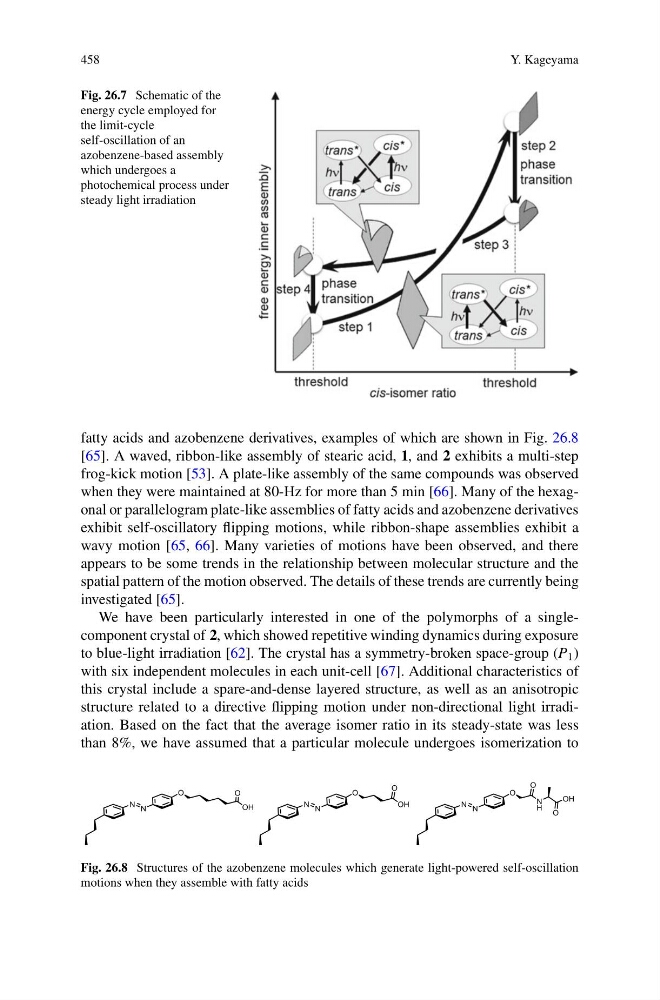
Fig. 26.7 Schematic of the
energy cycle employed for
the limit-cycle
self-oscillation of an
azobenzene-based assembly
which undergoes a
photochemical process under
steady light irradiation
fatty acids and azobenzene derivatives, examples of which are shown in Fig. 26.8
[65]. A waved, ribbon-like assembly of stearic acid, 1, and 2 exhibits a multi-step
frog-kick motion [53]. A plate-like assembly of the same compounds was observed
when they were maintained at 80-Hz for more than 5 min [66]. Many of the hexagonal or parallelogram plate-like assemblies of fatty acids and azobenzene derivatives
exhibit self-oscillatory flipping motions, while ribbon-shape assemblies exhibit a
wavy motion [65, 66]. Many varieties of motions have been observed, and there
appears to be some trends in the relationship between molecular structure and the
spatial pattern of the motion observed. The details of these trends are currently being
investigated [65].
We have been particularly interested in one of the polymorphs of a singlecomponent crystal of 2, which showed repetitive winding dynamics during exposure
to blue-light irradiation [62]. The crystal has a symmetry-broken space-group (P 1 )
with six independent molecules in each unit-cell [67]. Additional characteristics of
this crystal include a spare-and-dense layered structure, as well as an anisotropic
structure related to a directive flipping motion under non-directional light irradiation. Based on the fact that the average isomer ratio in its steady-state was less
than 8%, we have assumed that a particular molecule undergoes isomerization to
N N
O
OH
O
N N
O
OH
N N
O
N
H
O
O
OH
O
Fig. 26.8 Structures of the azobenzene molecules which generate light-powered self-oscillation
motions when they assemble with fatty acids
Y. Kageyama
Fig. 26.7 Schematic of the
energy cycle employed for
the limit-cycle
self-oscillation of an
azobenzene-based assembly
which undergoes a
photochemical process under
steady light irradiation
fatty acids and azobenzene derivatives, examples of which are shown in Fig. 26.8
[65]. A waved, ribbon-like assembly of stearic acid, 1, and 2 exhibits a multi-step
frog-kick motion [53]. A plate-like assembly of the same compounds was observed
when they were maintained at 80-Hz for more than 5 min [66]. Many of the hexagonal or parallelogram plate-like assemblies of fatty acids and azobenzene derivatives
exhibit self-oscillatory flipping motions, while ribbon-shape assemblies exhibit a
wavy motion [65, 66]. Many varieties of motions have been observed, and there
appears to be some trends in the relationship between molecular structure and the
spatial pattern of the motion observed. The details of these trends are currently being
investigated [65].
We have been particularly interested in one of the polymorphs of a singlecomponent crystal of 2, which showed repetitive winding dynamics during exposure
to blue-light irradiation [62]. The crystal has a symmetry-broken space-group (P 1 )
with six independent molecules in each unit-cell [67]. Additional characteristics of
this crystal include a spare-and-dense layered structure, as well as an anisotropic
structure related to a directive flipping motion under non-directional light irradiation. Based on the fact that the average isomer ratio in its steady-state was less
than 8%, we have assumed that a particular molecule undergoes isomerization to
N N
O
OH
O
N N
O
OH
N N
O
N
H
O
O
OH
O
Fig. 26.8 Structures of the azobenzene molecules which generate light-powered self-oscillation
motions when they assemble with fatty acids