

450
Y. Kageyama
26.1 Introduction
26.1.1 Achieving Mechanical Work with Molecular Motors
The creation of active matter and active transporters is currently an exciting area of
research. For chemists, the synthesis of molecules which continuously and mechanically perform work is a fundamental task in the preparation of such active molecular
devices. From this viewpoint, synthetic molecular motors have been proposed to date
[1–3]. Similar to the enzymatic molecular motors in biological systems, molecular
motors generally involve a molecular-based catalyst which spontaneously repeats
a cyclic structural change while converting a source of energy (e.g., a chemical
substrate, electric power, or light) into mechanical energy. The mechanical energy
generated by these molecular motors is the sum of kinetic energy and potential
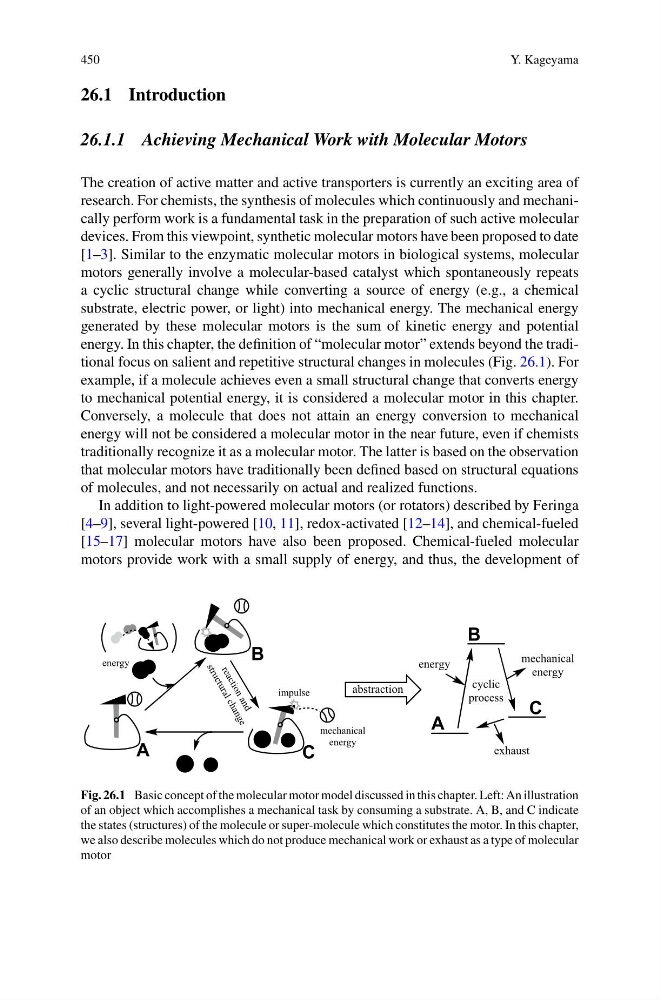
energy. In this chapter, the definition of “molecular motor” extends beyond the traditional focus on salient and repetitive structural changes in molecules (Fig. 26.1). For
example, if a molecule achieves even a small structural change that converts energy
to mechanical potential energy, it is considered a molecular motor in this chapter.
Conversely, a molecule that does not attain an energy conversion to mechanical
energy will not be considered a molecular motor in the near future, even if chemists
traditionally recognize it as a molecular motor. The latter is based on the observation
that molecular motors have traditionally been defined based on structural equations
of molecules, and not necessarily on actual and realized functions.
In addition to light-powered molecular motors (or rotators) described by Feringa
[4–9], several light-powered [10, 11], redox-activated [12–14], and chemical-fueled
[15–17] molecular motors have also been proposed. Chemical-fueled molecular
motors provide work with a small supply of energy, and thus, the development of
abstraction
r
e
a
c
ti
o
n
a
n
d
s
tr
u
c
tu
r
a
l
c
h
a
n
g
e
energy
mechanical
energy
exhaust
A
B
C
cyclic
process
A
B
C
mechanical
energy
impulse
energy
Fig. 26.1 Basic concept of the molecular motor model discussed in this chapter. Left: An illustration
of an object which accomplishes a mechanical task by consuming a substrate. A, B, and C indicate
the states (structures) of the molecule or super-molecule which constitutes the motor. In this chapter,
we also describe molecules which do not produce mechanical work or exhaust as a type of molecular
motor
Y. Kageyama
26.1 Introduction
26.1.1 Achieving Mechanical Work with Molecular Motors
The creation of active matter and active transporters is currently an exciting area of
research. For chemists, the synthesis of molecules which continuously and mechanically perform work is a fundamental task in the preparation of such active molecular
devices. From this viewpoint, synthetic molecular motors have been proposed to date
[1–3]. Similar to the enzymatic molecular motors in biological systems, molecular
motors generally involve a molecular-based catalyst which spontaneously repeats
a cyclic structural change while converting a source of energy (e.g., a chemical
substrate, electric power, or light) into mechanical energy. The mechanical energy
generated by these molecular motors is the sum of kinetic energy and potential
energy. In this chapter, the definition of “molecular motor” extends beyond the traditional focus on salient and repetitive structural changes in molecules (Fig. 26.1). For
example, if a molecule achieves even a small structural change that converts energy
to mechanical potential energy, it is considered a molecular motor in this chapter.
Conversely, a molecule that does not attain an energy conversion to mechanical
energy will not be considered a molecular motor in the near future, even if chemists
traditionally recognize it as a molecular motor. The latter is based on the observation
that molecular motors have traditionally been defined based on structural equations
of molecules, and not necessarily on actual and realized functions.
In addition to light-powered molecular motors (or rotators) described by Feringa
[4–9], several light-powered [10, 11], redox-activated [12–14], and chemical-fueled
[15–17] molecular motors have also been proposed. Chemical-fueled molecular
motors provide work with a small supply of energy, and thus, the development of
abstraction
r
e
a
c
ti
o
n
a
n
d
s
tr
u
c
tu
r
a
l
c
h
a
n
g
e
energy
mechanical
energy
exhaust
A
B
C
cyclic
process
A
B
C
mechanical
energy
impulse
energy
Fig. 26.1 Basic concept of the molecular motor model discussed in this chapter. Left: An illustration
of an object which accomplishes a mechanical task by consuming a substrate. A, B, and C indicate
the states (structures) of the molecule or super-molecule which constitutes the motor. In this chapter,
we also describe molecules which do not produce mechanical work or exhaust as a type of molecular
motor