

25 Photoresponsive Molecular Crystals …
429
(a)
(b)
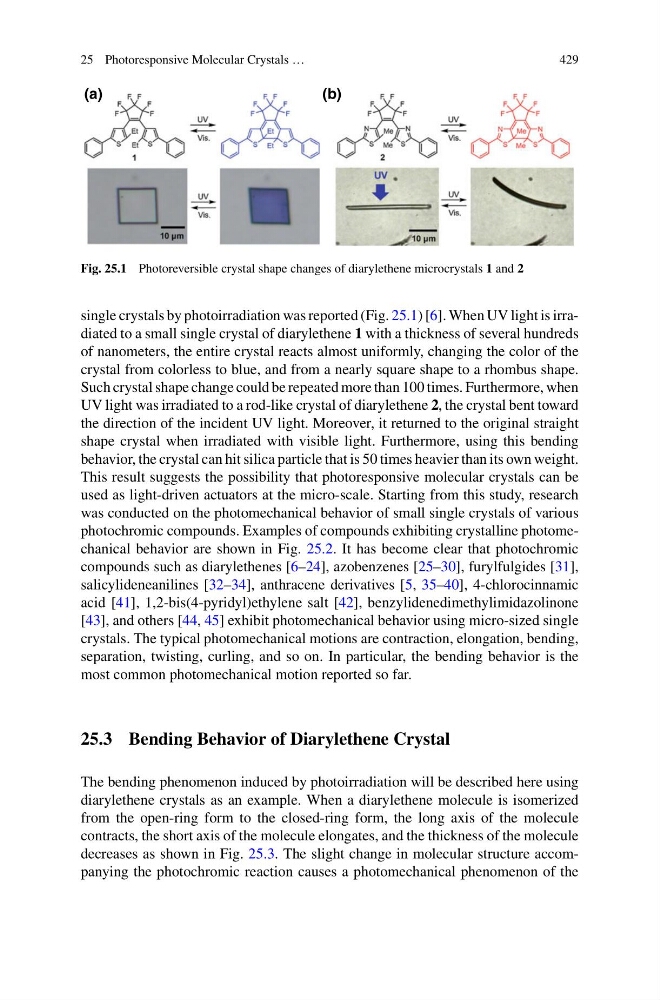
Fig. 25.1 Photoreversible crystal shape changes of diarylethene microcrystals 1 and 2
single crystals by photoirradiation was reported (Fig. 25.1) [6]. When UV light is irradiated to a small single crystal of diarylethene 1 with a thickness of several hundreds
of nanometers, the entire crystal reacts almost uniformly, changing the color of the
crystal from colorless to blue, and from a nearly square shape to a rhombus shape.
Such crystal shape change could be repeated more than 100 times. Furthermore, when
UV light was irradiated to a rod-like crystal of diarylethene 2, the crystal bent toward
the direction of the incident UV light. Moreover, it returned to the original straight
shape crystal when irradiated with visible light. Furthermore, using this bending
behavior, the crystal can hit silica particle that is 50 times heavier than its own weight.
This result suggests the possibility that photoresponsive molecular crystals can be
used as light-driven actuators at the micro-scale. Starting from this study, research
was conducted on the photomechanical behavior of small single crystals of various
photochromic compounds. Examples of compounds exhibiting crystalline photomechanical behavior are shown in Fig. 25.2. It has become clear that photochromic
compounds such as diarylethenes [6–24], azobenzenes [25–30], furylfulgides [31],
salicylideneanilines [32–34], anthracene derivatives [5, 35–40], 4-chlorocinnamic
acid [41], 1,2-bis(4-pyridyl)ethylene salt [42], benzylidenedimethylimidazolinone
[43], and others [44, 45] exhibit photomechanical behavior using micro-sized single
crystals. The typical photomechanical motions are contraction, elongation, bending,
separation, twisting, curling, and so on. In particular, the bending behavior is the
most common photomechanical motion reported so far.
25.3 Bending Behavior of Diarylethene Crystal
The bending phenomenon induced by photoirradiation will be described here using
diarylethene crystals as an example. When a diarylethene molecule is isomerized
from the open-ring form to the closed-ring form, the long axis of the molecule
contracts, the short axis of the molecule elongates, and the thickness of the molecule
decreases as shown in Fig. 25.3. The slight change in molecular structure accompanying the photochromic reaction causes a photomechanical phenomenon of the
429
(a)
(b)
Fig. 25.1 Photoreversible crystal shape changes of diarylethene microcrystals 1 and 2
single crystals by photoirradiation was reported (Fig. 25.1) [6]. When UV light is irradiated to a small single crystal of diarylethene 1 with a thickness of several hundreds
of nanometers, the entire crystal reacts almost uniformly, changing the color of the
crystal from colorless to blue, and from a nearly square shape to a rhombus shape.
Such crystal shape change could be repeated more than 100 times. Furthermore, when
UV light was irradiated to a rod-like crystal of diarylethene 2, the crystal bent toward
the direction of the incident UV light. Moreover, it returned to the original straight
shape crystal when irradiated with visible light. Furthermore, using this bending
behavior, the crystal can hit silica particle that is 50 times heavier than its own weight.
This result suggests the possibility that photoresponsive molecular crystals can be
used as light-driven actuators at the micro-scale. Starting from this study, research
was conducted on the photomechanical behavior of small single crystals of various
photochromic compounds. Examples of compounds exhibiting crystalline photomechanical behavior are shown in Fig. 25.2. It has become clear that photochromic
compounds such as diarylethenes [6–24], azobenzenes [25–30], furylfulgides [31],
salicylideneanilines [32–34], anthracene derivatives [5, 35–40], 4-chlorocinnamic
acid [41], 1,2-bis(4-pyridyl)ethylene salt [42], benzylidenedimethylimidazolinone
[43], and others [44, 45] exhibit photomechanical behavior using micro-sized single
crystals. The typical photomechanical motions are contraction, elongation, bending,
separation, twisting, curling, and so on. In particular, the bending behavior is the
most common photomechanical motion reported so far.
25.3 Bending Behavior of Diarylethene Crystal
The bending phenomenon induced by photoirradiation will be described here using
diarylethene crystals as an example. When a diarylethene molecule is isomerized
from the open-ring form to the closed-ring form, the long axis of the molecule
contracts, the short axis of the molecule elongates, and the thickness of the molecule
decreases as shown in Fig. 25.3. The slight change in molecular structure accompanying the photochromic reaction causes a photomechanical phenomenon of the