

24 Biomimetic Functions by Microscopic Molecular Reactions …
421
24.7 Photosalient Phenomena of Hollow Crystals
of a Diarylethene
In diarylethene crystals, the most commonly observed phenomena have been bending
and twisting [4, 22]. On the other hand, light induced scattering of organic crystals
are well known as photosalient effect [26]. A photosalient effect was also observed
in non-hollow crystals of some diarylethenes [27, 28]. Recently, we synthesized
a diarylethene 7o having a perfluorocyclohexene ring with two thiazole rings and
reported photochromism in solution and a crystalline state as well as the photosalient
effect [29]. The thin crystals of 7o fabricated by sublimation at normal pressure
showed bending, jumping, and scattering upon UV irradiation.
A diarylethene 7o with a perfluorocyclohexene ring formed hollow crystals by
sublimation under ambient pressure. Upon UV irradiation of the crystals, they showed
remarkable photosalient phenomena and scattered into small pieces. The speed of
the flying debris released from the crystal by UV irradiation exceeded several meters
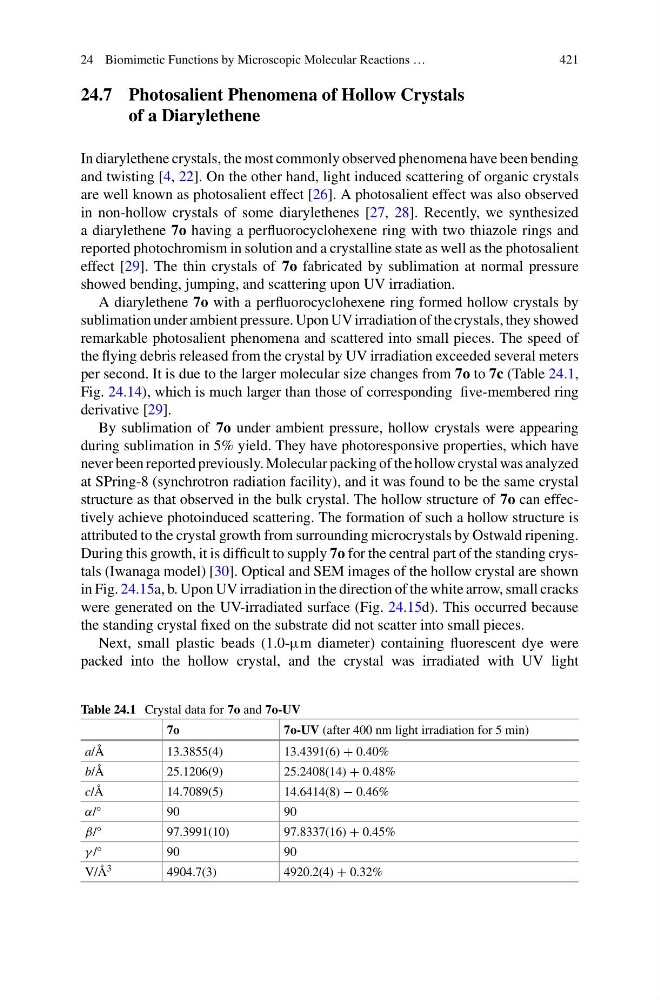
per second. It is due to the larger molecular size changes from 7o to 7c (Table 24.1,
Fig. 24.14), which is much larger than those of corresponding five-membered ring
derivative [29].
By sublimation of 7o under ambient pressure, hollow crystals were appearing
during sublimation in 5% yield. They have photoresponsive properties, which have
never been reported previously. Molecular packing of the hollow crystal was analyzed
at SPring-8 (synchrotron radiation facility), and it was found to be the same crystal
structure as that observed in the bulk crystal. The hollow structure of 7o can effectively achieve photoinduced scattering. The formation of such a hollow structure is
attributed to the crystal growth from surrounding microcrystals by Ostwald ripening.
During this growth, it is difficult to supply 7o for the central part of the standing crystals (Iwanaga model) [30]. Optical and SEM images of the hollow crystal are shown
in Fig. 24.15a, b. Upon UV irradiation in the direction of the white arrow, small cracks
were generated on the UV-irradiated surface (Fig. 24.15d). This occurred because
the standing crystal fixed on the substrate did not scatter into small pieces.
Next, small plastic beads (1.0-µm diameter) containing fluorescent dye were
packed into the hollow crystal, and the crystal was irradiated with UV light
Table 24.1 Crystal data for 7o and 7o-UV
7o
7o-UV (after 400 nm light irradiation for 5 min)
a/Å
13.3855(4)
13.4391(6) + 0.40%
b/Å
25.1206(9)
25.2408(14) + 0.48%
c/Å
14.7089(5)
14.6414(8) − 0.46%
α/°
90
90
β/°
97.3991(10)
97.8337(16) + 0.45%
γ /°
90
90
V/Å 3
4904.7(3)
4920.2(4) + 0.32%
421
24.7 Photosalient Phenomena of Hollow Crystals
of a Diarylethene
In diarylethene crystals, the most commonly observed phenomena have been bending
and twisting [4, 22]. On the other hand, light induced scattering of organic crystals
are well known as photosalient effect [26]. A photosalient effect was also observed
in non-hollow crystals of some diarylethenes [27, 28]. Recently, we synthesized
a diarylethene 7o having a perfluorocyclohexene ring with two thiazole rings and
reported photochromism in solution and a crystalline state as well as the photosalient
effect [29]. The thin crystals of 7o fabricated by sublimation at normal pressure
showed bending, jumping, and scattering upon UV irradiation.
A diarylethene 7o with a perfluorocyclohexene ring formed hollow crystals by
sublimation under ambient pressure. Upon UV irradiation of the crystals, they showed
remarkable photosalient phenomena and scattered into small pieces. The speed of
the flying debris released from the crystal by UV irradiation exceeded several meters
per second. It is due to the larger molecular size changes from 7o to 7c (Table 24.1,
Fig. 24.14), which is much larger than those of corresponding five-membered ring
derivative [29].
By sublimation of 7o under ambient pressure, hollow crystals were appearing
during sublimation in 5% yield. They have photoresponsive properties, which have
never been reported previously. Molecular packing of the hollow crystal was analyzed
at SPring-8 (synchrotron radiation facility), and it was found to be the same crystal
structure as that observed in the bulk crystal. The hollow structure of 7o can effectively achieve photoinduced scattering. The formation of such a hollow structure is
attributed to the crystal growth from surrounding microcrystals by Ostwald ripening.
During this growth, it is difficult to supply 7o for the central part of the standing crystals (Iwanaga model) [30]. Optical and SEM images of the hollow crystal are shown
in Fig. 24.15a, b. Upon UV irradiation in the direction of the white arrow, small cracks
were generated on the UV-irradiated surface (Fig. 24.15d). This occurred because
the standing crystal fixed on the substrate did not scatter into small pieces.
Next, small plastic beads (1.0-µm diameter) containing fluorescent dye were
packed into the hollow crystal, and the crystal was irradiated with UV light
Table 24.1 Crystal data for 7o and 7o-UV
7o
7o-UV (after 400 nm light irradiation for 5 min)
a/Å
13.3855(4)
13.4391(6) + 0.40%
b/Å
25.1206(9)
25.2408(14) + 0.48%
c/Å
14.7089(5)
14.6414(8) − 0.46%
α/°
90
90
β/°
97.3991(10)
97.8337(16) + 0.45%
γ /°
90
90
V/Å 3
4904.7(3)
4920.2(4) + 0.32%