

416
K. Uchida et al.
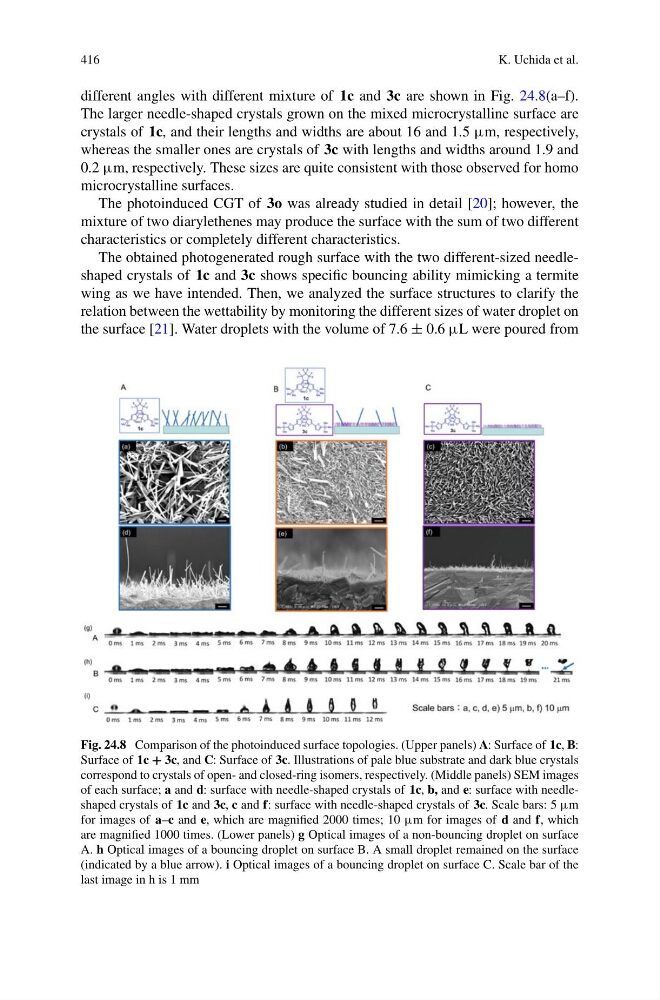
different angles with different mixture of 1c and 3c are shown in Fig. 24.8(a–f).
The larger needle-shaped crystals grown on the mixed microcrystalline surface are
crystals of 1c, and their lengths and widths are about 16 and 1.5 µm, respectively,
whereas the smaller ones are crystals of 3c with lengths and widths around 1.9 and
0.2 µm, respectively. These sizes are quite consistent with those observed for homo
microcrystalline surfaces.
The photoinduced CGT of 3o was already studied in detail [20]; however, the
mixture of two diarylethenes may produce the surface with the sum of two different
characteristics or completely different characteristics.
The obtained photogenerated rough surface with the two different-sized needleshaped crystals of 1c and 3c shows specific bouncing ability mimicking a termite
wing as we have intended. Then, we analyzed the surface structures to clarify the
relation between the wettability by monitoring the different sizes of water droplet on
the surface [21]. Water droplets with the volume of 7.6 ± 0.6 µL were poured from
Fig. 24.8 Comparison of the photoinduced surface topologies. (Upper panels) A: Surface of 1c, B:
Surface of 1c + 3c, and C: Surface of 3c. Illustrations of pale blue substrate and dark blue crystals
correspond to crystals of open- and closed-ring isomers, respectively. (Middle panels) SEM images
of each surface; a and d: surface with needle-shaped crystals of 1c, b, and e: surface with needleshaped crystals of 1c and 3c, c and f: surface with needle-shaped crystals of 3c. Scale bars: 5 µm
for images of a–c and e, which are magnified 2000 times; 10 µm for images of d and f, which
are magnified 1000 times. (Lower panels) g Optical images of a non-bouncing droplet on surface
A. h Optical images of a bouncing droplet on surface B. A small droplet remained on the surface
(indicated by a blue arrow). i Optical images of a bouncing droplet on surface C. Scale bar of the
last image in h is 1 mm
K. Uchida et al.
different angles with different mixture of 1c and 3c are shown in Fig. 24.8(a–f).
The larger needle-shaped crystals grown on the mixed microcrystalline surface are
crystals of 1c, and their lengths and widths are about 16 and 1.5 µm, respectively,
whereas the smaller ones are crystals of 3c with lengths and widths around 1.9 and
0.2 µm, respectively. These sizes are quite consistent with those observed for homo
microcrystalline surfaces.
The photoinduced CGT of 3o was already studied in detail [20]; however, the
mixture of two diarylethenes may produce the surface with the sum of two different
characteristics or completely different characteristics.
The obtained photogenerated rough surface with the two different-sized needleshaped crystals of 1c and 3c shows specific bouncing ability mimicking a termite
wing as we have intended. Then, we analyzed the surface structures to clarify the
relation between the wettability by monitoring the different sizes of water droplet on
the surface [21]. Water droplets with the volume of 7.6 ± 0.6 µL were poured from
Fig. 24.8 Comparison of the photoinduced surface topologies. (Upper panels) A: Surface of 1c, B:
Surface of 1c + 3c, and C: Surface of 3c. Illustrations of pale blue substrate and dark blue crystals
correspond to crystals of open- and closed-ring isomers, respectively. (Middle panels) SEM images
of each surface; a and d: surface with needle-shaped crystals of 1c, b, and e: surface with needleshaped crystals of 1c and 3c, c and f: surface with needle-shaped crystals of 3c. Scale bars: 5 µm
for images of a–c and e, which are magnified 2000 times; 10 µm for images of d and f, which
are magnified 1000 times. (Lower panels) g Optical images of a non-bouncing droplet on surface
A. h Optical images of a bouncing droplet on surface B. A small droplet remained on the surface
(indicated by a blue arrow). i Optical images of a bouncing droplet on surface C. Scale bar of the
last image in h is 1 mm