

23 Ultrafast Energy Transfer of Biohybrid Photosynthetic Antenna …
399
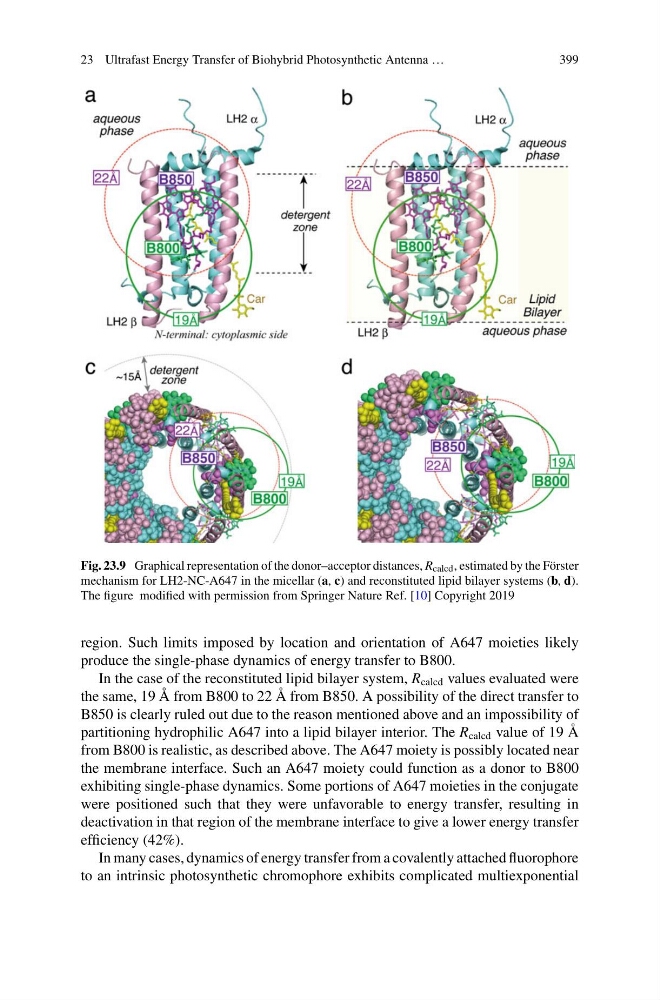
Fig. 23.9 Graphical representation of the donor–acceptor distances, R calcd , estimated by the Förster
mechanism for LH2-NC-A647 in the micellar (a, c) and reconstituted lipid bilayer systems (b, d).
The figure modified with permission from Springer Nature Ref. [10] Copyright 2019
region. Such limits imposed by location and orientation of A647 moieties likely
produce the single-phase dynamics of energy transfer to B800.
In the case of the reconstituted lipid bilayer system, R calcd values evaluated were
the same, 19 Å from B800 to 22 Å from B850. A possibility of the direct transfer to
B850 is clearly ruled out due to the reason mentioned above and an impossibility of
partitioning hydrophilic A647 into a lipid bilayer interior. The R calcd value of 19 Å
from B800 is realistic, as described above. The A647 moiety is possibly located near
the membrane interface. Such an A647 moiety could function as a donor to B800
exhibiting single-phase dynamics. Some portions of A647 moieties in the conjugate
were positioned such that they were unfavorable to energy transfer, resulting in
deactivation in that region of the membrane interface to give a lower energy transfer
efficiency (42%).
In many cases, dynamics of energy transfer from a covalently attached fluorophore
to an intrinsic photosynthetic chromophore exhibits complicated multiexponential
399
Fig. 23.9 Graphical representation of the donor–acceptor distances, R calcd , estimated by the Förster
mechanism for LH2-NC-A647 in the micellar (a, c) and reconstituted lipid bilayer systems (b, d).
The figure modified with permission from Springer Nature Ref. [10] Copyright 2019
region. Such limits imposed by location and orientation of A647 moieties likely
produce the single-phase dynamics of energy transfer to B800.
In the case of the reconstituted lipid bilayer system, R calcd values evaluated were
the same, 19 Å from B800 to 22 Å from B850. A possibility of the direct transfer to
B850 is clearly ruled out due to the reason mentioned above and an impossibility of
partitioning hydrophilic A647 into a lipid bilayer interior. The R calcd value of 19 Å
from B800 is realistic, as described above. The A647 moiety is possibly located near
the membrane interface. Such an A647 moiety could function as a donor to B800
exhibiting single-phase dynamics. Some portions of A647 moieties in the conjugate
were positioned such that they were unfavorable to energy transfer, resulting in
deactivation in that region of the membrane interface to give a lower energy transfer
efficiency (42%).
In many cases, dynamics of energy transfer from a covalently attached fluorophore
to an intrinsic photosynthetic chromophore exhibits complicated multiexponential