

382
A. Shishido et al.
B
A
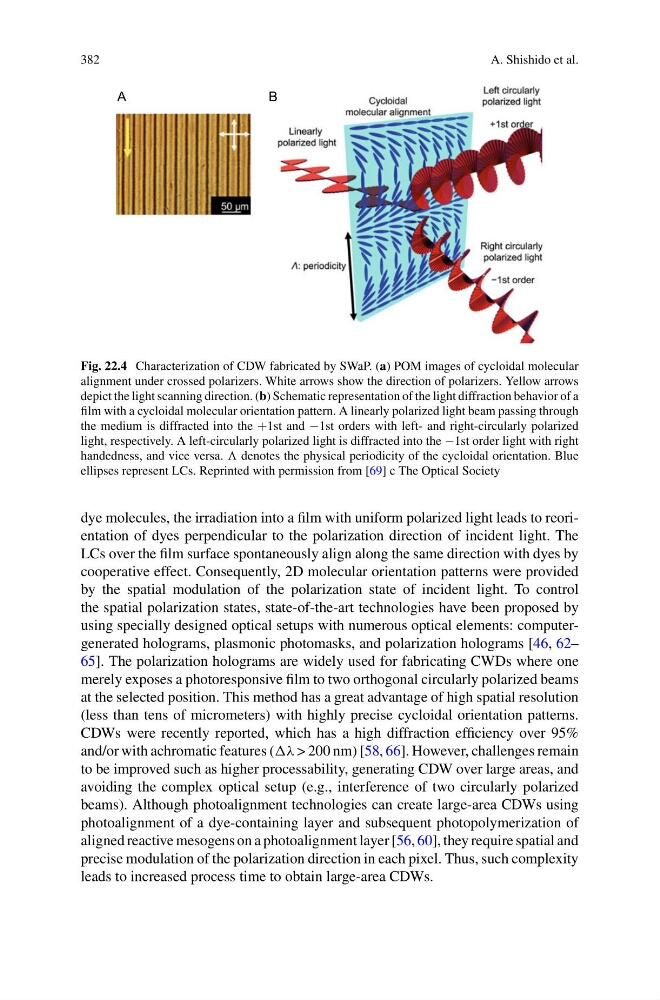
Fig. 22.4 Characterization of CDW fabricated by SWaP. (a) POM images of cycloidal molecular
alignment under crossed polarizers. White arrows show the direction of polarizers. Yellow arrows
depict the light scanning direction. (b) Schematic representation of the light diffraction behavior of a
film with a cycloidal molecular orientation pattern. A linearly polarized light beam passing through
the medium is diffracted into the +1st and −1st orders with left- and right-circularly polarized
light, respectively. A left-circularly polarized light is diffracted into the −1st order light with right
handedness, and vice versa. denotes the physical periodicity of the cycloidal orientation. Blue
ellipses represent LCs. Reprinted with permission from [69] c The Optical Society
dye molecules, the irradiation into a film with uniform polarized light leads to reorientation of dyes perpendicular to the polarization direction of incident light. The
LCs over the film surface spontaneously align along the same direction with dyes by
cooperative effect. Consequently, 2D molecular orientation patterns were provided
by the spatial modulation of the polarization state of incident light. To control
the spatial polarization states, state-of-the-art technologies have been proposed by
using specially designed optical setups with numerous optical elements: computergenerated holograms, plasmonic photomasks, and polarization holograms [46, 62–
65]. The polarization holograms are widely used for fabricating CWDs where one
merely exposes a photoresponsive film to two orthogonal circularly polarized beams
at the selected position. This method has a great advantage of high spatial resolution
(less than tens of micrometers) with highly precise cycloidal orientation patterns.
CDWs were recently reported, which has a high diffraction efficiency over 95%
and/or with achromatic features (λ > 200 nm) [58, 66]. However, challenges remain
to be improved such as higher processability, generating CDW over large areas, and
avoiding the complex optical setup (e.g., interference of two circularly polarized
beams). Although photoalignment technologies can create large-area CDWs using
photoalignment of a dye-containing layer and subsequent photopolymerization of
aligned reactive mesogens on a photoalignment layer [56, 60], they require spatial and
precise modulation of the polarization direction in each pixel. Thus, such complexity
leads to increased process time to obtain large-area CDWs.
A. Shishido et al.
B
A
Fig. 22.4 Characterization of CDW fabricated by SWaP. (a) POM images of cycloidal molecular
alignment under crossed polarizers. White arrows show the direction of polarizers. Yellow arrows
depict the light scanning direction. (b) Schematic representation of the light diffraction behavior of a
film with a cycloidal molecular orientation pattern. A linearly polarized light beam passing through
the medium is diffracted into the +1st and −1st orders with left- and right-circularly polarized
light, respectively. A left-circularly polarized light is diffracted into the −1st order light with right
handedness, and vice versa. denotes the physical periodicity of the cycloidal orientation. Blue
ellipses represent LCs. Reprinted with permission from [69] c The Optical Society
dye molecules, the irradiation into a film with uniform polarized light leads to reorientation of dyes perpendicular to the polarization direction of incident light. The
LCs over the film surface spontaneously align along the same direction with dyes by
cooperative effect. Consequently, 2D molecular orientation patterns were provided
by the spatial modulation of the polarization state of incident light. To control
the spatial polarization states, state-of-the-art technologies have been proposed by
using specially designed optical setups with numerous optical elements: computergenerated holograms, plasmonic photomasks, and polarization holograms [46, 62–
65]. The polarization holograms are widely used for fabricating CWDs where one
merely exposes a photoresponsive film to two orthogonal circularly polarized beams
at the selected position. This method has a great advantage of high spatial resolution
(less than tens of micrometers) with highly precise cycloidal orientation patterns.
CDWs were recently reported, which has a high diffraction efficiency over 95%
and/or with achromatic features (λ > 200 nm) [58, 66]. However, challenges remain
to be improved such as higher processability, generating CDW over large areas, and
avoiding the complex optical setup (e.g., interference of two circularly polarized
beams). Although photoalignment technologies can create large-area CDWs using
photoalignment of a dye-containing layer and subsequent photopolymerization of
aligned reactive mesogens on a photoalignment layer [56, 60], they require spatial and
precise modulation of the polarization direction in each pixel. Thus, such complexity
leads to increased process time to obtain large-area CDWs.