

376
A. Shishido et al.
powerful method for only one-dimensional (1D) molecular alignment. However,
the other methods enable to control hierarchical alignment over two dimensions. Of
these more advanced 2D techniques, light-driven alignment control (photoalignment)
offers the greatest potential to finely control molecular orientation because of its
remote and precise influence, and suitability for micro- to nano-fabrication. These
advantages lead to many applications that require more complex alignment patterns
[13–33].
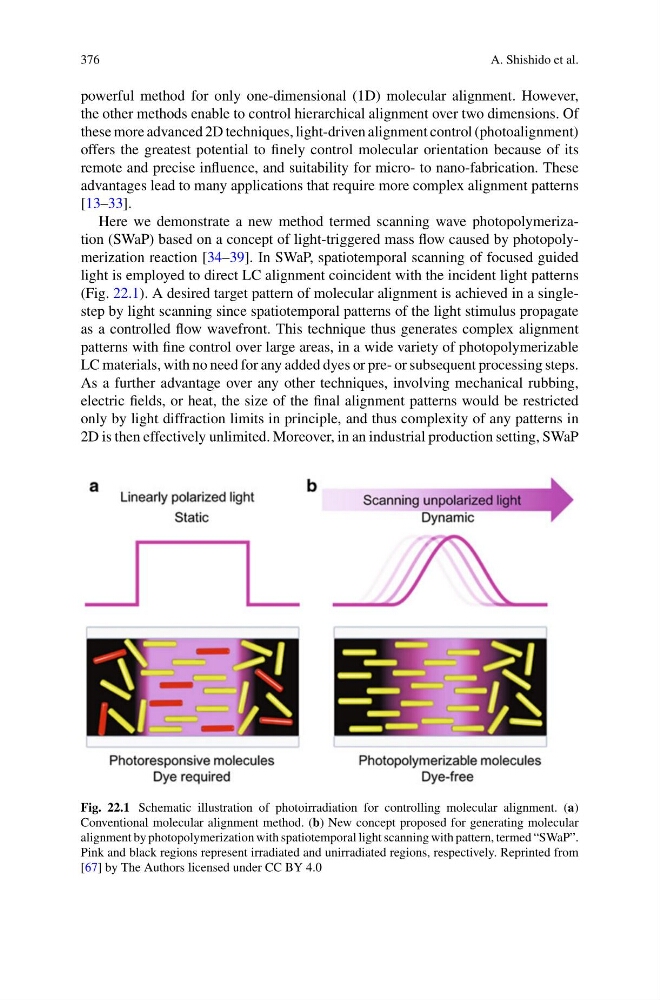
Here we demonstrate a new method termed scanning wave photopolymerization (SWaP) based on a concept of light-triggered mass flow caused by photopolymerization reaction [34–39]. In SWaP, spatiotemporal scanning of focused guided
light is employed to direct LC alignment coincident with the incident light patterns
(Fig. 22.1). A desired target pattern of molecular alignment is achieved in a singlestep by light scanning since spatiotemporal patterns of the light stimulus propagate
as a controlled flow wavefront. This technique thus generates complex alignment
patterns with fine control over large areas, in a wide variety of photopolymerizable
LC materials, with no need for any added dyes or pre- or subsequent processing steps.
As a further advantage over any other techniques, involving mechanical rubbing,
electric fields, or heat, the size of the final alignment patterns would be restricted
only by light diffraction limits in principle, and thus complexity of any patterns in
2D is then effectively unlimited. Moreover, in an industrial production setting, SWaP
Fig. 22.1 Schematic illustration of photoirradiation for controlling molecular alignment. (a)
Conventional molecular alignment method. (b) New concept proposed for generating molecular
alignment by photopolymerization with spatiotemporal light scanning with pattern, termed “SWaP”.
Pink and black regions represent irradiated and unirradiated regions, respectively. Reprinted from
[67] by The Authors licensed under CC BY 4.0
A. Shishido et al.
powerful method for only one-dimensional (1D) molecular alignment. However,
the other methods enable to control hierarchical alignment over two dimensions. Of
these more advanced 2D techniques, light-driven alignment control (photoalignment)
offers the greatest potential to finely control molecular orientation because of its
remote and precise influence, and suitability for micro- to nano-fabrication. These
advantages lead to many applications that require more complex alignment patterns
[13–33].
Here we demonstrate a new method termed scanning wave photopolymerization (SWaP) based on a concept of light-triggered mass flow caused by photopolymerization reaction [34–39]. In SWaP, spatiotemporal scanning of focused guided
light is employed to direct LC alignment coincident with the incident light patterns
(Fig. 22.1). A desired target pattern of molecular alignment is achieved in a singlestep by light scanning since spatiotemporal patterns of the light stimulus propagate
as a controlled flow wavefront. This technique thus generates complex alignment
patterns with fine control over large areas, in a wide variety of photopolymerizable
LC materials, with no need for any added dyes or pre- or subsequent processing steps.
As a further advantage over any other techniques, involving mechanical rubbing,
electric fields, or heat, the size of the final alignment patterns would be restricted
only by light diffraction limits in principle, and thus complexity of any patterns in
2D is then effectively unlimited. Moreover, in an industrial production setting, SWaP
Fig. 22.1 Schematic illustration of photoirradiation for controlling molecular alignment. (a)
Conventional molecular alignment method. (b) New concept proposed for generating molecular
alignment by photopolymerization with spatiotemporal light scanning with pattern, termed “SWaP”.
Pink and black regions represent irradiated and unirradiated regions, respectively. Reprinted from
[67] by The Authors licensed under CC BY 4.0