

338
K. Higashiguchi and K. Matsuda
O.D.
Time / sec
-0.02
0
0.02
0.04
0.06
0.08
0.1
0
1 0
2 0
3 0
4 0
5 0
6 0
Number of molecules / 10
16
Time / sec
(a)
0
0.5
1
1.5
2
2.5
3
3.5
4
0
100
200
300
400
500
600
700
(b)
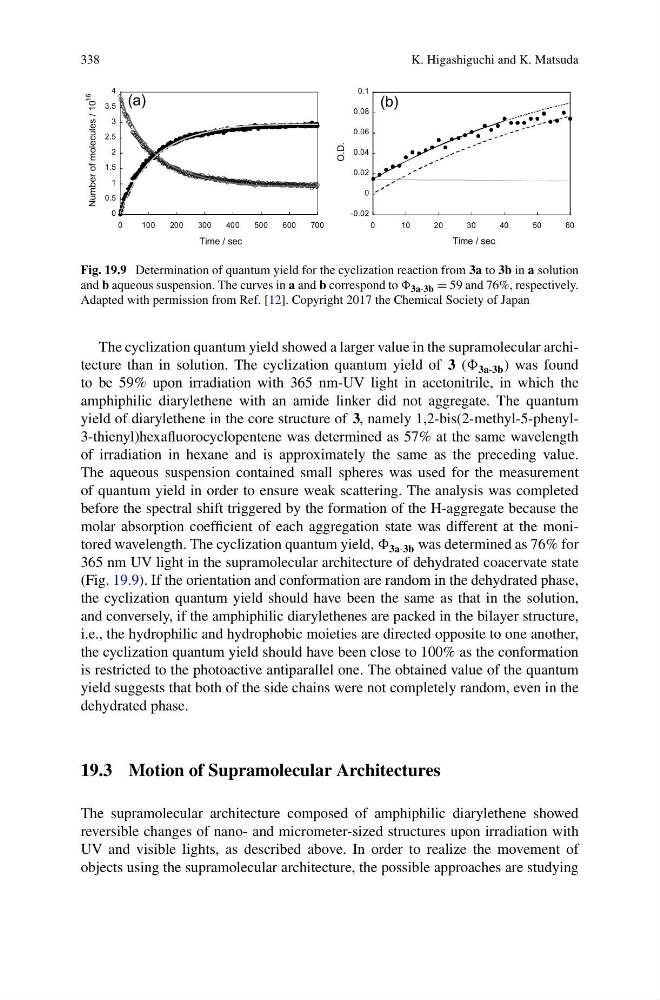
Fig. 19.9 Determination of quantum yield for the cyclization reaction from 3a to 3b in a solution
and b aqueous suspension. The curves in a and b correspond to 3a-3b = 59 and 76%, respectively.
Adapted with permission from Ref. [12]. Copyright 2017 the Chemical Society of Japan
The cyclization quantum yield showed a larger value in the supramolecular architecture than in solution. The cyclization quantum yield of 3 ( 3a-3b ) was found
to be 59% upon irradiation with 365 nm-UV light in acetonitrile, in which the
amphiphilic diarylethene with an amide linker did not aggregate. The quantum
yield of diarylethene in the core structure of 3, namely 1,2-bis(2-methyl-5-phenyl3-thienyl)hexafluorocyclopentene was determined as 57% at the same wavelength
of irradiation in hexane and is approximately the same as the preceding value.
The aqueous suspension contained small spheres was used for the measurement
of quantum yield in order to ensure weak scattering. The analysis was completed
before the spectral shift triggered by the formation of the H-aggregate because the
molar absorption coefficient of each aggregation state was different at the monitored wavelength. The cyclization quantum yield, 3a-3b was determined as 76% for
365 nm UV light in the supramolecular architecture of dehydrated coacervate state
(Fig. 19.9). If the orientation and conformation are random in the dehydrated phase,
the cyclization quantum yield should have been the same as that in the solution,
and conversely, if the amphiphilic diarylethenes are packed in the bilayer structure,
i.e., the hydrophilic and hydrophobic moieties are directed opposite to one another,
the cyclization quantum yield should have been close to 100% as the conformation
is restricted to the photoactive antiparallel one. The obtained value of the quantum
yield suggests that both of the side chains were not completely random, even in the
dehydrated phase.
19.3 Motion of Supramolecular Architectures
The supramolecular architecture composed of amphiphilic diarylethene showed
reversible changes of nano- and micrometer-sized structures upon irradiation with
UV and visible lights, as described above. In order to realize the movement of
objects using the supramolecular architecture, the possible approaches are studying
K. Higashiguchi and K. Matsuda
O.D.
Time / sec
-0.02
0
0.02
0.04
0.06
0.08
0.1
0
1 0
2 0
3 0
4 0
5 0
6 0
Number of molecules / 10
16
Time / sec
(a)
0
0.5
1
1.5
2
2.5
3
3.5
4
0
100
200
300
400
500
600
700
(b)
Fig. 19.9 Determination of quantum yield for the cyclization reaction from 3a to 3b in a solution
and b aqueous suspension. The curves in a and b correspond to 3a-3b = 59 and 76%, respectively.
Adapted with permission from Ref. [12]. Copyright 2017 the Chemical Society of Japan
The cyclization quantum yield showed a larger value in the supramolecular architecture than in solution. The cyclization quantum yield of 3 ( 3a-3b ) was found
to be 59% upon irradiation with 365 nm-UV light in acetonitrile, in which the
amphiphilic diarylethene with an amide linker did not aggregate. The quantum
yield of diarylethene in the core structure of 3, namely 1,2-bis(2-methyl-5-phenyl3-thienyl)hexafluorocyclopentene was determined as 57% at the same wavelength
of irradiation in hexane and is approximately the same as the preceding value.
The aqueous suspension contained small spheres was used for the measurement
of quantum yield in order to ensure weak scattering. The analysis was completed
before the spectral shift triggered by the formation of the H-aggregate because the
molar absorption coefficient of each aggregation state was different at the monitored wavelength. The cyclization quantum yield, 3a-3b was determined as 76% for
365 nm UV light in the supramolecular architecture of dehydrated coacervate state
(Fig. 19.9). If the orientation and conformation are random in the dehydrated phase,
the cyclization quantum yield should have been the same as that in the solution,
and conversely, if the amphiphilic diarylethenes are packed in the bilayer structure,
i.e., the hydrophilic and hydrophobic moieties are directed opposite to one another,
the cyclization quantum yield should have been close to 100% as the conformation
is restricted to the photoactive antiparallel one. The obtained value of the quantum
yield suggests that both of the side chains were not completely random, even in the
dehydrated phase.
19.3 Motion of Supramolecular Architectures
The supramolecular architecture composed of amphiphilic diarylethene showed
reversible changes of nano- and micrometer-sized structures upon irradiation with
UV and visible lights, as described above. In order to realize the movement of
objects using the supramolecular architecture, the possible approaches are studying