

19 Photoinduced Morphological Transformation and Photodriven …
329
19.2 Photoinduced LCST Transition and Morphological
Changes in Supramolecular Architectures
We recently studied the photoinduced morphological changes in supramolecular
architecture and the movement of objects assisted by this architecture. The used
amphiphilic diarylethenes had an alkyl chain and two tri(ethylene glycol) ether chains
at each end of the diarylethene. As the open- and closed-ring isomers have different
LCSTs, LCST behavior was induced by photoirradiation accompanied by the change
in the ratio of both isomers [10–15].
The molecule is designed to modify both the photoreactivity and the morphology
of the supramolecular architectures. These modifications require undergoing a
photoreaction for the cyclization and cycloreversion process under an optical microscope, which means that the chosen diarylethene should have a high conversion ratio
to the closed-ring isomer upon irradiation with 365 nm-UV light, generated from the
light source of an epi-illumination system. Therefore, 1,2-bis(2-methyl-5-phenyl-3thienyl)hexafluorocyclopentene [16] was selected because it has an absorption edge
near 365 nm as well as a large quantum yield (57%) in a cyclization reaction. In
order to give it amphiphilic properties, two tri(ethylene glycol) ether chains were
introduced to one of the phenyl groups and an alkyl chain was added to the other as
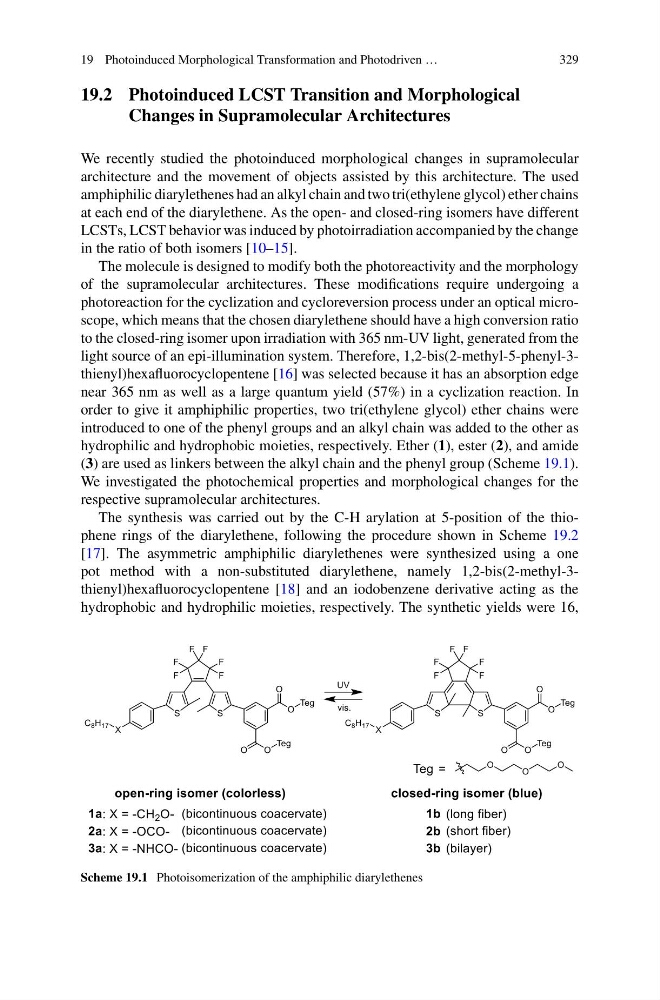
hydrophilic and hydrophobic moieties, respectively. Ether (1), ester (2), and amide
(3) are used as linkers between the alkyl chain and the phenyl group (Scheme 19.1).
We investigated the photochemical properties and morphological changes for the
respective supramolecular architectures.
The synthesis was carried out by the C-H arylation at 5-position of the thiophene rings of the diarylethene, following the procedure shown in Scheme 19.2
[17]. The asymmetric amphiphilic diarylethenes were synthesized using a one
pot method with a non-substituted diarylethene, namely 1,2-bis(2-methyl-3thienyl)hexafluorocyclopentene [18] and an iodobenzene derivative acting as the
hydrophobic and hydrophilic moieties, respectively. The synthetic yields were 16,
Scheme 19.1 Photoisomerization of the amphiphilic diarylethenes
329
19.2 Photoinduced LCST Transition and Morphological
Changes in Supramolecular Architectures
We recently studied the photoinduced morphological changes in supramolecular
architecture and the movement of objects assisted by this architecture. The used
amphiphilic diarylethenes had an alkyl chain and two tri(ethylene glycol) ether chains
at each end of the diarylethene. As the open- and closed-ring isomers have different
LCSTs, LCST behavior was induced by photoirradiation accompanied by the change
in the ratio of both isomers [10–15].
The molecule is designed to modify both the photoreactivity and the morphology
of the supramolecular architectures. These modifications require undergoing a
photoreaction for the cyclization and cycloreversion process under an optical microscope, which means that the chosen diarylethene should have a high conversion ratio
to the closed-ring isomer upon irradiation with 365 nm-UV light, generated from the
light source of an epi-illumination system. Therefore, 1,2-bis(2-methyl-5-phenyl-3thienyl)hexafluorocyclopentene [16] was selected because it has an absorption edge
near 365 nm as well as a large quantum yield (57%) in a cyclization reaction. In
order to give it amphiphilic properties, two tri(ethylene glycol) ether chains were
introduced to one of the phenyl groups and an alkyl chain was added to the other as
hydrophilic and hydrophobic moieties, respectively. Ether (1), ester (2), and amide
(3) are used as linkers between the alkyl chain and the phenyl group (Scheme 19.1).
We investigated the photochemical properties and morphological changes for the
respective supramolecular architectures.
The synthesis was carried out by the C-H arylation at 5-position of the thiophene rings of the diarylethene, following the procedure shown in Scheme 19.2
[17]. The asymmetric amphiphilic diarylethenes were synthesized using a one
pot method with a non-substituted diarylethene, namely 1,2-bis(2-methyl-3thienyl)hexafluorocyclopentene [18] and an iodobenzene derivative acting as the
hydrophobic and hydrophilic moieties, respectively. The synthetic yields were 16,
Scheme 19.1 Photoisomerization of the amphiphilic diarylethenes