

22
H. Miyasaka et al.
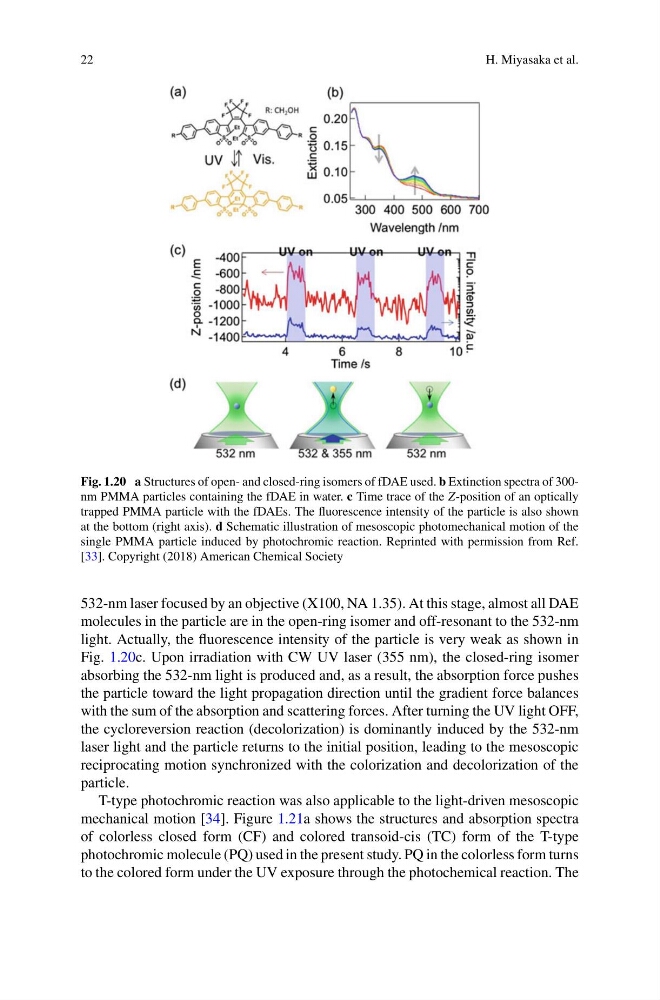
Fig. 1.20 a Structures of open- and closed-ring isomers of fDAE used. b Extinction spectra of 300nm PMMA particles containing the fDAE in water. c Time trace of the Z-position of an optically
trapped PMMA particle with the fDAEs. The fluorescence intensity of the particle is also shown
at the bottom (right axis). d Schematic illustration of mesoscopic photomechanical motion of the
single PMMA particle induced by photochromic reaction. Reprinted with permission from Ref.
[33]. Copyright (2018) American Chemical Society
532-nm laser focused by an objective (X100, NA 1.35). At this stage, almost all DAE
molecules in the particle are in the open-ring isomer and off-resonant to the 532-nm
light. Actually, the fluorescence intensity of the particle is very weak as shown in
Fig. 1.20c. Upon irradiation with CW UV laser (355 nm), the closed-ring isomer
absorbing the 532-nm light is produced and, as a result, the absorption force pushes
the particle toward the light propagation direction until the gradient force balances
with the sum of the absorption and scattering forces. After turning the UV light OFF,
the cycloreversion reaction (decolorization) is dominantly induced by the 532-nm
laser light and the particle returns to the initial position, leading to the mesoscopic
reciprocating motion synchronized with the colorization and decolorization of the
particle.
T-type photochromic reaction was also applicable to the light-driven mesoscopic
mechanical motion [34]. Figure 1.21a shows the structures and absorption spectra
of colorless closed form (CF) and colored transoid-cis (TC) form of the T-type
photochromic molecule (PQ) used in the present study. PQ in the colorless form turns
to the colored form under the UV exposure through the photochemical reaction. The
H. Miyasaka et al.
Fig. 1.20 a Structures of open- and closed-ring isomers of fDAE used. b Extinction spectra of 300nm PMMA particles containing the fDAE in water. c Time trace of the Z-position of an optically
trapped PMMA particle with the fDAEs. The fluorescence intensity of the particle is also shown
at the bottom (right axis). d Schematic illustration of mesoscopic photomechanical motion of the
single PMMA particle induced by photochromic reaction. Reprinted with permission from Ref.
[33]. Copyright (2018) American Chemical Society
532-nm laser focused by an objective (X100, NA 1.35). At this stage, almost all DAE
molecules in the particle are in the open-ring isomer and off-resonant to the 532-nm
light. Actually, the fluorescence intensity of the particle is very weak as shown in
Fig. 1.20c. Upon irradiation with CW UV laser (355 nm), the closed-ring isomer
absorbing the 532-nm light is produced and, as a result, the absorption force pushes
the particle toward the light propagation direction until the gradient force balances
with the sum of the absorption and scattering forces. After turning the UV light OFF,
the cycloreversion reaction (decolorization) is dominantly induced by the 532-nm
laser light and the particle returns to the initial position, leading to the mesoscopic
reciprocating motion synchronized with the colorization and decolorization of the
particle.
T-type photochromic reaction was also applicable to the light-driven mesoscopic
mechanical motion [34]. Figure 1.21a shows the structures and absorption spectra
of colorless closed form (CF) and colored transoid-cis (TC) form of the T-type
photochromic molecule (PQ) used in the present study. PQ in the colorless form turns
to the colored form under the UV exposure through the photochemical reaction. The