

17 Synergetic Photon Upconversion Realized by a Controlled …
293
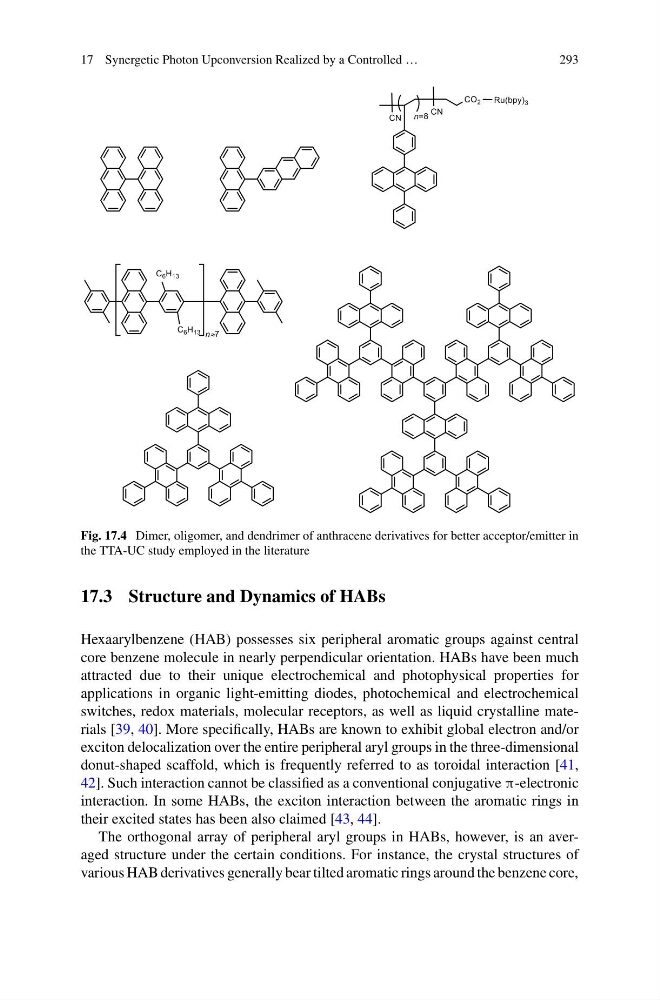
Fig. 17.4 Dimer, oligomer, and dendrimer of anthracene derivatives for better acceptor/emitter in
the TTA-UC study employed in the literature
17.3 Structure and Dynamics of HABs
Hexaarylbenzene (HAB) possesses six peripheral aromatic groups against central
core benzene molecule in nearly perpendicular orientation. HABs have been much
attracted due to their unique electrochemical and photophysical properties for
applications in organic light-emitting diodes, photochemical and electrochemical
switches, redox materials, molecular receptors, as well as liquid crystalline materials [39, 40]. More specifically, HABs are known to exhibit global electron and/or
exciton delocalization over the entire peripheral aryl groups in the three-dimensional
donut-shaped scaffold, which is frequently referred to as toroidal interaction [41,
42]. Such interaction cannot be classified as a conventional conjugative π-electronic
interaction. In some HABs, the exciton interaction between the aromatic rings in
their excited states has been also claimed [43, 44].
The orthogonal array of peripheral aryl groups in HABs, however, is an averaged structure under the certain conditions. For instance, the crystal structures of
various HAB derivatives generally bear tilted aromatic rings around the benzene core,
293
Fig. 17.4 Dimer, oligomer, and dendrimer of anthracene derivatives for better acceptor/emitter in
the TTA-UC study employed in the literature
17.3 Structure and Dynamics of HABs
Hexaarylbenzene (HAB) possesses six peripheral aromatic groups against central
core benzene molecule in nearly perpendicular orientation. HABs have been much
attracted due to their unique electrochemical and photophysical properties for
applications in organic light-emitting diodes, photochemical and electrochemical
switches, redox materials, molecular receptors, as well as liquid crystalline materials [39, 40]. More specifically, HABs are known to exhibit global electron and/or
exciton delocalization over the entire peripheral aryl groups in the three-dimensional
donut-shaped scaffold, which is frequently referred to as toroidal interaction [41,
42]. Such interaction cannot be classified as a conventional conjugative π-electronic
interaction. In some HABs, the exciton interaction between the aromatic rings in
their excited states has been also claimed [43, 44].
The orthogonal array of peripheral aryl groups in HABs, however, is an averaged structure under the certain conditions. For instance, the crystal structures of
various HAB derivatives generally bear tilted aromatic rings around the benzene core,