

242
T. Kawai
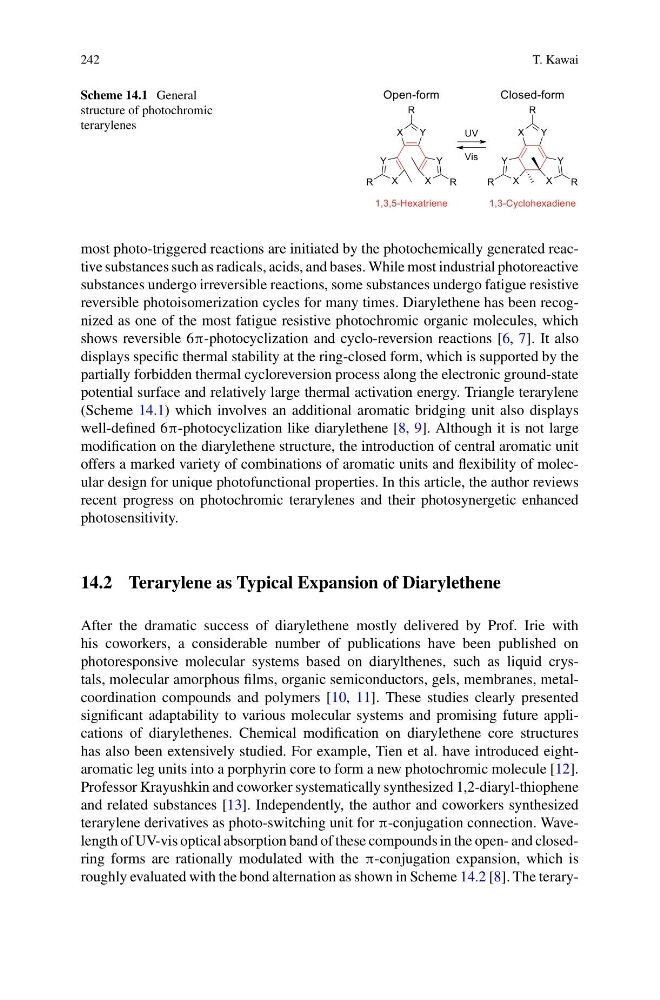
Scheme 14.1 General
structure of photochromic
terarylenes
most photo-triggered reactions are initiated by the photochemically generated reactive substances such as radicals, acids, and bases. While most industrial photoreactive
substances undergo irreversible reactions, some substances undergo fatigue resistive
reversible photoisomerization cycles for many times. Diarylethene has been recognized as one of the most fatigue resistive photochromic organic molecules, which
shows reversible 6π-photocyclization and cyclo-reversion reactions [6, 7]. It also
displays specific thermal stability at the ring-closed form, which is supported by the
partially forbidden thermal cycloreversion process along the electronic ground-state
potential surface and relatively large thermal activation energy. Triangle terarylene
(Scheme 14.1) which involves an additional aromatic bridging unit also displays
well-defined 6π-photocyclization like diarylethene [8, 9]. Although it is not large
modification on the diarylethene structure, the introduction of central aromatic unit
offers a marked variety of combinations of aromatic units and flexibility of molecular design for unique photofunctional properties. In this article, the author reviews
recent progress on photochromic terarylenes and their photosynergetic enhanced
photosensitivity.
14.2 Terarylene as Typical Expansion of Diarylethene
After the dramatic success of diarylethene mostly delivered by Prof. Irie with
his coworkers, a considerable number of publications have been published on
photoresponsive molecular systems based on diarylthenes, such as liquid crystals, molecular amorphous films, organic semiconductors, gels, membranes, metalcoordination compounds and polymers [10, 11]. These studies clearly presented
significant adaptability to various molecular systems and promising future applications of diarylethenes. Chemical modification on diarylethene core structures
has also been extensively studied. For example, Tien et al. have introduced eightaromatic leg units into a porphyrin core to form a new photochromic molecule [12].
Professor Krayushkin and coworker systematically synthesized 1,2-diaryl-thiophene
and related substances [13]. Independently, the author and coworkers synthesized
terarylene derivatives as photo-switching unit for π-conjugation connection. Wavelength of UV-vis optical absorption band of these compounds in the open- and closedring forms are rationally modulated with the π-conjugation expansion, which is
roughly evaluated with the bond alternation as shown in Scheme 14.2 [8]. The terary-
T. Kawai
Scheme 14.1 General
structure of photochromic
terarylenes
most photo-triggered reactions are initiated by the photochemically generated reactive substances such as radicals, acids, and bases. While most industrial photoreactive
substances undergo irreversible reactions, some substances undergo fatigue resistive
reversible photoisomerization cycles for many times. Diarylethene has been recognized as one of the most fatigue resistive photochromic organic molecules, which
shows reversible 6π-photocyclization and cyclo-reversion reactions [6, 7]. It also
displays specific thermal stability at the ring-closed form, which is supported by the
partially forbidden thermal cycloreversion process along the electronic ground-state
potential surface and relatively large thermal activation energy. Triangle terarylene
(Scheme 14.1) which involves an additional aromatic bridging unit also displays
well-defined 6π-photocyclization like diarylethene [8, 9]. Although it is not large
modification on the diarylethene structure, the introduction of central aromatic unit
offers a marked variety of combinations of aromatic units and flexibility of molecular design for unique photofunctional properties. In this article, the author reviews
recent progress on photochromic terarylenes and their photosynergetic enhanced
photosensitivity.
14.2 Terarylene as Typical Expansion of Diarylethene
After the dramatic success of diarylethene mostly delivered by Prof. Irie with
his coworkers, a considerable number of publications have been published on
photoresponsive molecular systems based on diarylthenes, such as liquid crystals, molecular amorphous films, organic semiconductors, gels, membranes, metalcoordination compounds and polymers [10, 11]. These studies clearly presented
significant adaptability to various molecular systems and promising future applications of diarylethenes. Chemical modification on diarylethene core structures
has also been extensively studied. For example, Tien et al. have introduced eightaromatic leg units into a porphyrin core to form a new photochromic molecule [12].
Professor Krayushkin and coworker systematically synthesized 1,2-diaryl-thiophene
and related substances [13]. Independently, the author and coworkers synthesized
terarylene derivatives as photo-switching unit for π-conjugation connection. Wavelength of UV-vis optical absorption band of these compounds in the open- and closedring forms are rationally modulated with the π-conjugation expansion, which is
roughly evaluated with the bond alternation as shown in Scheme 14.2 [8]. The terary-