

220
M. Sakamoto et al.
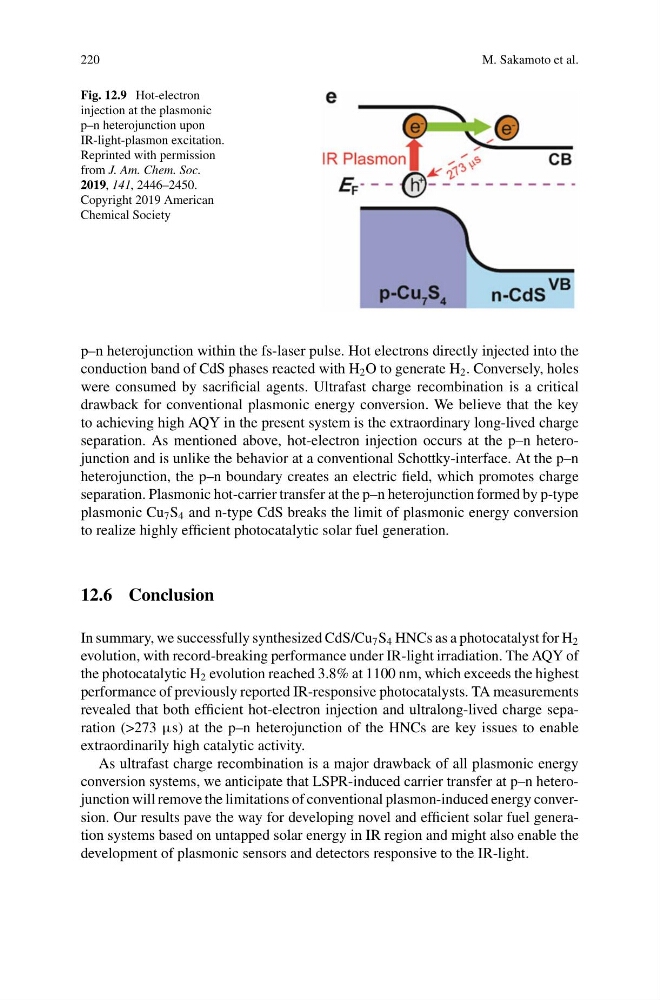
Fig. 12.9 Hot-electron
injection at the plasmonic
p–n heterojunction upon
IR-light-plasmon excitation.
Reprinted with permission
from J. Am. Chem. Soc.
2019, 141, 2446–2450.
Copyright 2019 American
Chemical Society
p–n heterojunction within the fs-laser pulse. Hot electrons directly injected into the
conduction band of CdS phases reacted with H 2 O to generate H 2 . Conversely, holes
were consumed by sacrificial agents. Ultrafast charge recombination is a critical
drawback for conventional plasmonic energy conversion. We believe that the key
to achieving high AQY in the present system is the extraordinary long-lived charge
separation. As mentioned above, hot-electron injection occurs at the p–n heterojunction and is unlike the behavior at a conventional Schottky-interface. At the p–n
heterojunction, the p–n boundary creates an electric field, which promotes charge
separation. Plasmonic hot-carrier transfer at the p–n heterojunction formed by p-type
plasmonic Cu 7 S 4 and n-type CdS breaks the limit of plasmonic energy conversion
to realize highly efficient photocatalytic solar fuel generation.
12.6 Conclusion
In summary, we successfully synthesized CdS/Cu 7 S 4 HNCs as a photocatalyst for H 2
evolution, with record-breaking performance under IR-light irradiation. The AQY of
the photocatalytic H 2 evolution reached 3.8% at 1100 nm, which exceeds the highest
performance of previously reported IR-responsive photocatalysts. TA measurements
revealed that both efficient hot-electron injection and ultralong-lived charge separation (>273 μs) at the p–n heterojunction of the HNCs are key issues to enable
extraordinarily high catalytic activity.
As ultrafast charge recombination is a major drawback of all plasmonic energy
conversion systems, we anticipate that LSPR-induced carrier transfer at p–n heterojunction will remove the limitations of conventional plasmon-induced energy conversion. Our results pave the way for developing novel and efficient solar fuel generation systems based on untapped solar energy in IR region and might also enable the
development of plasmonic sensors and detectors responsive to the IR-light.
M. Sakamoto et al.
Fig. 12.9 Hot-electron
injection at the plasmonic
p–n heterojunction upon
IR-light-plasmon excitation.
Reprinted with permission
from J. Am. Chem. Soc.
2019, 141, 2446–2450.
Copyright 2019 American
Chemical Society
p–n heterojunction within the fs-laser pulse. Hot electrons directly injected into the
conduction band of CdS phases reacted with H 2 O to generate H 2 . Conversely, holes
were consumed by sacrificial agents. Ultrafast charge recombination is a critical
drawback for conventional plasmonic energy conversion. We believe that the key
to achieving high AQY in the present system is the extraordinary long-lived charge
separation. As mentioned above, hot-electron injection occurs at the p–n heterojunction and is unlike the behavior at a conventional Schottky-interface. At the p–n
heterojunction, the p–n boundary creates an electric field, which promotes charge
separation. Plasmonic hot-carrier transfer at the p–n heterojunction formed by p-type
plasmonic Cu 7 S 4 and n-type CdS breaks the limit of plasmonic energy conversion
to realize highly efficient photocatalytic solar fuel generation.
12.6 Conclusion
In summary, we successfully synthesized CdS/Cu 7 S 4 HNCs as a photocatalyst for H 2
evolution, with record-breaking performance under IR-light irradiation. The AQY of
the photocatalytic H 2 evolution reached 3.8% at 1100 nm, which exceeds the highest
performance of previously reported IR-responsive photocatalysts. TA measurements
revealed that both efficient hot-electron injection and ultralong-lived charge separation (>273 μs) at the p–n heterojunction of the HNCs are key issues to enable
extraordinarily high catalytic activity.
As ultrafast charge recombination is a major drawback of all plasmonic energy
conversion systems, we anticipate that LSPR-induced carrier transfer at p–n heterojunction will remove the limitations of conventional plasmon-induced energy conversion. Our results pave the way for developing novel and efficient solar fuel generation systems based on untapped solar energy in IR region and might also enable the
development of plasmonic sensors and detectors responsive to the IR-light.