

198
S. Ghimire et al.
11.1 Introduction
Halide perovskites are exciting materials for light-harvesting [1–3] and light-emitting
[4–6] applications. Their success foots on the large absorption coefficient, high
charge-carrier mobility, high photoluminescence (PL) quantum yield (QY), and costeffective synthesis [1–6]. Further, the emission color from halide perovskites can
cover the entire UV-visible-near infrared spectrum, which emanates from different
band-gaps induced by changing the halogen compositions in the material [4–6].
Interestingly, these properties of halide perovskite are maintained irrespective of
their size. Such attributes make halide perovskites highly promising semiconductor
materials that can compete with the existing silicon technology for solar cells and
quantum dot (QD) technology for light-emitting devices and displays. In addition to
the chemical and physical stability of perovskites, the generation, stabilization, and
binding energy of charge-carriers in these materials are also fundamental aspects to
be considered for such device applications.
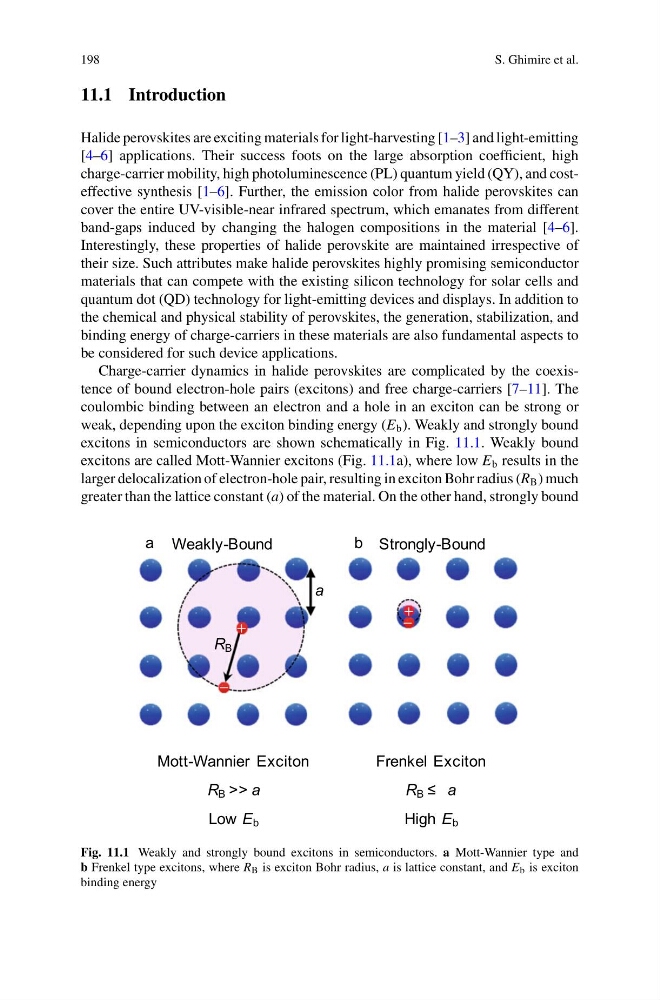
Charge-carrier dynamics in halide perovskites are complicated by the coexistence of bound electron-hole pairs (excitons) and free charge-carriers [7–11]. The
coulombic binding between an electron and a hole in an exciton can be strong or
weak, depending upon the exciton binding energy (E b ). Weakly and strongly bound
excitons in semiconductors are shown schematically in Fig. 11.1. Weakly bound
excitons are called Mott-Wannier excitons (Fig. 11.1a), where low E b results in the
larger delocalization of electron-hole pair, resulting in exciton Bohr radius (R B ) much
greater than the lattice constant (a) of the material. On the other hand, strongly bound
−
Mott-Wannier Exciton
R B >> a
Low E b
+
+
R B
a
Weakly-Bound
−
Strongly-Bound
Frenkel Exciton
R B ≤ a
High E b
a
b
Fig. 11.1 Weakly and strongly bound excitons in semiconductors. a Mott-Wannier type and
b Frenkel type excitons, where R B is exciton Bohr radius, a is lattice constant, and E b is exciton
binding energy
S. Ghimire et al.
11.1 Introduction
Halide perovskites are exciting materials for light-harvesting [1–3] and light-emitting
[4–6] applications. Their success foots on the large absorption coefficient, high
charge-carrier mobility, high photoluminescence (PL) quantum yield (QY), and costeffective synthesis [1–6]. Further, the emission color from halide perovskites can
cover the entire UV-visible-near infrared spectrum, which emanates from different
band-gaps induced by changing the halogen compositions in the material [4–6].
Interestingly, these properties of halide perovskite are maintained irrespective of
their size. Such attributes make halide perovskites highly promising semiconductor
materials that can compete with the existing silicon technology for solar cells and
quantum dot (QD) technology for light-emitting devices and displays. In addition to
the chemical and physical stability of perovskites, the generation, stabilization, and
binding energy of charge-carriers in these materials are also fundamental aspects to
be considered for such device applications.
Charge-carrier dynamics in halide perovskites are complicated by the coexistence of bound electron-hole pairs (excitons) and free charge-carriers [7–11]. The
coulombic binding between an electron and a hole in an exciton can be strong or
weak, depending upon the exciton binding energy (E b ). Weakly and strongly bound
excitons in semiconductors are shown schematically in Fig. 11.1. Weakly bound
excitons are called Mott-Wannier excitons (Fig. 11.1a), where low E b results in the
larger delocalization of electron-hole pair, resulting in exciton Bohr radius (R B ) much
greater than the lattice constant (a) of the material. On the other hand, strongly bound
−
Mott-Wannier Exciton
R B >> a
Low E b
+
+
R B
a
Weakly-Bound
−
Strongly-Bound
Frenkel Exciton
R B ≤ a
High E b
a
b
Fig. 11.1 Weakly and strongly bound excitons in semiconductors. a Mott-Wannier type and
b Frenkel type excitons, where R B is exciton Bohr radius, a is lattice constant, and E b is exciton
binding energy