

10 Hot Carrier Transfer and Carrier Manipulation of Semiconductor …
193
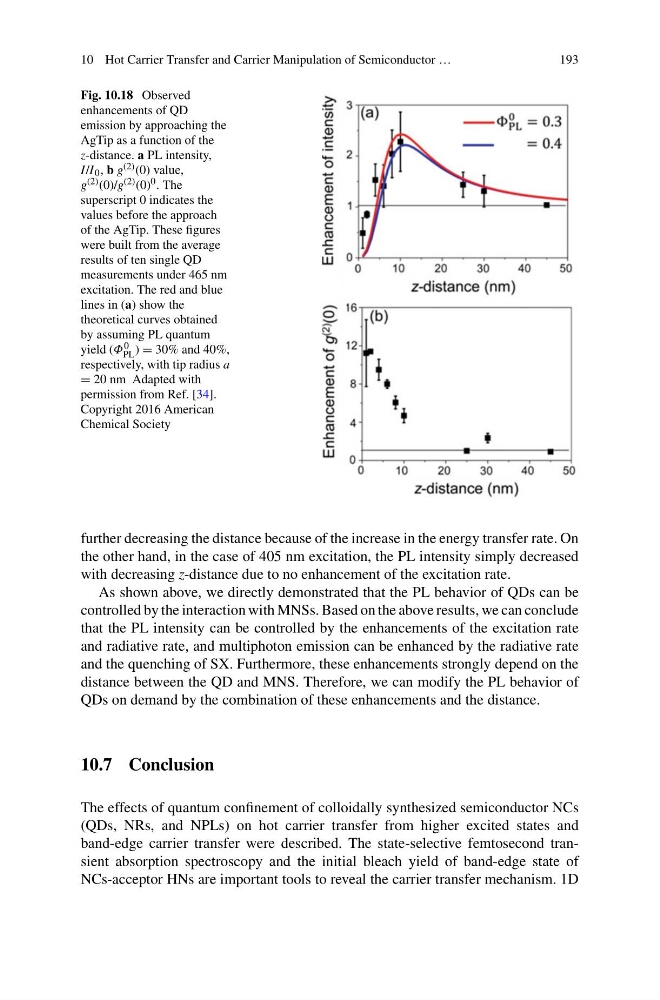
Fig. 10.18 Observed
enhancements of QD
emission by approaching the
AgTip as a function of the
z-distance. a PL intensity,
I/I 0 , b g (2) (0) value,
g (2) (0)/g (2) (0) 0 . The
superscript 0 indicates the
values before the approach
of the AgTip. These figures
were built from the average
results of ten single QD
measurements under 465 nm
excitation. The red and blue
lines in (a) show the
theoretical curves obtained
by assuming PL quantum
yield (Φ 0
PL ) = 30% and 40%,
respectively, with tip radius a
= 20 nm Adapted with
permission from Ref. [34].
Copyright 2016 American
Chemical Society
further decreasing the distance because of the increase in the energy transfer rate. On
the other hand, in the case of 405 nm excitation, the PL intensity simply decreased
with decreasing z-distance due to no enhancement of the excitation rate.
As shown above, we directly demonstrated that the PL behavior of QDs can be
controlled by the interaction with MNSs. Based on the above results, we can conclude
that the PL intensity can be controlled by the enhancements of the excitation rate
and radiative rate, and multiphoton emission can be enhanced by the radiative rate
and the quenching of SX. Furthermore, these enhancements strongly depend on the
distance between the QD and MNS. Therefore, we can modify the PL behavior of
QDs on demand by the combination of these enhancements and the distance.
10.7 Conclusion
The effects of quantum confinement of colloidally synthesized semiconductor NCs
(QDs, NRs, and NPLs) on hot carrier transfer from higher excited states and
band-edge carrier transfer were described. The state-selective femtosecond transient absorption spectroscopy and the initial bleach yield of band-edge state of
NCs-acceptor HNs are important tools to reveal the carrier transfer mechanism. 1D
193
Fig. 10.18 Observed
enhancements of QD
emission by approaching the
AgTip as a function of the
z-distance. a PL intensity,
I/I 0 , b g (2) (0) value,
g (2) (0)/g (2) (0) 0 . The
superscript 0 indicates the
values before the approach
of the AgTip. These figures
were built from the average
results of ten single QD
measurements under 465 nm
excitation. The red and blue
lines in (a) show the
theoretical curves obtained
by assuming PL quantum
yield (Φ 0
PL ) = 30% and 40%,
respectively, with tip radius a
= 20 nm Adapted with
permission from Ref. [34].
Copyright 2016 American
Chemical Society
further decreasing the distance because of the increase in the energy transfer rate. On
the other hand, in the case of 405 nm excitation, the PL intensity simply decreased
with decreasing z-distance due to no enhancement of the excitation rate.
As shown above, we directly demonstrated that the PL behavior of QDs can be
controlled by the interaction with MNSs. Based on the above results, we can conclude
that the PL intensity can be controlled by the enhancements of the excitation rate
and radiative rate, and multiphoton emission can be enhanced by the radiative rate
and the quenching of SX. Furthermore, these enhancements strongly depend on the
distance between the QD and MNS. Therefore, we can modify the PL behavior of
QDs on demand by the combination of these enhancements and the distance.
10.7 Conclusion
The effects of quantum confinement of colloidally synthesized semiconductor NCs
(QDs, NRs, and NPLs) on hot carrier transfer from higher excited states and
band-edge carrier transfer were described. The state-selective femtosecond transient absorption spectroscopy and the initial bleach yield of band-edge state of
NCs-acceptor HNs are important tools to reveal the carrier transfer mechanism. 1D