

10 Hot Carrier Transfer and Carrier Manipulation of Semiconductor …
187
10.6.2 Multiexciton Control of Single QDs Using AFM AgTip
The interaction between QDs and MNS is based on dipole-dipole interaction. Thus,
the interaction should be strongly influenced by the distance with a nanometerscale between the QD and MNS. In the case of above AFM manipulation, however,
control of the distance between the single QD and the AuCube with nanometer-scale
precision was quite hard. Thus, we utilized a silver-coated AFM cantilever (AgTip)
as an MNS to achieve the distance control. By setting the AgTip on an AFM system as
a cantilever, distance between a QD and an AgTip can be controlled with the spatial
resolution of a Piezo actuator unit, i.e., nanometer-scale precision. In addition, using
the AgTip, which exhibits a well-defined LSPR band, both the distance and the
spectral overlap can be controlled [34].
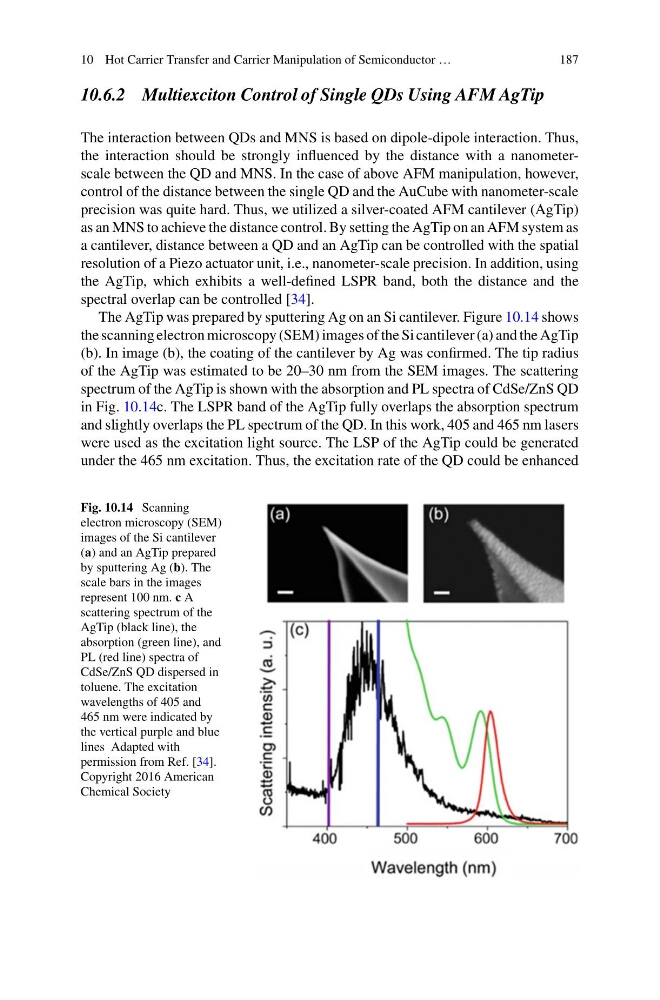
The AgTip was prepared by sputtering Ag on an Si cantilever. Figure 10.14 shows
the scanning electron microscopy (SEM) images of the Si cantilever (a) and the AgTip
(b). In image (b), the coating of the cantilever by Ag was confirmed. The tip radius
of the AgTip was estimated to be 20–30 nm from the SEM images. The scattering
spectrum of the AgTip is shown with the absorption and PL spectra of CdSe/ZnS QD
in Fig. 10.14c. The LSPR band of the AgTip fully overlaps the absorption spectrum
and slightly overlaps the PL spectrum of the QD. In this work, 405 and 465 nm lasers
were used as the excitation light source. The LSP of the AgTip could be generated
under the 465 nm excitation. Thus, the excitation rate of the QD could be enhanced
Fig. 10.14 Scanning
electron microscopy (SEM)
images of the Si cantilever
(a) and an AgTip prepared
by sputtering Ag (b). The
scale bars in the images
represent 100 nm. c A
scattering spectrum of the
AgTip (black line), the
absorption (green line), and
PL (red line) spectra of
CdSe/ZnS QD dispersed in
toluene. The excitation
wavelengths of 405 and
465 nm were indicated by
the vertical purple and blue
lines Adapted with
permission from Ref. [34].
Copyright 2016 American
Chemical Society
187
10.6.2 Multiexciton Control of Single QDs Using AFM AgTip
The interaction between QDs and MNS is based on dipole-dipole interaction. Thus,
the interaction should be strongly influenced by the distance with a nanometerscale between the QD and MNS. In the case of above AFM manipulation, however,
control of the distance between the single QD and the AuCube with nanometer-scale
precision was quite hard. Thus, we utilized a silver-coated AFM cantilever (AgTip)
as an MNS to achieve the distance control. By setting the AgTip on an AFM system as
a cantilever, distance between a QD and an AgTip can be controlled with the spatial
resolution of a Piezo actuator unit, i.e., nanometer-scale precision. In addition, using
the AgTip, which exhibits a well-defined LSPR band, both the distance and the
spectral overlap can be controlled [34].
The AgTip was prepared by sputtering Ag on an Si cantilever. Figure 10.14 shows
the scanning electron microscopy (SEM) images of the Si cantilever (a) and the AgTip
(b). In image (b), the coating of the cantilever by Ag was confirmed. The tip radius
of the AgTip was estimated to be 20–30 nm from the SEM images. The scattering
spectrum of the AgTip is shown with the absorption and PL spectra of CdSe/ZnS QD
in Fig. 10.14c. The LSPR band of the AgTip fully overlaps the absorption spectrum
and slightly overlaps the PL spectrum of the QD. In this work, 405 and 465 nm lasers
were used as the excitation light source. The LSP of the AgTip could be generated
under the 465 nm excitation. Thus, the excitation rate of the QD could be enhanced
Fig. 10.14 Scanning
electron microscopy (SEM)
images of the Si cantilever
(a) and an AgTip prepared
by sputtering Ag (b). The
scale bars in the images
represent 100 nm. c A
scattering spectrum of the
AgTip (black line), the
absorption (green line), and
PL (red line) spectra of
CdSe/ZnS QD dispersed in
toluene. The excitation
wavelengths of 405 and
465 nm were indicated by
the vertical purple and blue
lines Adapted with
permission from Ref. [34].
Copyright 2016 American
Chemical Society