

3 Derivative Operations for Classes C N of Boolean Functions
79
and all functions of the given class C N do not depend on the change of all
x 0i ∈ x 0 .
In this case the mark functions of the k-fold derivative operations of the given class
C N
f re (x), f id (x)
are
g
re
1 (x) = 0,
IDM(g 1 ) = I n ,
(3.36)
g
re
2 (x) = f
re (x), IDM(g 2 ) = IDM(f ),
(3.37)
g
re
3 (x) = f
re (x), IDM(g 3 ) = IDM(f ),
(3.38)
g
re
4 (x) = 0,
IDM(g 4 ) = I n ,
(3.39)
where I n is the identity matrix of the size n. From (3.36) and (3.39) follows that
the k-fold derivatives as well as the Δ-operation with regard to x 0 of all functions
f (x) of the given class C N
f re (x), f id (x)
, which do not depend on the change of
all x 0i ∈ x 0 , i.e., s min = 0 for all these x 0i , are equal to the constant function
f (x) = 0(x).
Example 3.10 A class C N
f re (x), f id (x)
of eight Boolean functions of four
variables is given by the unique representative function:
f
re (x) = x 2 ∨ x 1 x 3 x 4 ∨ x 1 x 3 x 4
and the independence function:
f
id (x) = der
(x 1 ,x 3 ,x 4 )
f (x).
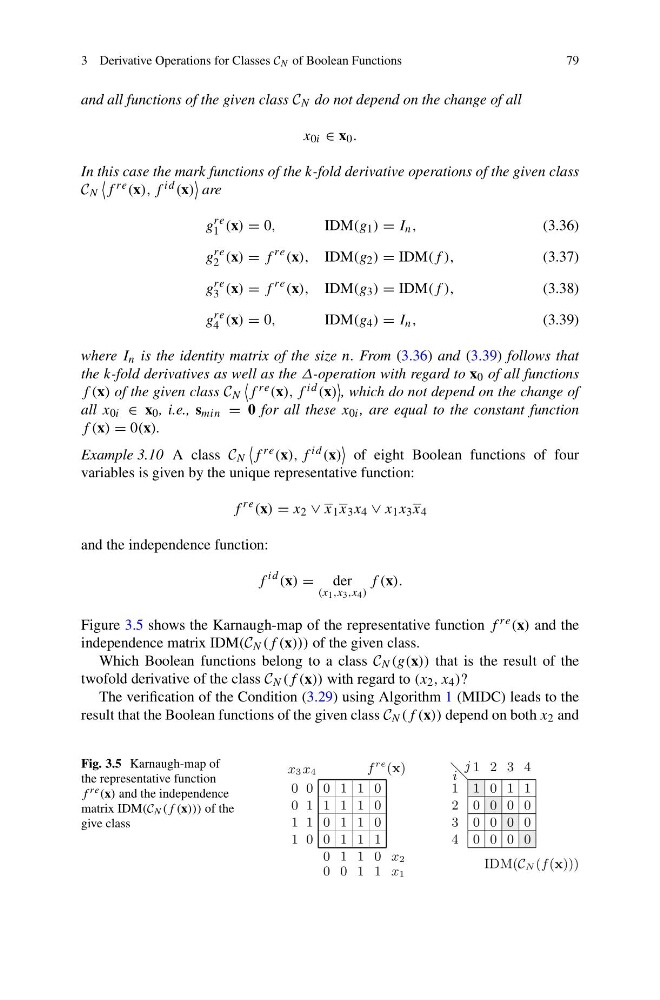
Figure 3.5 shows the Karnaugh-map of the representative function f re (x) and the
independence matrix IDM(C N (f (x))) of the given class.
Which Boolean functions belong to a class C N (g(x)) that is the result of the
twofold derivative of the class C N (f (x)) with regard to (x 2 , x 4 )?
The verification of the Condition (3.29) using Algorithm 1 (MIDC) leads to the
result that the Boolean functions of the given class C N (f (x)) depend on both x 2 and
Fig. 3.5 Karnaugh-map of
the representative function
f re (x) and the independence
matrix IDM(C N (f (x))) of the
give class
0 1 1 0
1 1 1 0
0 1 1 0
0 1 1 1
0
0
1
0
1
1
0
1 x1
x2
0
0
1
0
1
1
0
1
x3 x4
f
re (x)
1
2
3
4
1 2 3 4
i
j
1 0 1 1
0 0 0 0
0 0 0 0
0 0 0 0
IDM(CN (f (x)))
79
and all functions of the given class C N do not depend on the change of all
x 0i ∈ x 0 .
In this case the mark functions of the k-fold derivative operations of the given class
C N
f re (x), f id (x)
are
g
re
1 (x) = 0,
IDM(g 1 ) = I n ,
(3.36)
g
re
2 (x) = f
re (x), IDM(g 2 ) = IDM(f ),
(3.37)
g
re
3 (x) = f
re (x), IDM(g 3 ) = IDM(f ),
(3.38)
g
re
4 (x) = 0,
IDM(g 4 ) = I n ,
(3.39)
where I n is the identity matrix of the size n. From (3.36) and (3.39) follows that
the k-fold derivatives as well as the Δ-operation with regard to x 0 of all functions
f (x) of the given class C N
f re (x), f id (x)
, which do not depend on the change of
all x 0i ∈ x 0 , i.e., s min = 0 for all these x 0i , are equal to the constant function
f (x) = 0(x).
Example 3.10 A class C N
f re (x), f id (x)
of eight Boolean functions of four
variables is given by the unique representative function:
f
re (x) = x 2 ∨ x 1 x 3 x 4 ∨ x 1 x 3 x 4
and the independence function:
f
id (x) = der
(x 1 ,x 3 ,x 4 )
f (x).
Figure 3.5 shows the Karnaugh-map of the representative function f re (x) and the
independence matrix IDM(C N (f (x))) of the given class.
Which Boolean functions belong to a class C N (g(x)) that is the result of the
twofold derivative of the class C N (f (x)) with regard to (x 2 , x 4 )?
The verification of the Condition (3.29) using Algorithm 1 (MIDC) leads to the
result that the Boolean functions of the given class C N (f (x)) depend on both x 2 and
Fig. 3.5 Karnaugh-map of
the representative function
f re (x) and the independence
matrix IDM(C N (f (x))) of the
give class
0 1 1 0
1 1 1 0
0 1 1 0
0 1 1 1
0
0
1
0
1
1
0
1 x1
x2
0
0
1
0
1
1
0
1
x3 x4
f
re (x)
1
2
3
4
1 2 3 4
i
j
1 0 1 1
0 0 0 0
0 0 0 0
0 0 0 0
IDM(CN (f (x)))