

72
B. Steinbach and C. Posthoff
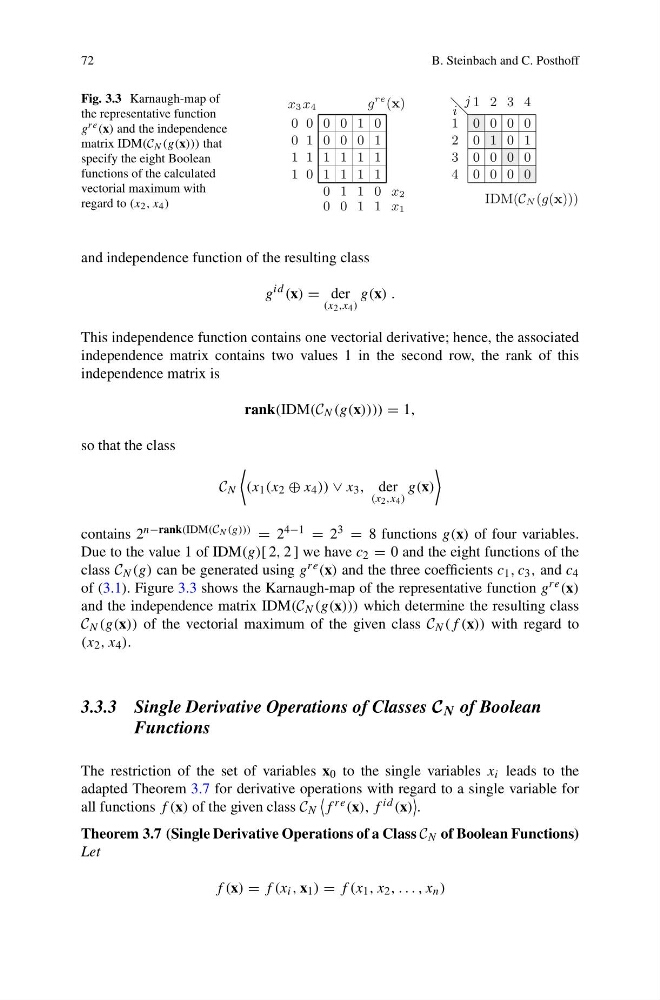
Fig. 3.3 Karnaugh-map of
the representative function
g re (x) and the independence
matrix IDM(C N (g(x))) that
specify the eight Boolean
functions of the calculated
vectorial maximum with
regard to (x 2 , x 4 )
0 0 1 0
0 0 0 1
1 1 1 1
1 1 1 1
0
0
1
0
1
1
0
1 x1
x2
0
0
1
0
1
1
0
1
x3 x4
g
re (x)
1
2
3
4
1 2 3 4
i
j
0 0 0 0
0 1 0 1
0 0 0 0
0 0 0 0
IDM(CN (g(x)))
and independence function of the resulting class
g
id (x) = der
(x 2 ,x 4 )
g(x) .
This independence function contains one vectorial derivative; hence, the associated
independence matrix contains two values 1 in the second row, the rank of this
independence matrix is
rank(IDM(C N (g(x)))) = 1,
so that the class
C N
(x 1 (x 2 ⊕ x 4 )) ∨ x 3 , der
(x 2 ,x 4 )
g(x)
contains 2 n−rank(IDM(C N (g))) = 2 4−1 = 2 3 = 8 functions g(x) of four variables.
Due to the value 1 of IDM(g)[ 2, 2 ] we have c 2 = 0 and the eight functions of the
class C N (g) can be generated using g re (x) and the three coefficients c 1 , c 3 , and c 4
of (3.1). Figure 3.3 shows the Karnaugh-map of the representative function g re (x)
and the independence matrix IDM(C N (g(x))) which determine the resulting class
C N (g(x)) of the vectorial maximum of the given class C N (f (x)) with regard to
(x 2 , x 4 ).
3.3.3 Single Derivative Operations of Classes C N of Boolean
Functions
The restriction of the set of variables x 0 to the single variables x i leads to the
adapted Theorem 3.7 for derivative operations with regard to a single variable for
all functions f (x) of the given class C N
f re (x), f id (x)
.
Theorem 3.7 (Single Derivative Operations of a Class C N of Boolean Functions)
Let
f (x) = f (x i , x 1 ) = f (x 1 , x 2 , . . . , x n )
B. Steinbach and C. Posthoff
Fig. 3.3 Karnaugh-map of
the representative function
g re (x) and the independence
matrix IDM(C N (g(x))) that
specify the eight Boolean
functions of the calculated
vectorial maximum with
regard to (x 2 , x 4 )
0 0 1 0
0 0 0 1
1 1 1 1
1 1 1 1
0
0
1
0
1
1
0
1 x1
x2
0
0
1
0
1
1
0
1
x3 x4
g
re (x)
1
2
3
4
1 2 3 4
i
j
0 0 0 0
0 1 0 1
0 0 0 0
0 0 0 0
IDM(CN (g(x)))
and independence function of the resulting class
g
id (x) = der
(x 2 ,x 4 )
g(x) .
This independence function contains one vectorial derivative; hence, the associated
independence matrix contains two values 1 in the second row, the rank of this
independence matrix is
rank(IDM(C N (g(x)))) = 1,
so that the class
C N
(x 1 (x 2 ⊕ x 4 )) ∨ x 3 , der
(x 2 ,x 4 )
g(x)
contains 2 n−rank(IDM(C N (g))) = 2 4−1 = 2 3 = 8 functions g(x) of four variables.
Due to the value 1 of IDM(g)[ 2, 2 ] we have c 2 = 0 and the eight functions of the
class C N (g) can be generated using g re (x) and the three coefficients c 1 , c 3 , and c 4
of (3.1). Figure 3.3 shows the Karnaugh-map of the representative function g re (x)
and the independence matrix IDM(C N (g(x))) which determine the resulting class
C N (g(x)) of the vectorial maximum of the given class C N (f (x)) with regard to
(x 2 , x 4 ).
3.3.3 Single Derivative Operations of Classes C N of Boolean
Functions
The restriction of the set of variables x 0 to the single variables x i leads to the
adapted Theorem 3.7 for derivative operations with regard to a single variable for
all functions f (x) of the given class C N
f re (x), f id (x)
.
Theorem 3.7 (Single Derivative Operations of a Class C N of Boolean Functions)
Let
f (x) = f (x i , x 1 ) = f (x 1 , x 2 , . . . , x n )