

3 Derivative Operations for Classes C N of Boolean Functions
69
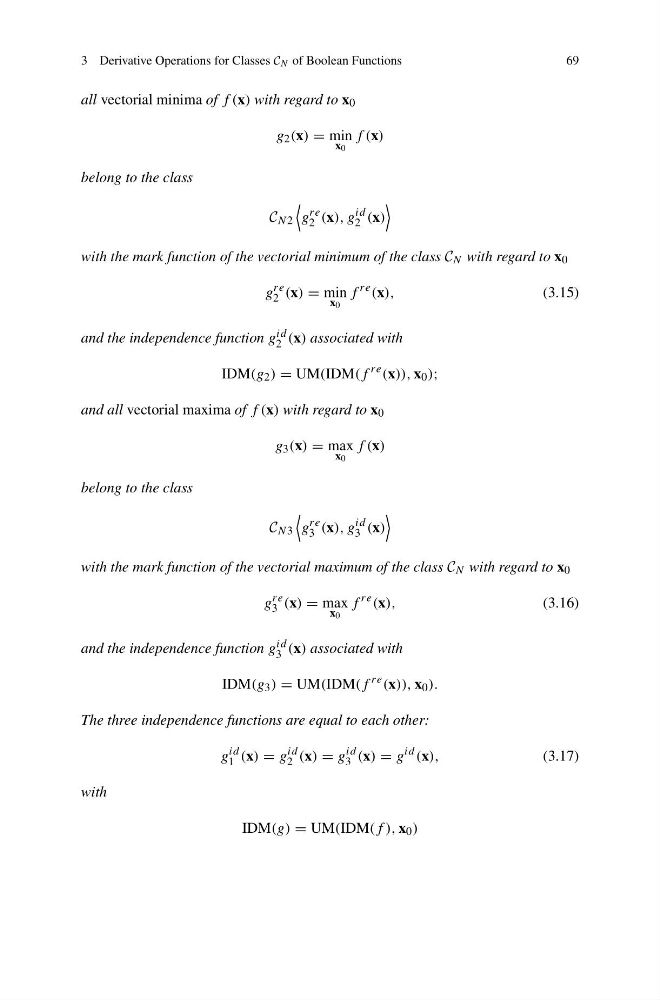
all vectorial minima of f (x) with regard to x 0
g 2 (x) = min
x 0
f (x)
belong to the class
C N 2
g
re
2 (x), g
id
2 (x)
with the mark function of the vectorial minimum of the class C N with regard to x 0
g
re
2 (x) = min
x 0
f
re (x),
(3.15)
and the independence function g id
2 (x) associated with
IDM(g 2 ) = UM(IDM(f
re (x)), x 0 );
and all vectorial maxima of f (x) with regard to x 0
g 3 (x) = max
x 0
f (x)
belong to the class
C N 3
g
re
3 (x), g
id
3 (x)
with the mark function of the vectorial maximum of the class C N with regard to x 0
g
re
3 (x) = max
x 0
f
re (x),
(3.16)
and the independence function g id
3 (x) associated with
IDM(g 3 ) = UM(IDM(f
re (x)), x 0 ).
The three independence functions are equal to each other:
g
id
1 (x) = g
id
2 (x) = g
id
3 (x) = g
id (x),
(3.17)
with
IDM(g) = UM(IDM(f ), x 0 )
69
all vectorial minima of f (x) with regard to x 0
g 2 (x) = min
x 0
f (x)
belong to the class
C N 2
g
re
2 (x), g
id
2 (x)
with the mark function of the vectorial minimum of the class C N with regard to x 0
g
re
2 (x) = min
x 0
f
re (x),
(3.15)
and the independence function g id
2 (x) associated with
IDM(g 2 ) = UM(IDM(f
re (x)), x 0 );
and all vectorial maxima of f (x) with regard to x 0
g 3 (x) = max
x 0
f (x)
belong to the class
C N 3
g
re
3 (x), g
id
3 (x)
with the mark function of the vectorial maximum of the class C N with regard to x 0
g
re
3 (x) = max
x 0
f
re (x),
(3.16)
and the independence function g id
3 (x) associated with
IDM(g 3 ) = UM(IDM(f
re (x)), x 0 ).
The three independence functions are equal to each other:
g
id
1 (x) = g
id
2 (x) = g
id
3 (x) = g
id (x),
(3.17)
with
IDM(g) = UM(IDM(f ), x 0 )