

3 Derivative Operations for Classes C N of Boolean Functions
65
Using the unique representative function f re (x) and the independence function
f id (x) of a class C N we get as short notation:
C N
f
re (x), f
id (x)
.
(3.10)
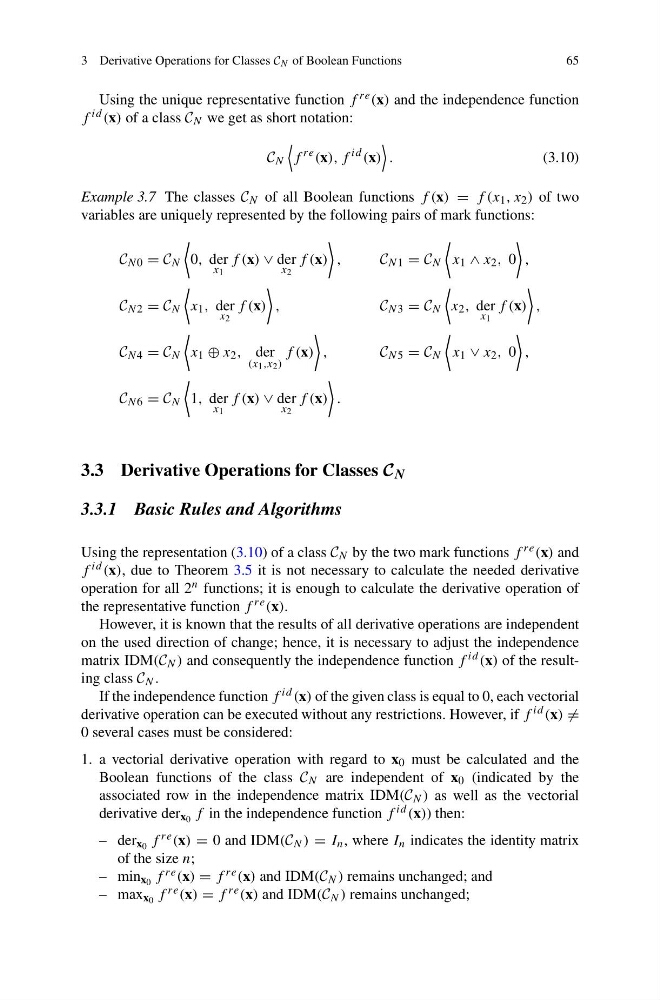
Example 3.7 The classes C N of all Boolean functions f (x) = f (x 1 , x 2 ) of two
variables are uniquely represented by the following pairs of mark functions:
C N 0 = C N
0, der
x 1
f (x) ∨ der
x 2
f (x)
,
C N 1 = C N
x 1 ∧ x 2 , 0
,
C N 2 = C N
x 1 , der
x 2
f (x)
,
C N 3 = C N
x 2 , der
x 1
f (x)
,
C N 4 = C N
x 1 ⊕ x 2 , der
(x 1 ,x 2 )
f (x)
,
C N 5 = C N
x 1 ∨ x 2 , 0
,
C N 6 = C N
1, der
x 1
f (x) ∨ der
x 2
f (x)
.
3.3 Derivative Operations for Classes C N
3.3.1 Basic Rules and Algorithms
Using the representation (3.10) of a class C N by the two mark functions f re (x) and
f id (x), due to Theorem 3.5 it is not necessary to calculate the needed derivative
operation for all 2 n functions; it is enough to calculate the derivative operation of
the representative function f re (x).
However, it is known that the results of all derivative operations are independent
on the used direction of change; hence, it is necessary to adjust the independence
matrix IDM(C N ) and consequently the independence function f id (x) of the resulting class C N .
If the independence function f id (x) of the given class is equal to 0, each vectorial
derivative operation can be executed without any restrictions. However, if f id (x) =
0 several cases must be considered:
1. a vectorial derivative operation with regard to x 0 must be calculated and the
Boolean functions of the class C N are independent of x 0 (indicated by the
associated row in the independence matrix IDM(C N ) as well as the vectorial
derivative der x 0 f in the independence function f id (x)) then:
– der x 0 f re (x) = 0 and IDM(C N ) = I n , where I n indicates the identity matrix
of the size n;
– min x 0 f re (x) = f re (x) and IDM(C N ) remains unchanged; and
– max x 0 f re (x) = f re (x) and IDM(C N ) remains unchanged;
65
Using the unique representative function f re (x) and the independence function
f id (x) of a class C N we get as short notation:
C N
f
re (x), f
id (x)
.
(3.10)
Example 3.7 The classes C N of all Boolean functions f (x) = f (x 1 , x 2 ) of two
variables are uniquely represented by the following pairs of mark functions:
C N 0 = C N
0, der
x 1
f (x) ∨ der
x 2
f (x)
,
C N 1 = C N
x 1 ∧ x 2 , 0
,
C N 2 = C N
x 1 , der
x 2
f (x)
,
C N 3 = C N
x 2 , der
x 1
f (x)
,
C N 4 = C N
x 1 ⊕ x 2 , der
(x 1 ,x 2 )
f (x)
,
C N 5 = C N
x 1 ∨ x 2 , 0
,
C N 6 = C N
1, der
x 1
f (x) ∨ der
x 2
f (x)
.
3.3 Derivative Operations for Classes C N
3.3.1 Basic Rules and Algorithms
Using the representation (3.10) of a class C N by the two mark functions f re (x) and
f id (x), due to Theorem 3.5 it is not necessary to calculate the needed derivative
operation for all 2 n functions; it is enough to calculate the derivative operation of
the representative function f re (x).
However, it is known that the results of all derivative operations are independent
on the used direction of change; hence, it is necessary to adjust the independence
matrix IDM(C N ) and consequently the independence function f id (x) of the resulting class C N .
If the independence function f id (x) of the given class is equal to 0, each vectorial
derivative operation can be executed without any restrictions. However, if f id (x) =
0 several cases must be considered:
1. a vectorial derivative operation with regard to x 0 must be calculated and the
Boolean functions of the class C N are independent of x 0 (indicated by the
associated row in the independence matrix IDM(C N ) as well as the vectorial
derivative der x 0 f in the independence function f id (x)) then:
– der x 0 f re (x) = 0 and IDM(C N ) = I n , where I n indicates the identity matrix
of the size n;
– min x 0 f re (x) = f re (x) and IDM(C N ) remains unchanged; and
– max x 0 f re (x) = f re (x) and IDM(C N ) remains unchanged;