

60
B. Steinbach and C. Posthoff
be omitted from (3.1) if der x i f (x) = 0 and the remaining n − 1 other coefficients
completely specify all 2 n−1 Boolean functions f (x) of the associated class C N .
The functions of the class C N 4 , however, depend on both variables x 1 and x 2 .
Example 3.5 explores the possibilities of the coefficients needed to generate all
functions of the class C N 4 .
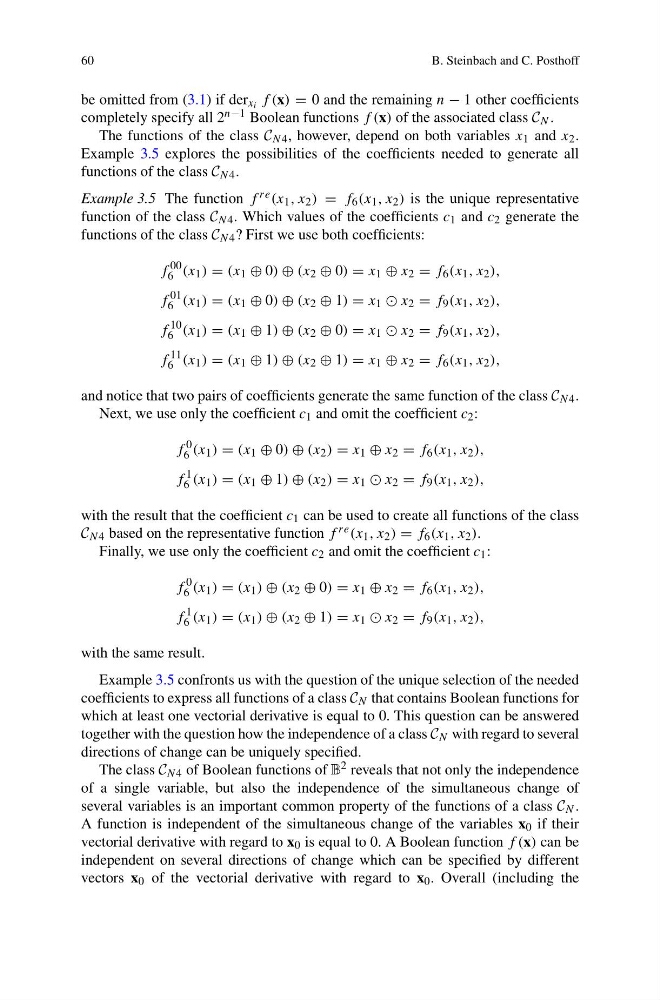
Example 3.5 The function f re (x 1 , x 2 ) = f 6 (x 1 , x 2 ) is the unique representative
function of the class C N 4 . Which values of the coefficients c 1 and c 2 generate the
functions of the class C N 4 ? First we use both coefficients:
f
00
6 (x 1 ) = (x 1 ⊕ 0) ⊕ (x 2 ⊕ 0) = x 1 ⊕ x 2 = f 6 (x 1 , x 2 ),
f
01
6 (x 1 ) = (x 1 ⊕ 0) ⊕ (x 2 ⊕ 1) = x 1 x 2 = f 9 (x 1 , x 2 ),
f
10
6 (x 1 ) = (x 1 ⊕ 1) ⊕ (x 2 ⊕ 0) = x 1 x 2 = f 9 (x 1 , x 2 ),
f
11
6 (x 1 ) = (x 1 ⊕ 1) ⊕ (x 2 ⊕ 1) = x 1 ⊕ x 2 = f 6 (x 1 , x 2 ),
and notice that two pairs of coefficients generate the same function of the class C N 4 .
Next, we use only the coefficient c 1 and omit the coefficient c 2 :
f
0
6 (x 1 ) = (x 1 ⊕ 0) ⊕ (x 2 ) = x 1 ⊕ x 2 = f 6 (x 1 , x 2 ),
f
1
6 (x 1 ) = (x 1 ⊕ 1) ⊕ (x 2 ) = x 1 x 2 = f 9 (x 1 , x 2 ),
with the result that the coefficient c 1 can be used to create all functions of the class
C N 4 based on the representative function f re (x 1 , x 2 ) = f 6 (x 1 , x 2 ).
Finally, we use only the coefficient c 2 and omit the coefficient c 1 :
f
0
6 (x 1 ) = (x 1 ) ⊕ (x 2 ⊕ 0) = x 1 ⊕ x 2 = f 6 (x 1 , x 2 ),
f
1
6 (x 1 ) = (x 1 ) ⊕ (x 2 ⊕ 1) = x 1 x 2 = f 9 (x 1 , x 2 ),
with the same result.
Example 3.5 confronts us with the question of the unique selection of the needed
coefficients to express all functions of a class C N that contains Boolean functions for
which at least one vectorial derivative is equal to 0. This question can be answered
together with the question how the independence of a class C N with regard to several
directions of change can be uniquely specified.
The class C N 4 of Boolean functions of B 2 reveals that not only the independence
of a single variable, but also the independence of the simultaneous change of
several variables is an important common property of the functions of a class C N .
A function is independent of the simultaneous change of the variables x 0 if their
vectorial derivative with regard to x 0 is equal to 0. A Boolean function f (x) can be
independent on several directions of change which can be specified by different
vectors x 0 of the vectorial derivative with regard to x 0 . Overall (including the
B. Steinbach and C. Posthoff
be omitted from (3.1) if der x i f (x) = 0 and the remaining n − 1 other coefficients
completely specify all 2 n−1 Boolean functions f (x) of the associated class C N .
The functions of the class C N 4 , however, depend on both variables x 1 and x 2 .
Example 3.5 explores the possibilities of the coefficients needed to generate all
functions of the class C N 4 .
Example 3.5 The function f re (x 1 , x 2 ) = f 6 (x 1 , x 2 ) is the unique representative
function of the class C N 4 . Which values of the coefficients c 1 and c 2 generate the
functions of the class C N 4 ? First we use both coefficients:
f
00
6 (x 1 ) = (x 1 ⊕ 0) ⊕ (x 2 ⊕ 0) = x 1 ⊕ x 2 = f 6 (x 1 , x 2 ),
f
01
6 (x 1 ) = (x 1 ⊕ 0) ⊕ (x 2 ⊕ 1) = x 1 x 2 = f 9 (x 1 , x 2 ),
f
10
6 (x 1 ) = (x 1 ⊕ 1) ⊕ (x 2 ⊕ 0) = x 1 x 2 = f 9 (x 1 , x 2 ),
f
11
6 (x 1 ) = (x 1 ⊕ 1) ⊕ (x 2 ⊕ 1) = x 1 ⊕ x 2 = f 6 (x 1 , x 2 ),
and notice that two pairs of coefficients generate the same function of the class C N 4 .
Next, we use only the coefficient c 1 and omit the coefficient c 2 :
f
0
6 (x 1 ) = (x 1 ⊕ 0) ⊕ (x 2 ) = x 1 ⊕ x 2 = f 6 (x 1 , x 2 ),
f
1
6 (x 1 ) = (x 1 ⊕ 1) ⊕ (x 2 ) = x 1 x 2 = f 9 (x 1 , x 2 ),
with the result that the coefficient c 1 can be used to create all functions of the class
C N 4 based on the representative function f re (x 1 , x 2 ) = f 6 (x 1 , x 2 ).
Finally, we use only the coefficient c 2 and omit the coefficient c 1 :
f
0
6 (x 1 ) = (x 1 ) ⊕ (x 2 ⊕ 0) = x 1 ⊕ x 2 = f 6 (x 1 , x 2 ),
f
1
6 (x 1 ) = (x 1 ) ⊕ (x 2 ⊕ 1) = x 1 x 2 = f 9 (x 1 , x 2 ),
with the same result.
Example 3.5 confronts us with the question of the unique selection of the needed
coefficients to express all functions of a class C N that contains Boolean functions for
which at least one vectorial derivative is equal to 0. This question can be answered
together with the question how the independence of a class C N with regard to several
directions of change can be uniquely specified.
The class C N 4 of Boolean functions of B 2 reveals that not only the independence
of a single variable, but also the independence of the simultaneous change of
several variables is an important common property of the functions of a class C N .
A function is independent of the simultaneous change of the variables x 0 if their
vectorial derivative with regard to x 0 is equal to 0. A Boolean function f (x) can be
independent on several directions of change which can be specified by different
vectors x 0 of the vectorial derivative with regard to x 0 . Overall (including the