

100
R. S. Stankovi´ c et al.
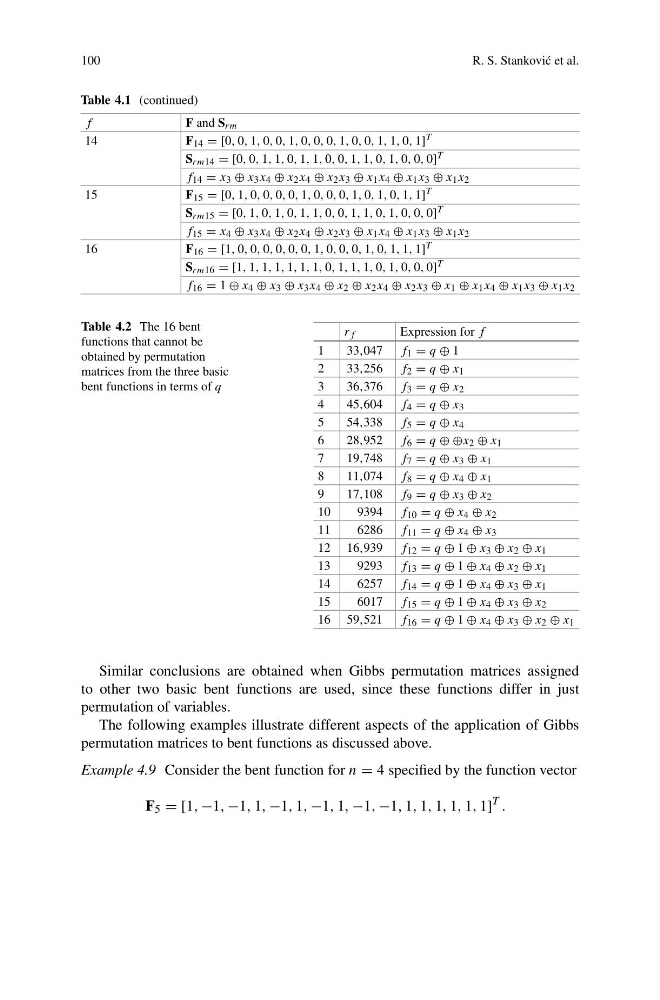
Table 4.1 (continued)
f
F and S rm
14
F 14 = [0, 0, 1, 0, 0, 1, 0, 0, 0, 1, 0, 0, 1, 1, 0, 1] T
S rm14 = [0, 0, 1, 1, 0, 1, 1, 0, 0, 1, 1, 0, 1, 0, 0, 0] T
f 14 = x 3 ⊕ x 3 x 4 ⊕ x 2 x 4 ⊕ x 2 x 3 ⊕ x 1 x 4 ⊕ x 1 x 3 ⊕ x 1 x 2
15
F 15 = [0, 1, 0, 0, 0, 0, 1, 0, 0, 0, 1, 0, 1, 0, 1, 1] T
S rm15 = [0, 1, 0, 1, 0, 1, 1, 0, 0, 1, 1, 0, 1, 0, 0, 0] T
f 15 = x 4 ⊕ x 3 x 4 ⊕ x 2 x 4 ⊕ x 2 x 3 ⊕ x 1 x 4 ⊕ x 1 x 3 ⊕ x 1 x 2
16
F 16 = [1, 0, 0, 0, 0, 0, 0, 1, 0, 0, 0, 1, 0, 1, 1, 1] T
S rm16 = [1, 1, 1, 1, 1, 1, 1, 0, 1, 1, 1, 0, 1, 0, 0, 0] T
f 16 = 1 ⊕ x 4 ⊕ x 3 ⊕ x 3 x 4 ⊕ x 2 ⊕ x 2 x 4 ⊕ x 2 x 3 ⊕ x 1 ⊕ x 1 x 4 ⊕ x 1 x 3 ⊕ x 1 x 2
Table 4.2 The 16 bent
functions that cannot be
obtained by permutation
matrices from the three basic
bent functions in terms of q
r f
Expression for f
1
33,047 f 1 = q ⊕ 1
2
33,256 f 2 = q ⊕ x 1
3
36,376 f 3 = q ⊕ x 2
4
45,604 f 4 = q ⊕ x 3
5
54,338 f 5 = q ⊕ x 4
6
28,952 f 6 = q ⊕ ⊕x 2 ⊕ x 1
7
19,748 f 7 = q ⊕ x 3 ⊕ x 1
8
11,074 f 8 = q ⊕ x 4 ⊕ x 1
9
17,108 f 9 = q ⊕ x 3 ⊕ x 2
10
9394 f 10 = q ⊕ x 4 ⊕ x 2
11
6286 f 11 = q ⊕ x 4 ⊕ x 3
12 16,939 f 12 = q ⊕ 1 ⊕ x 3 ⊕ x 2 ⊕ x 1
13
9293 f 13 = q ⊕ 1 ⊕ x 4 ⊕ x 2 ⊕ x 1
14
6257 f 14 = q ⊕ 1 ⊕ x 4 ⊕ x 3 ⊕ x 1
15
6017 f 15 = q ⊕ 1 ⊕ x 4 ⊕ x 3 ⊕ x 2
16 59,521 f 16 = q ⊕ 1 ⊕ x 4 ⊕ x 3 ⊕ x 2 ⊕ x 1
Similar conclusions are obtained when Gibbs permutation matrices assigned
to other two basic bent functions are used, since these functions differ in just
permutation of variables.
The following examples illustrate different aspects of the application of Gibbs
permutation matrices to bent functions as discussed above.
Example 4.9 Consider the bent function for n = 4 specified by the function vector
F 5 = [1, −1, −1, 1, −1, 1, −1, 1, −1, −1, 1, 1, 1, 1, 1, 1]
T .
R. S. Stankovi´ c et al.
Table 4.1 (continued)
f
F and S rm
14
F 14 = [0, 0, 1, 0, 0, 1, 0, 0, 0, 1, 0, 0, 1, 1, 0, 1] T
S rm14 = [0, 0, 1, 1, 0, 1, 1, 0, 0, 1, 1, 0, 1, 0, 0, 0] T
f 14 = x 3 ⊕ x 3 x 4 ⊕ x 2 x 4 ⊕ x 2 x 3 ⊕ x 1 x 4 ⊕ x 1 x 3 ⊕ x 1 x 2
15
F 15 = [0, 1, 0, 0, 0, 0, 1, 0, 0, 0, 1, 0, 1, 0, 1, 1] T
S rm15 = [0, 1, 0, 1, 0, 1, 1, 0, 0, 1, 1, 0, 1, 0, 0, 0] T
f 15 = x 4 ⊕ x 3 x 4 ⊕ x 2 x 4 ⊕ x 2 x 3 ⊕ x 1 x 4 ⊕ x 1 x 3 ⊕ x 1 x 2
16
F 16 = [1, 0, 0, 0, 0, 0, 0, 1, 0, 0, 0, 1, 0, 1, 1, 1] T
S rm16 = [1, 1, 1, 1, 1, 1, 1, 0, 1, 1, 1, 0, 1, 0, 0, 0] T
f 16 = 1 ⊕ x 4 ⊕ x 3 ⊕ x 3 x 4 ⊕ x 2 ⊕ x 2 x 4 ⊕ x 2 x 3 ⊕ x 1 ⊕ x 1 x 4 ⊕ x 1 x 3 ⊕ x 1 x 2
Table 4.2 The 16 bent
functions that cannot be
obtained by permutation
matrices from the three basic
bent functions in terms of q
r f
Expression for f
1
33,047 f 1 = q ⊕ 1
2
33,256 f 2 = q ⊕ x 1
3
36,376 f 3 = q ⊕ x 2
4
45,604 f 4 = q ⊕ x 3
5
54,338 f 5 = q ⊕ x 4
6
28,952 f 6 = q ⊕ ⊕x 2 ⊕ x 1
7
19,748 f 7 = q ⊕ x 3 ⊕ x 1
8
11,074 f 8 = q ⊕ x 4 ⊕ x 1
9
17,108 f 9 = q ⊕ x 3 ⊕ x 2
10
9394 f 10 = q ⊕ x 4 ⊕ x 2
11
6286 f 11 = q ⊕ x 4 ⊕ x 3
12 16,939 f 12 = q ⊕ 1 ⊕ x 3 ⊕ x 2 ⊕ x 1
13
9293 f 13 = q ⊕ 1 ⊕ x 4 ⊕ x 2 ⊕ x 1
14
6257 f 14 = q ⊕ 1 ⊕ x 4 ⊕ x 3 ⊕ x 1
15
6017 f 15 = q ⊕ 1 ⊕ x 4 ⊕ x 3 ⊕ x 2
16 59,521 f 16 = q ⊕ 1 ⊕ x 4 ⊕ x 3 ⊕ x 2 ⊕ x 1
Similar conclusions are obtained when Gibbs permutation matrices assigned
to other two basic bent functions are used, since these functions differ in just
permutation of variables.
The following examples illustrate different aspects of the application of Gibbs
permutation matrices to bent functions as discussed above.
Example 4.9 Consider the bent function for n = 4 specified by the function vector
F 5 = [1, −1, −1, 1, −1, 1, −1, 1, −1, −1, 1, 1, 1, 1, 1, 1]
T .