

61
Steam Gasification and Reforming Technologies
can be generated on CaO that can be removed by steam or carbon dioxide reactions
with coke producing hydrogen and carbon monoxide. Thus, steam gasification of coal
is often carried out with an addition of CaO so that the gasifier simultaneously removes
carbon dioxide during the gasification process.
In general, carbon conversion and char gasification in a fluidized bed reactor
increase with temperature between 600°C and 900°C. While tar yield (or tar content)
and CO 2 capture decrease with an increase in the temperature in the same range.
High contents of alkalis during gasification can also cause the problems of agglomeration, sintering, and melting, all of which are harmful to the smooth operation of the
gasifier. Besides CaO, often calcined dolomites (CaO–MgO) and magnesium-based
minerals silicates such as serpentine [Mg 3 Si 2 O 5 (OH) 4 ], olivine (Mg 0.9 Fe 0.1 SiO 4 ), and
calcine limestones or calcites have also been tested.
The study showed that for a clean and efficient steam gasification of coal in a
fluidized bed at low/medium temperatures, at an atmospheric pressure, and with
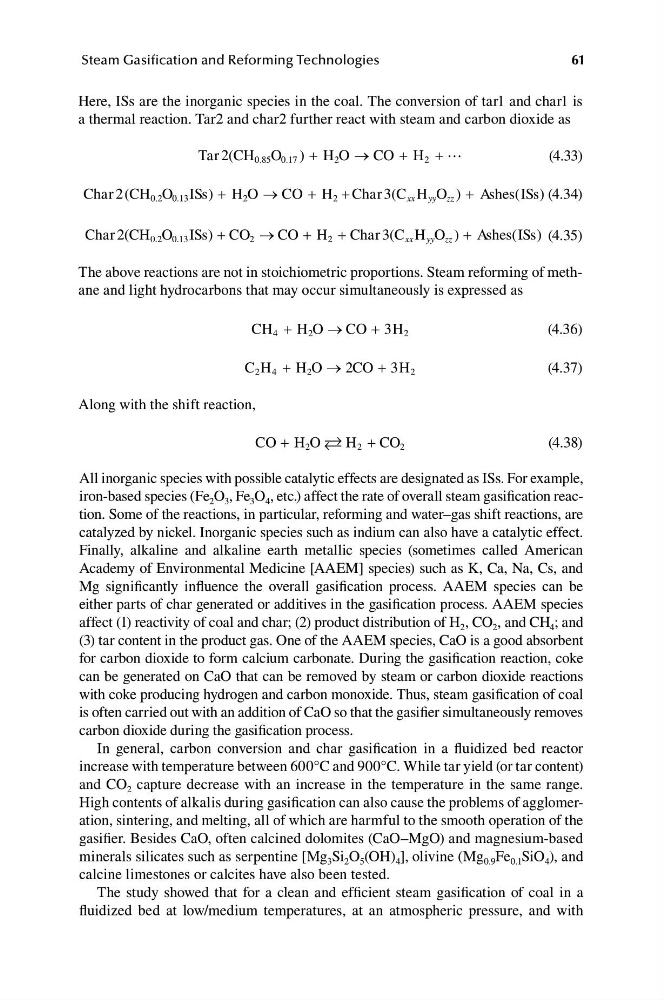
Here, ISs are the inorganic species in the coal. The conversion of tar1 and char1 is
a thermal reaction. Tar2 and char2 further react with steam and carbon dioxide as
Tar 2(CH 0.85 O 0.17 ) + H 2 O → CO + H 2 +
(4.33)
Char 2(CH 0.2 O 0.13 ISs) + H 2 O → CO + H 2 + Char 3(C xx H yy O zz ) + Ashes(ISs) (4.34)
Char 2(CH 0.2 O 0.13 ISs) + CO 2 → CO + H 2 + Char 3(C xx H yy O zz ) + Ashes(ISs) (4.35)
The above reactions are not in stoichiometric proportions. Steam reforming of methane and light hydrocarbons that may occur simultaneously is expressed as
CH 4 + H 2 O → CO + 3H 2
(4.36)
C 2 H 4 + H 2 O → 2CO + 3H 2
(4.37)
Along with the shift reaction,
CO + H 2 O H 2 + CO 2
(4.38)
All inorganic species with possible catalytic effects are designated as ISs. For example,
iron-based species (Fe 2 O 3 , Fe 3 O 4 , etc.) affect the rate of overall steam gasification reaction. Some of the reactions, in particular, reforming and water–gas shift reactions, are
catalyzed by nickel. Inorganic species such as indium can also have a catalytic effect.
Finally, alkaline and alkaline earth metallic species (sometimes called American
Academy of Environmental Medicine [AAEM] species) such as K, Ca, Na, Cs, and
Mg significantly influence the overall gasification process. AAEM species can be
either parts of char generated or additives in the gasification process. AAEM species
affect (1) reactivity of coal and char; (2) product distribution of H 2 , CO 2 , and CH 4 ; and
(3) tar content in the product gas. One of the AAEM species, CaO is a good absorbent
for carbon dioxide to form calcium carbonate. During the gasification reaction, coke
Steam Gasification and Reforming Technologies
can be generated on CaO that can be removed by steam or carbon dioxide reactions
with coke producing hydrogen and carbon monoxide. Thus, steam gasification of coal
is often carried out with an addition of CaO so that the gasifier simultaneously removes
carbon dioxide during the gasification process.
In general, carbon conversion and char gasification in a fluidized bed reactor
increase with temperature between 600°C and 900°C. While tar yield (or tar content)
and CO 2 capture decrease with an increase in the temperature in the same range.
High contents of alkalis during gasification can also cause the problems of agglomeration, sintering, and melting, all of which are harmful to the smooth operation of the
gasifier. Besides CaO, often calcined dolomites (CaO–MgO) and magnesium-based
minerals silicates such as serpentine [Mg 3 Si 2 O 5 (OH) 4 ], olivine (Mg 0.9 Fe 0.1 SiO 4 ), and
calcine limestones or calcites have also been tested.
The study showed that for a clean and efficient steam gasification of coal in a
fluidized bed at low/medium temperatures, at an atmospheric pressure, and with
Here, ISs are the inorganic species in the coal. The conversion of tar1 and char1 is
a thermal reaction. Tar2 and char2 further react with steam and carbon dioxide as
Tar 2(CH 0.85 O 0.17 ) + H 2 O → CO + H 2 +
(4.33)
Char 2(CH 0.2 O 0.13 ISs) + H 2 O → CO + H 2 + Char 3(C xx H yy O zz ) + Ashes(ISs) (4.34)
Char 2(CH 0.2 O 0.13 ISs) + CO 2 → CO + H 2 + Char 3(C xx H yy O zz ) + Ashes(ISs) (4.35)
The above reactions are not in stoichiometric proportions. Steam reforming of methane and light hydrocarbons that may occur simultaneously is expressed as
CH 4 + H 2 O → CO + 3H 2
(4.36)
C 2 H 4 + H 2 O → 2CO + 3H 2
(4.37)
Along with the shift reaction,
CO + H 2 O H 2 + CO 2
(4.38)
All inorganic species with possible catalytic effects are designated as ISs. For example,
iron-based species (Fe 2 O 3 , Fe 3 O 4 , etc.) affect the rate of overall steam gasification reaction. Some of the reactions, in particular, reforming and water–gas shift reactions, are
catalyzed by nickel. Inorganic species such as indium can also have a catalytic effect.
Finally, alkaline and alkaline earth metallic species (sometimes called American
Academy of Environmental Medicine [AAEM] species) such as K, Ca, Na, Cs, and
Mg significantly influence the overall gasification process. AAEM species can be
either parts of char generated or additives in the gasification process. AAEM species
affect (1) reactivity of coal and char; (2) product distribution of H 2 , CO 2 , and CH 4 ; and
(3) tar content in the product gas. One of the AAEM species, CaO is a good absorbent
for carbon dioxide to form calcium carbonate. During the gasification reaction, coke