

55
Steam Gasification and Reforming Technologies
4.2.3.2 nickel-Based Catalysts
As mentioned earlier, the gasification and reforming in the presence of steam are
overlapping reactions. Tar and lower hydrocarbons produced by the gasification can be
simultaneously reformed in the presence of a suitable catalyst. Rostrup-Nielsen et al.
[37] presented a very good review of applicability of transition metals (group VIII) and
noble metal catalysts to steam gasification/reforming process. While a number of noble
metal catalysts such as Ru and Rh have superior performance for steam reforming,
the cost and easy availability of these catalysts compared to that of nickel, made the
latter choice more practical. The literature has convincingly demonstrated the usefulness of nickel catalysts for biomass gasification [19–23,36,37,43]. Olivares et al. [53]
showed that nickel reforming catalysts display 8–10 times more reactivity than calcined dolomite. Nickel catalysts can be, however, deactivated by the poisons such as
sulfur, chlorine, and alkali metals. They can also be deactivated by the formation of
coke. The coke deposition can be reduced by increasing steam/biomass ratio; however,
this increases the energy cost and changes the gas-phase composition of the product.
In general, Ni-gamma-alumina catalyst gave higher conversion and lower deactivation
compared to Ni-alpha-alumina catalysts. The MgO/CaO addition to alumina also gives
the catalyst more stability. Lanthanum-based pervoskite support was also found to be
very effective. The topics of coking, catalyst deactivation, and effective support for
the nickel are discussed in Sections 4.2.4, 4.3, and 4.4. Suffice to say that nickel-based
catalysts have gained a significant support for steam gasification and reforming.
4.2.4 CATAlySTS For STeAm reForming
In general, two types of sites are required for the steam reforming catalysts: the catalytic
sites for hydrogenation and dehydrogenation and the acidic sites [22,23,28,36,37,41–56].
The acidic sites promote the formation of carbonium ions. For aromatization and isomerization reactions, the two types of sites are necessary. While, as mentioned earlier,
Ni catalysts on oxide supports have been most extensively used in the industry, recent
studies show that bimetallic catalysts such as Ni/Ru and Pt/Re have been more effective catalysts. Again, due to economical reasons, one of the catalysts needs to be nickel.
Trimetallic catalysts of noble metal alloys have also been tested. In general, bi- and trimetallic catalysts give better stability (with low sintering at high temperatures) and increased
catalyst activity and stability. Coke deposition on the catalysts has been the main reason
for catalyst decay; however, coke can be removed by the oxidation at high temperatures.
The coke deposition can vary from 15% to 25% on the catalyst [22,23,28,36,37,41–56].
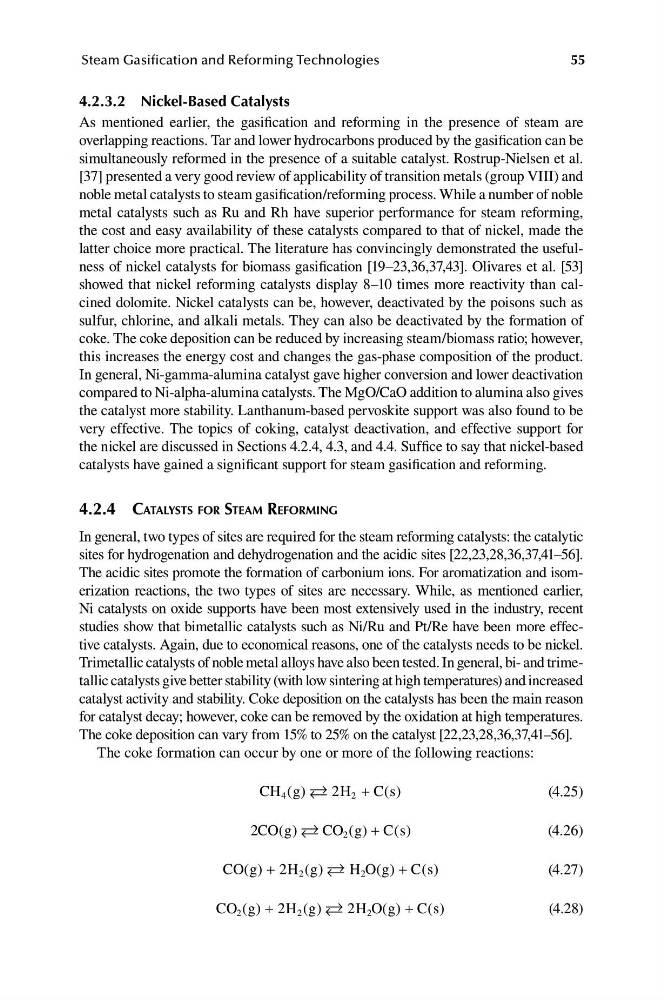
The coke formation can occur by one or more of the following reactions:
CH g 2H 2 + C s
4 ( )
( )
(4.25)
2CO g
( ) CO 2 g + ( )
(4.26)
( ) C s
CO g + 2H ( ) H O g + ( )
( )
2 g
2 ( ) C s
(4.27)
2
( )
(4.28)
CO 2 ( )
g + 2H 2 ( )
g 2H O g
( ) + C s