

53
Steam Gasification and Reforming Technologies
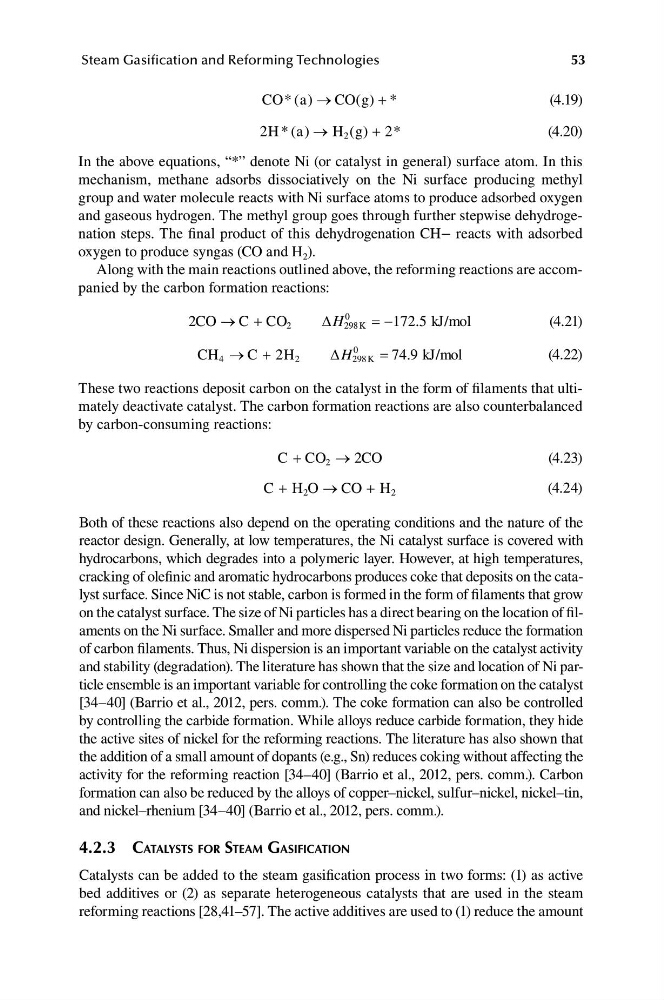
CO* (a) → CO(g) + *
(4.19)
2H * (a) → H 2 (g) + 2*
(4.20)
In the above equations, “*” denote Ni (or catalyst in general) surface atom. In this
mechanism, methane adsorbs dissociatively on the Ni surface producing methyl
group and water molecule reacts with Ni surface atoms to produce adsorbed oxygen
and gaseous hydrogen. The methyl group goes through further stepwise dehydrogenation steps. The final product of this dehydrogenation CH− reacts with adsorbed
oxygen to produce syngas (CO and H 2 ).
Along with the main reactions outlined above, the reforming reactions are accompanied by the carbon formation reactions:
2CO → C + CO
0
2
∆H 298 K = −172.5 kJ/mol
(4.21)
CH 4 → C + 2H 2
∆H
0
298 K = 74.9 kJ/mol
(4.22)
These two reactions deposit carbon on the catalyst in the form of filaments that ultimately deactivate catalyst. The carbon formation reactions are also counterbalanced
by carbon-consuming reactions:
C + CO 2 → 2CO
(4.23)
C + H 2 O → CO + H 2
(4.24)
Both of these reactions also depend on the operating conditions and the nature of the
reactor design. Generally, at low temperatures, the Ni catalyst surface is covered with
hydrocarbons, which degrades into a polymeric layer. However, at high temperatures,
cracking of olefinic and aromatic hydrocarbons produces coke that deposits on the catalyst surface. Since NiC is not stable, carbon is formed in the form of filaments that grow
on the catalyst surface. The size of Ni particles has a direct bearing on the location of filaments on the Ni surface. Smaller and more dispersed Ni particles reduce the formation
of carbon filaments. Thus, Ni dispersion is an important variable on the catalyst activity
and stability (degradation). The literature has shown that the size and location of Ni particle ensemble is an important variable for controlling the coke formation on the catalyst
[34–40] (Barrio et al., 2012, pers. comm.). The coke formation can also be controlled
by controlling the carbide formation. While alloys reduce carbide formation, they hide
the active sites of nickel for the reforming reactions. The literature has also shown that
the addition of a small amount of dopants (e.g., Sn) reduces coking without affecting the
activity for the reforming reaction [34–40] (Barrio et al., 2012, pers. comm.). Carbon
formation can also be reduced by the alloys of copper–nickel, sulfur–nickel, nickel–tin,
and nickel– rhenium [34–40] (Barrio et al., 2012, pers. comm.).
4.2.3 CATAlySTS For STeAm gASiFiCATion
Catalysts can be added to the steam gasification process in two forms: (1) as active
bed additives or (2) as separate heterogeneous catalysts that are used in the steam
reforming reactions [28,41–57]. The active additives are used to (1) reduce the amount
Steam Gasification and Reforming Technologies
CO* (a) → CO(g) + *
(4.19)
2H * (a) → H 2 (g) + 2*
(4.20)
In the above equations, “*” denote Ni (or catalyst in general) surface atom. In this
mechanism, methane adsorbs dissociatively on the Ni surface producing methyl
group and water molecule reacts with Ni surface atoms to produce adsorbed oxygen
and gaseous hydrogen. The methyl group goes through further stepwise dehydrogenation steps. The final product of this dehydrogenation CH− reacts with adsorbed
oxygen to produce syngas (CO and H 2 ).
Along with the main reactions outlined above, the reforming reactions are accompanied by the carbon formation reactions:
2CO → C + CO
0
2
∆H 298 K = −172.5 kJ/mol
(4.21)
CH 4 → C + 2H 2
∆H
0
298 K = 74.9 kJ/mol
(4.22)
These two reactions deposit carbon on the catalyst in the form of filaments that ultimately deactivate catalyst. The carbon formation reactions are also counterbalanced
by carbon-consuming reactions:
C + CO 2 → 2CO
(4.23)
C + H 2 O → CO + H 2
(4.24)
Both of these reactions also depend on the operating conditions and the nature of the
reactor design. Generally, at low temperatures, the Ni catalyst surface is covered with
hydrocarbons, which degrades into a polymeric layer. However, at high temperatures,
cracking of olefinic and aromatic hydrocarbons produces coke that deposits on the catalyst surface. Since NiC is not stable, carbon is formed in the form of filaments that grow
on the catalyst surface. The size of Ni particles has a direct bearing on the location of filaments on the Ni surface. Smaller and more dispersed Ni particles reduce the formation
of carbon filaments. Thus, Ni dispersion is an important variable on the catalyst activity
and stability (degradation). The literature has shown that the size and location of Ni particle ensemble is an important variable for controlling the coke formation on the catalyst
[34–40] (Barrio et al., 2012, pers. comm.). The coke formation can also be controlled
by controlling the carbide formation. While alloys reduce carbide formation, they hide
the active sites of nickel for the reforming reactions. The literature has also shown that
the addition of a small amount of dopants (e.g., Sn) reduces coking without affecting the
activity for the reforming reaction [34–40] (Barrio et al., 2012, pers. comm.). Carbon
formation can also be reduced by the alloys of copper–nickel, sulfur–nickel, nickel–tin,
and nickel– rhenium [34–40] (Barrio et al., 2012, pers. comm.).
4.2.3 CATAlySTS For STeAm gASiFiCATion
Catalysts can be added to the steam gasification process in two forms: (1) as active
bed additives or (2) as separate heterogeneous catalysts that are used in the steam
reforming reactions [28,41–57]. The active additives are used to (1) reduce the amount