

50
Water for Energy and Fuel Production
energy conversion process. The reforming process can also create pollutants such
as carbon dioxide, carbon monoxide, unburned original hydrocarbons, and nitrous
oxide that can be generated by oxidation with air.
While steam gasification and reforming has huge potential to generate hydrogen,
as discussed earlier, steam gasification of coal is more difficult than that of biomass.
Biomass has the potential to accelerate the realization of hydrogen as a major fuel of
the future. It is more acceptable than coal because it is renewable and consumes atmospheric carbon dioxide during its growth, thus having a small net CO 2 impact compared to fossil fuels. However, hydrogen produced from biomass has major challenges.
There are few commercial plants. While biomass is more reactive to steam compared
to coal, the yield of hydrogen is low from biomass since the hydrogen content of biomass is low to begin with (~6% vs. 25% for methane) and the energy content is low
due to 40% oxygen content of biomass. Since over half of the hydrogen from biomass
comes from splitting water in the steam reforming reaction, the energy content of
the feedstock is an inherent limitation of the process. Due to high oxygen content,
the yield of hydrogen per unit weight of biomass is low. The low yield of hydrogen
on a weight basis is, however, misleading since the energy conversion efficiency is
high. For example, the steam reforming of bio-oil at 825°C with a fivefold excess of
steam has an energy efficiency of 56% [24–26]. The cost of growing, harvesting, and
transporting biomass is, however, high. Thus, even with reasonable energy efficiencies, it is not currently economically competitive with natural gas steam reforming
for stand-alone hydrogen without the advantage of high-value coproducts. One way to
make steam reforming of biomass more competitive is to use coal–biomass mixture
as the feedstock [5,27–33]. This mixture will increase the hydrogen production rate,
maintain the overall reactivity between steam and feedstock, and also reduce the
emission of carbon dioxide. A 70/30 mixture of coal and biomass is CO 2 neutral for
environmental purposes [2].
4.2 meChanisms, KinetiCs, and Catalysis
OF steam GasiFiCatiOn and reFOrminG
4.2.1 meChAniSm oF STeAm gASiFiCATion
Steam gasification is an endothermic reaction and requires heat to move the reaction
in the forward direction. Generally, excess steam is also required to promote the
gasification reaction. However, excess steam affects the thermal efficiency of the
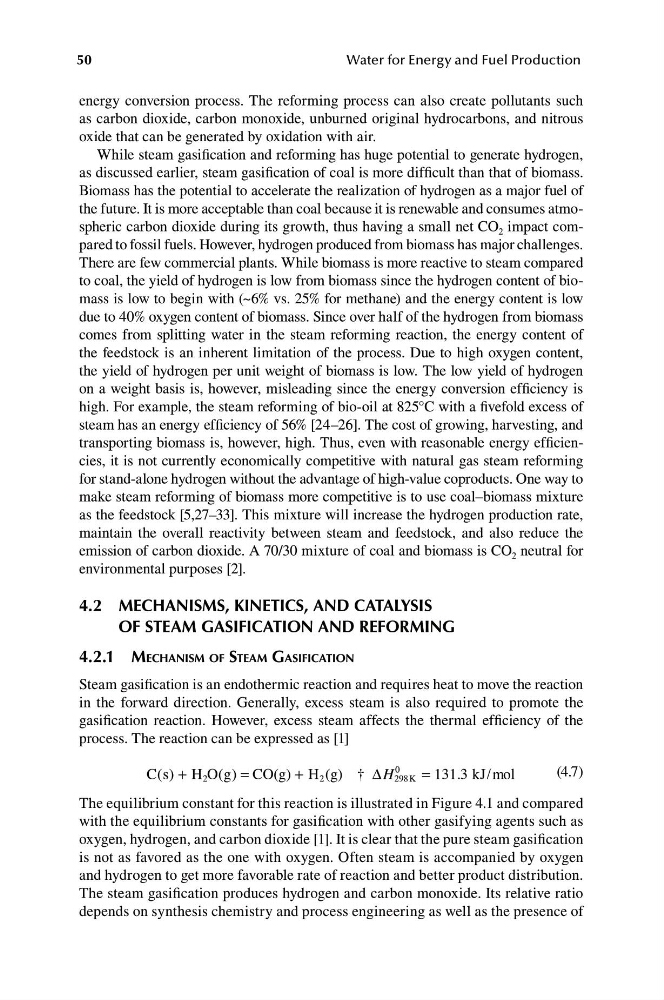
process. The reaction can be expressed as [1]
(4.7)
The equilibrium constant for this reaction is illustrated in Figure 4.1 and compared
with the equilibrium constants for gasification with other gasifying agents such as
oxygen, hydrogen, and carbon dioxide [1]. It is clear that the pure steam gasification
is not as favored as the one with oxygen. Often steam is accompanied by oxygen
and hydrogen to get more favorable rate of reaction and better product distribution.
The steam gasification produces hydrogen and carbon monoxide. Its relative ratio
depends on synthesis chemistry and process engineering as well as the presence of
C s
H O g CO(g) H (g) †
kJ mol
2
2
K
( )
( )
.
/
+
=
+
=
∆H 298
0
131 3