

−30
0
0.0005
0.0010
0.0020
0.0030
C + O 2 ⇄ CO 2
C + 2H 2 ⇄ CH 4
C + CO 2 ⇄ 2CO
CO + H 2 O ⇄ CO 2 + H 2
C + ½O 2 ⇄ CO
0.0025
0.0035
−20
−10
0
10
20
30
40
50
60
70
80
log
10
K
p
C + H 2 O ⇄ CO + H 2
0.0015
1/T (K −1 )
48
Water for Energy and Fuel Production
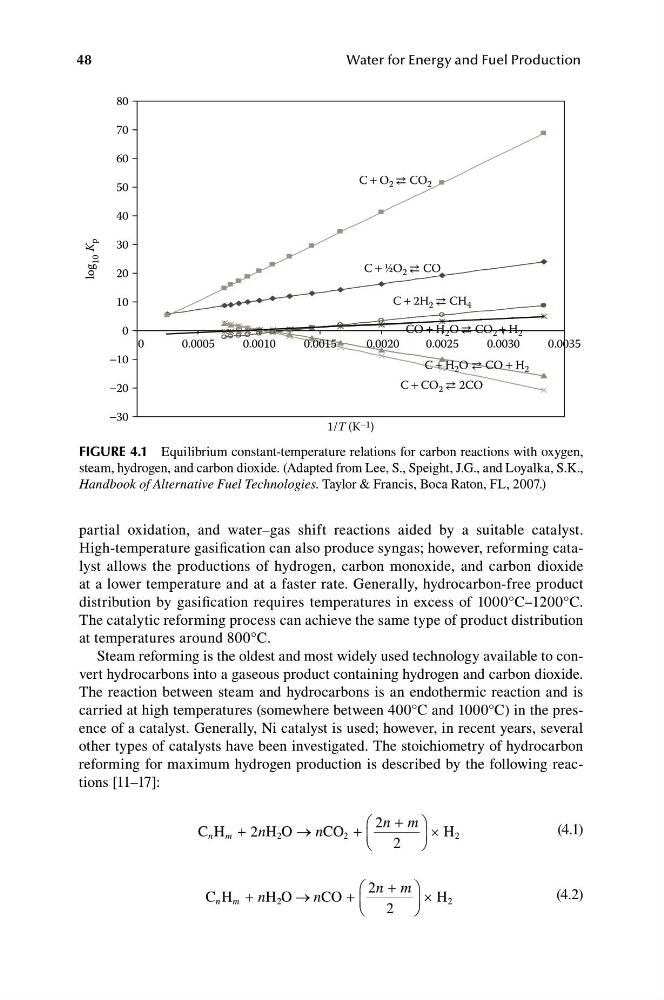
FiGUre 4.1 Equilibrium constant-temperature relations for carbon reactions with oxygen,
steam, hydrogen, and carbon dioxide. (Adapted from Lee, S., Speight, J.G., and Loyalka, S.K.,
Handbook of Alternative Fuel Technologies. Taylor & Francis, Boca Raton, FL, 2007.)
partial oxidation, and water–gas shift reactions aided by a suitable catalyst.
High-temperature gasification can also produce syngas; however, reforming catalyst allows the productions of hydrogen, carbon monoxide, and carbon dioxide
at a lower temperature and at a faster rate. Generally, hydrocarbon-free product
distribution by gasification requires temperatures in excess of 1000°C–1200°C.
The catalytic reforming process can achieve the same type of product distribution
at temperatures around 800°C.
Steam reforming is the oldest and most widely used technology available to convert hydrocarbons into a gaseous product containing hydrogen and carbon dioxide.
The reaction between steam and hydrocarbons is an endothermic reaction and is
carried at high temperatures (somewhere between 400°C and 1000°C) in the presence of a catalyst. Generally, Ni catalyst is used; however, in recent years, several
other types of catalysts have been investigated. The stoichiometry of hydrocarbon
reforming for maximum hydrogen production is described by the following reactions [11–17]:
(4.1)
(4.2)
C H
H O
CO
H
2
2
n m
n
n
n m
+
→
+
+
×
2
2
2
2
C H
H O
CO
H
2
n m
n
n
n m
+
→
+
+
×
2
2
2
0
0.0005
0.0010
0.0020
0.0030
C + O 2 ⇄ CO 2
C + 2H 2 ⇄ CH 4
C + CO 2 ⇄ 2CO
CO + H 2 O ⇄ CO 2 + H 2
C + ½O 2 ⇄ CO
0.0025
0.0035
−20
−10
0
10
20
30
40
50
60
70
80
log
10
K
p
C + H 2 O ⇄ CO + H 2
0.0015
1/T (K −1 )
48
Water for Energy and Fuel Production
FiGUre 4.1 Equilibrium constant-temperature relations for carbon reactions with oxygen,
steam, hydrogen, and carbon dioxide. (Adapted from Lee, S., Speight, J.G., and Loyalka, S.K.,
Handbook of Alternative Fuel Technologies. Taylor & Francis, Boca Raton, FL, 2007.)
partial oxidation, and water–gas shift reactions aided by a suitable catalyst.
High-temperature gasification can also produce syngas; however, reforming catalyst allows the productions of hydrogen, carbon monoxide, and carbon dioxide
at a lower temperature and at a faster rate. Generally, hydrocarbon-free product
distribution by gasification requires temperatures in excess of 1000°C–1200°C.
The catalytic reforming process can achieve the same type of product distribution
at temperatures around 800°C.
Steam reforming is the oldest and most widely used technology available to convert hydrocarbons into a gaseous product containing hydrogen and carbon dioxide.
The reaction between steam and hydrocarbons is an endothermic reaction and is
carried at high temperatures (somewhere between 400°C and 1000°C) in the presence of a catalyst. Generally, Ni catalyst is used; however, in recent years, several
other types of catalysts have been investigated. The stoichiometry of hydrocarbon
reforming for maximum hydrogen production is described by the following reactions [11–17]:
(4.1)
(4.2)
C H
H O
CO
H
2
2
n m
n
n
n m
+
→
+
+
×
2
2
2
2
C H
H O
CO
H
2
n m
n
n
n m
+
→
+
+
×
2
2
2