

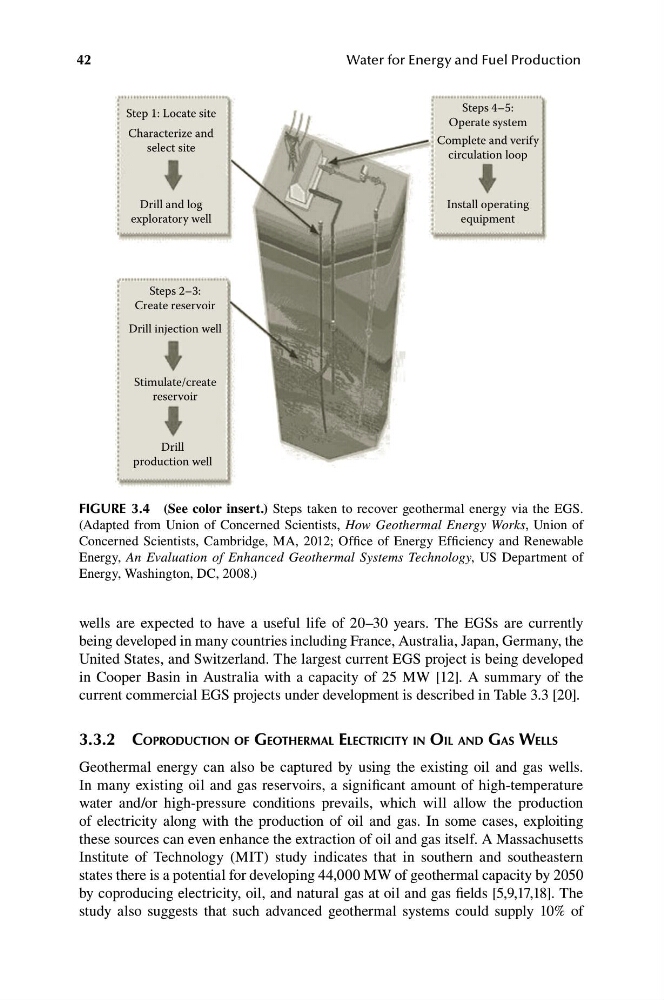
Steps 4–5:
Step 1: Locate site
Operate system
Characterize and
Complete and verify
select site
circulation loop
Drill and log
Install operating
exploratory well
equipment
Steps 2–3:
Create reservoir
Drill injection well
Stimulate/create
reservoir
Drill
production well
FiGUre 3.4 (See color insert.) Steps taken to recover geothermal energy via the EGS.
(Adapted from Union of Concerned Scientists, How Geothermal Energy Works, Union of
Concerned Scientists, Cambridge, MA, 2012; Office of Energy Efficiency and Renewable
Energy, An Evaluation of Enhanced Geothermal Systems Technology, US Department of
Energy, Washington, DC, 2008.)
42
Water for Energy and Fuel Production
wells are expected to have a useful life of 20–30 years. The EGSs are currently
being developed in many countries including France, Australia, Japan, Germany, the
United States, and Switzerland. The largest current EGS project is being developed
in Cooper Basin in Australia with a capacity of 25 MW [12]. A summary of the
current commercial EGS projects under development is described in Table 3.3 [20].
3.3.2 CoProduCTion oF geoThermAl eleCTriCiTy in oil And gAS WellS
Geothermal energy can also be captured by using the existing oil and gas wells.
In many existing oil and gas reservoirs, a significant amount of high-temperature
water and/or high-pressure conditions prevails, which will allow the production
of electricity along with the production of oil and gas. In some cases, exploiting
these sources can even enhance the extraction of oil and gas itself. A Massachusetts
Institute of Technology (MIT) study indicates that in southern and southeastern
states there is a potential for developing 44,000 MW of geothermal capacity by 2050
by coproducing electricity, oil, and natural gas at oil and gas fields [5,9,17,18]. The
study also suggests that such advanced geothermal systems could supply 10% of
Step 1: Locate site
Operate system
Characterize and
Complete and verify
select site
circulation loop
Drill and log
Install operating
exploratory well
equipment
Steps 2–3:
Create reservoir
Drill injection well
Stimulate/create
reservoir
Drill
production well
FiGUre 3.4 (See color insert.) Steps taken to recover geothermal energy via the EGS.
(Adapted from Union of Concerned Scientists, How Geothermal Energy Works, Union of
Concerned Scientists, Cambridge, MA, 2012; Office of Energy Efficiency and Renewable
Energy, An Evaluation of Enhanced Geothermal Systems Technology, US Department of
Energy, Washington, DC, 2008.)
42
Water for Energy and Fuel Production
wells are expected to have a useful life of 20–30 years. The EGSs are currently
being developed in many countries including France, Australia, Japan, Germany, the
United States, and Switzerland. The largest current EGS project is being developed
in Cooper Basin in Australia with a capacity of 25 MW [12]. A summary of the
current commercial EGS projects under development is described in Table 3.3 [20].
3.3.2 CoProduCTion oF geoThermAl eleCTriCiTy in oil And gAS WellS
Geothermal energy can also be captured by using the existing oil and gas wells.
In many existing oil and gas reservoirs, a significant amount of high-temperature
water and/or high-pressure conditions prevails, which will allow the production
of electricity along with the production of oil and gas. In some cases, exploiting
these sources can even enhance the extraction of oil and gas itself. A Massachusetts
Institute of Technology (MIT) study indicates that in southern and southeastern
states there is a potential for developing 44,000 MW of geothermal capacity by 2050
by coproducing electricity, oil, and natural gas at oil and gas fields [5,9,17,18]. The
study also suggests that such advanced geothermal systems could supply 10% of