

35
Energy Recovery by Benign Hydrothermal Processes
Steam
separator
Steam
Water
Pump
Control rods
Pump
Fuel elements
Concrete shield
Turbine
Steel
pressure
vessel
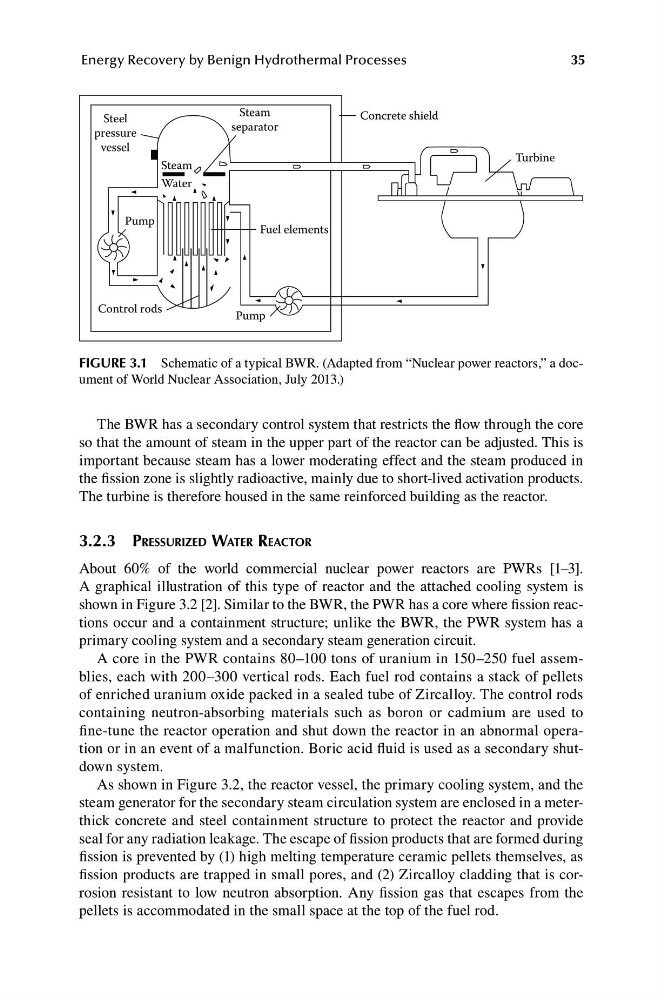
FiGUre 3.1 Schematic of a typical BWR. (Adapted from “Nuclear power reactors,” a document of World Nuclear Association, July 2013.)
The BWR has a secondary control system that restricts the flow through the core
so that the amount of steam in the upper part of the reactor can be adjusted. This is
important because steam has a lower moderating effect and the steam produced in
the fission zone is slightly radioactive, mainly due to short-lived activation products.
The turbine is therefore housed in the same reinforced building as the reactor.
3.2.3 PreSSurized WATer reACTor
About 60% of the world commercial nuclear power reactors are PWRs [1–3].
A graphical illustration of this type of reactor and the attached cooling system is
shown in Figure 3.2 [2]. Similar to the BWR, the PWR has a core where fission reactions occur and a containment structure; unlike the BWR, the PWR system has a
primary cooling system and a secondary steam generation circuit.
A core in the PWR contains 80–100 tons of uranium in 150–250 fuel assemblies, each with 200–300 vertical rods. Each fuel rod contains a stack of pellets
of enriched uranium oxide packed in a sealed tube of Zircalloy. The control rods
containing neutron-absorbing materials such as boron or cadmium are used to
fine-tune the reactor operation and shut down the reactor in an abnormal operation or in an event of a malfunction. Boric acid fluid is used as a secondary shutdown system.
As shown in Figure 3.2, the reactor vessel, the primary cooling system, and the
steam generator for the secondary steam circulation system are enclosed in a meterthick concrete and steel containment structure to protect the reactor and provide
seal for any radiation leakage. The escape of fission products that are formed during
fission is prevented by (1) high melting temperature ceramic pellets themselves, as
fission products are trapped in small pores, and (2) Zircalloy cladding that is corrosion resistant to low neutron absorption. Any fission gas that escapes from the
pellets is accommodated in the small space at the top of the fuel rod.