

16,000
14,000
12,000
Wave
10,000
Tidal barrage
Tidal
8,000
River hydrokinetic
OTEC
6,000
Ocean current
4,000
2,000
0
Capacity (MW)
2009
2010
2011
2012
2013
2014
2015
390
Water for Energy and Fuel Production
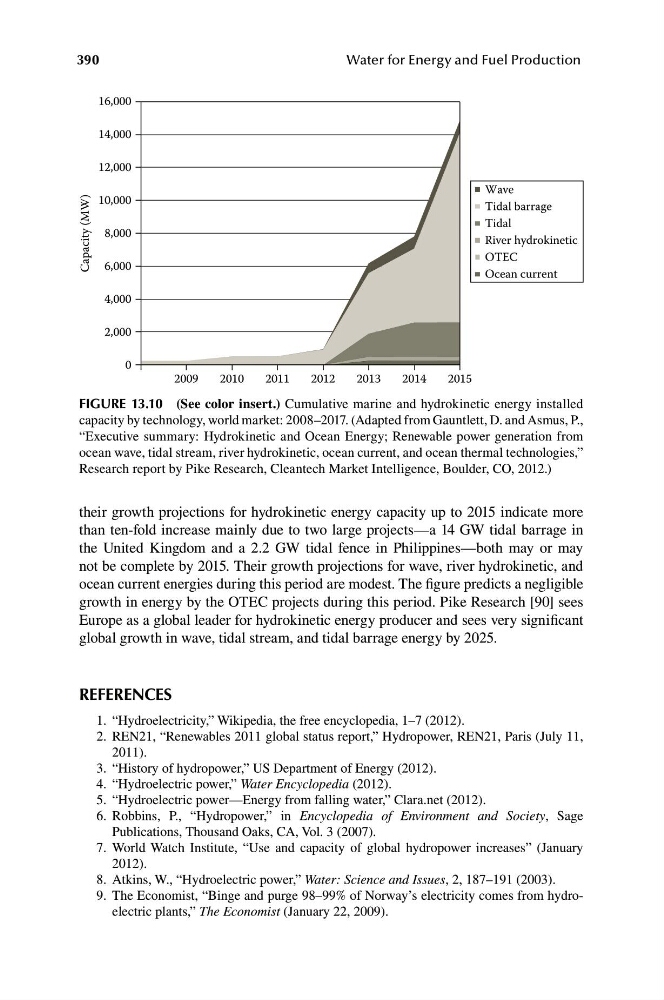
FiGUre 13.10 (See color insert.) Cumulative marine and hydrokinetic energy installed
capacity by technology, world market: 2008–2017. (Adapted from Gauntlett, D. and Asmus, P.,
“Executive summary: Hydrokinetic and Ocean Energy; Renewable power generation from
ocean wave, tidal stream, river hydrokinetic, ocean current, and ocean thermal technologies,”
Research report by Pike Research, Cleantech Market Intelligence, Boulder, CO, 2012.)
their growth projections for hydrokinetic energy capacity up to 2015 indicate more
than ten-fold increase mainly due to two large projects—a 14 GW tidal barrage in
the United Kingdom and a 2.2 GW tidal fence in Philippines—both may or may
not be complete by 2015. Their growth projections for wave, river hydrokinetic, and
ocean current energies during this period are modest. The figure predicts a negligible
growth in energy by the OTEC projects during this period. Pike Research [90] sees
Europe as a global leader for hydrokinetic energy producer and sees very significant
global growth in wave, tidal stream, and tidal barrage energy by 2025.
reFerenCes
1. “Hydroelectricity,” Wikipedia, the free encyclopedia, 1–7 (2012).
2. REN21, “Renewables 2011 global status report,” Hydropower, REN21, Paris (July 11,
2011).
3. “History of hydropower,” US Department of Energy (2012).
4. “Hydroelectric power,” Water Encyclopedia (2012).
5. “Hydroelectric power—Energy from falling water,” Clara.net (2012).
6. Robbins, P., “Hydropower,” in Encyclopedia of Environment and Society, Sage
Publications, Thousand Oaks, CA, Vol. 3 (2007).
7. World Watch Institute, “Use and capacity of global hydropower increases” (January
2012).
8. Atkins, W., “Hydroelectric power,” Water: Science and Issues, 2, 187–191 (2003).
9. The Economist, “Binge and purge 98–99% of Norway’s electricity comes from hydroelectric plants,” The Economist (January 22, 2009).