

388
Water for Energy and Fuel Production
Sun
Warm water
Desalinated water
Electricity
Drinking
Irrigation
Mariculture
Cold-water discharge
Kelp
Phytoplankton
Zooplankton
Cold-water
refrigeration
Air-conditioning
Building
airconditioning
Nori
Abalone
Clams
Oysters
Lobsters
Shrimp
Salmon
Steelhead
trout
OTEC
Cold water
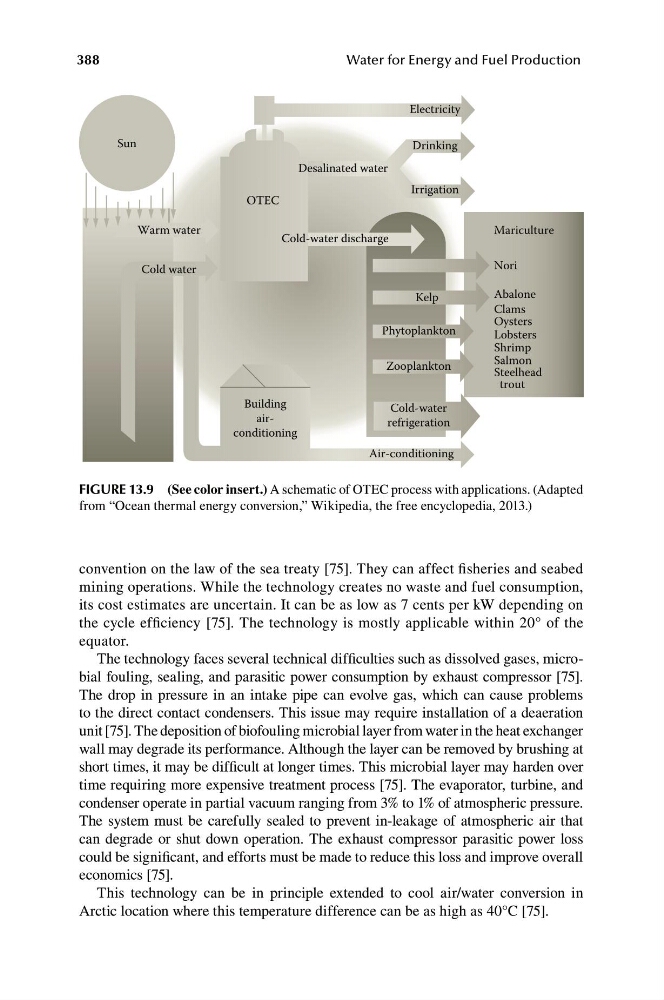
FiGUre 13.9 (See color insert.) A schematic of OTEC process with applications. (Adapted
from “Ocean thermal energy conversion,” Wikipedia, the free encyclopedia, 2013.)
convention on the law of the sea treaty [75]. They can affect fisheries and seabed
mining operations. While the technology creates no waste and fuel consumption,
its cost estimates are uncertain. It can be as low as 7 cents per kW depending on
the cycle efficiency [75]. The technology is mostly applicable within 20° of the
equator.
The technology faces several technical difficulties such as dissolved gases, microbial fouling, sealing, and parasitic power consumption by exhaust compressor [75].
The drop in pressure in an intake pipe can evolve gas, which can cause problems
to the direct contact condensers. This issue may require installation of a deaeration
unit [75]. The deposition of biofouling microbial layer from water in the heat exchanger
wall may degrade its performance. Although the layer can be removed by brushing at
short times, it may be difficult at longer times. This microbial layer may harden over
time requiring more expensive treatment process [75]. The evaporator, turbine, and
condenser operate in partial vacuum ranging from 3% to 1% of atmospheric pressure.
The system must be carefully sealed to prevent in-leakage of atmospheric air that
can degrade or shut down operation. The exhaust compressor parasitic power loss
could be significant, and efforts must be made to reduce this loss and improve overall
economics [75].
This technology can be in principle extended to cool air/water conversion in
Arctic location where this temperature difference can be as high as 40°C [75].