

374
Water for Energy and Fuel Production
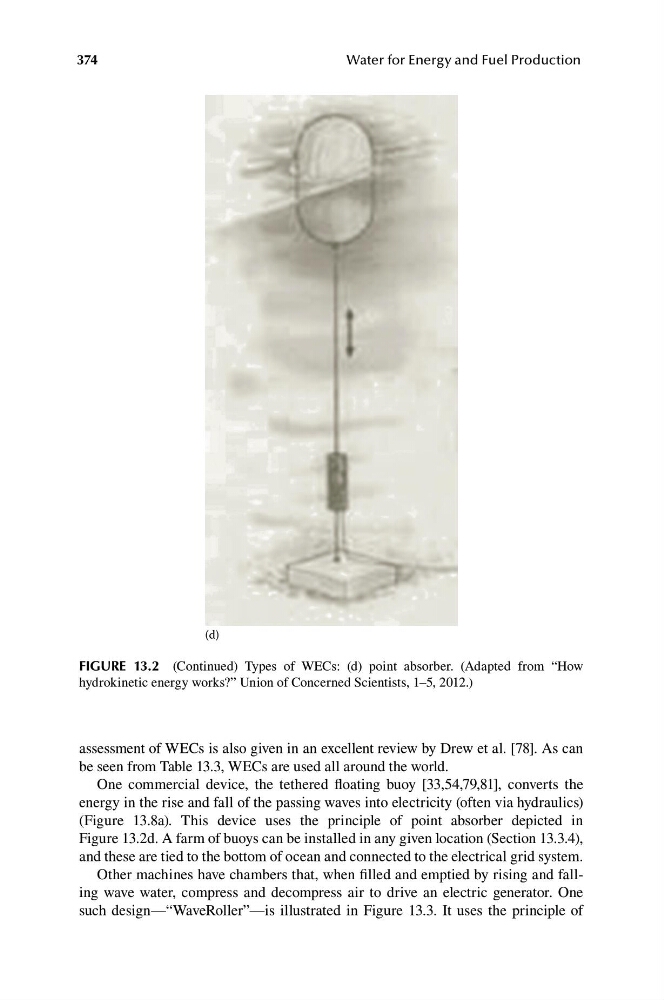
(d)
FiGUre 13.2 (Continued) Types of WECs: (d) point absorber. (Adapted from “How
hydrokinetic energy works?” Union of Concerned Scientists, 1–5, 2012.)
assessment of WECs is also given in an excellent review by Drew et al. [78]. As can
be seen from Table 13.3, WECs are used all around the world.
One commercial device, the tethered floating buoy [33,54,79,81], converts the
energy in the rise and fall of the passing waves into electricity (often via hydraulics)
(Figure 13.8a). This device uses the principle of point absorber depicted in
Figure 13.2d. A farm of buoys can be installed in any given location (Section 13.3.4),
and these are tied to the bottom of ocean and connected to the electrical grid system.
Other machines have chambers that, when filled and emptied by rising and falling wave water, compress and decompress air to drive an electric generator. One
such design—“WaveRoller”—is illustrated in Figure 13.3. It uses the principle of