

321
Water Dissociation Technologies for Hydrogen
by introducing anharmonic oscillations in the molecule. A novel method could be the
excitation of water molecules adsorbed on fiber optics that could be made conductive
to allow part of the light wave being transmitted to interact with the adsorbed water.
11.5.5 CATAlyTiC deComPoSiTion oF WATer
Another approach to the thermolysis of water is to pass water through a “getter”
that will remove oxygen [11]. The getter then needs to be regenerated after obtaining hydrogen. Kasal and Bishop [150,151] used zeolites for this purpose. They [40]
also described a simple two-step cycle to decompose water by cycling water over
chromium- and indium-substituted alumno silicates. For a two-step thermochemical process consisting of an endothermic step operating at lower temperature T L and
the second step operating at higher temperature T H , the transition between these two
steps will be accompanied by a large entropy change. A large entropy change can
also be realized by resorting to a cycle consisting of many reaction steps or a single
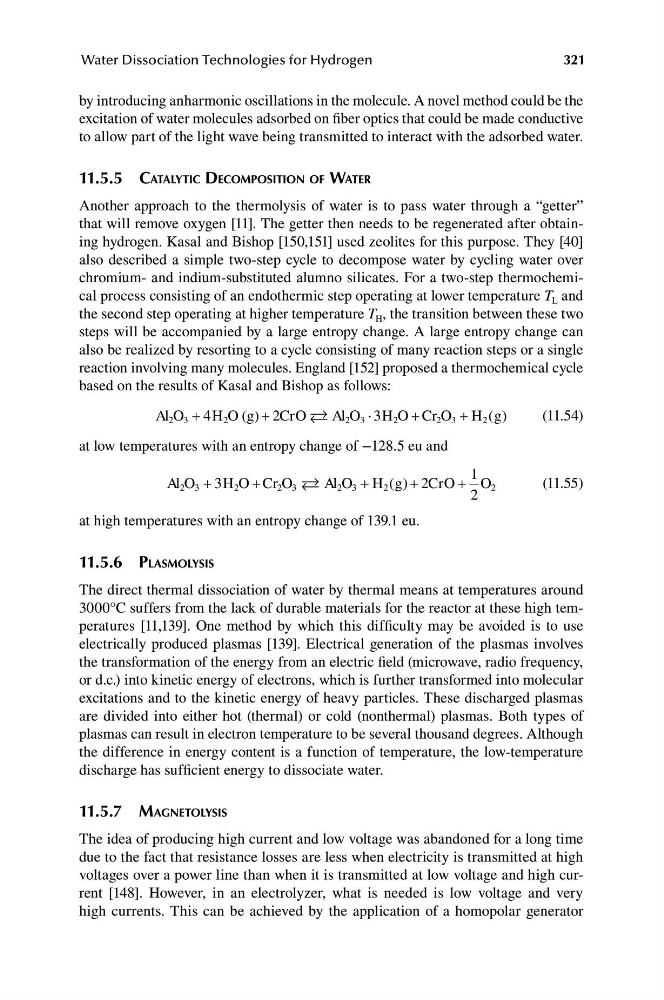
reaction involving many molecules. England [152] proposed a thermochemical cycle
based on the results of Kasal and Bishop as follows:
Al O + 4H O (g) + 2
Al O ⋅ 3H O + Cr O + H g
2 3
2
CrO
2 3
2
2 3
2 ( )
(11.54)
at low temperatures with an entropy change of −128.5 eu and
1
Al O + 3H O + Cr O Al O + H g + 2
+ O
(11.55)
2 3
2
2 3
2 3
2 ( ) CrO
2
2
at high temperatures with an entropy change of 139.1 eu.
11.5.6 PlASmolySiS
The direct thermal dissociation of water by thermal means at temperatures around
3000°C suffers from the lack of durable materials for the reactor at these high temperatures [11,139]. One method by which this difficulty may be avoided is to use
electrically produced plasmas [139]. Electrical generation of the plasmas involves
the transformation of the energy from an electric field (microwave, radio frequency,
or d.c.) into kinetic energy of electrons, which is further transformed into molecular
excitations and to the kinetic energy of heavy particles. These discharged plasmas
are divided into either hot (thermal) or cold (nonthermal) plasmas. Both types of
plasmas can result in electron temperature to be several thousand degrees. Although
the difference in energy content is a function of temperature, the low-temperature
discharge has sufficient energy to dissociate water.
11.5.7 mAgneTolySiS
The idea of producing high current and low voltage was abandoned for a long time
due to the fact that resistance losses are less when electricity is transmitted at high
voltages over a power line than when it is transmitted at low voltage and high current [148]. However, in an electrolyzer, what is needed is low voltage and very
high currents. This can be achieved by the application of a homopolar generator
Water Dissociation Technologies for Hydrogen
by introducing anharmonic oscillations in the molecule. A novel method could be the
excitation of water molecules adsorbed on fiber optics that could be made conductive
to allow part of the light wave being transmitted to interact with the adsorbed water.
11.5.5 CATAlyTiC deComPoSiTion oF WATer
Another approach to the thermolysis of water is to pass water through a “getter”
that will remove oxygen [11]. The getter then needs to be regenerated after obtaining hydrogen. Kasal and Bishop [150,151] used zeolites for this purpose. They [40]
also described a simple two-step cycle to decompose water by cycling water over
chromium- and indium-substituted alumno silicates. For a two-step thermochemical process consisting of an endothermic step operating at lower temperature T L and
the second step operating at higher temperature T H , the transition between these two
steps will be accompanied by a large entropy change. A large entropy change can
also be realized by resorting to a cycle consisting of many reaction steps or a single
reaction involving many molecules. England [152] proposed a thermochemical cycle
based on the results of Kasal and Bishop as follows:
Al O + 4H O (g) + 2
Al O ⋅ 3H O + Cr O + H g
2 3
2
CrO
2 3
2
2 3
2 ( )
(11.54)
at low temperatures with an entropy change of −128.5 eu and
1
Al O + 3H O + Cr O Al O + H g + 2
+ O
(11.55)
2 3
2
2 3
2 3
2 ( ) CrO
2
2
at high temperatures with an entropy change of 139.1 eu.
11.5.6 PlASmolySiS
The direct thermal dissociation of water by thermal means at temperatures around
3000°C suffers from the lack of durable materials for the reactor at these high temperatures [11,139]. One method by which this difficulty may be avoided is to use
electrically produced plasmas [139]. Electrical generation of the plasmas involves
the transformation of the energy from an electric field (microwave, radio frequency,
or d.c.) into kinetic energy of electrons, which is further transformed into molecular
excitations and to the kinetic energy of heavy particles. These discharged plasmas
are divided into either hot (thermal) or cold (nonthermal) plasmas. Both types of
plasmas can result in electron temperature to be several thousand degrees. Although
the difference in energy content is a function of temperature, the low-temperature
discharge has sufficient energy to dissociate water.
11.5.7 mAgneTolySiS
The idea of producing high current and low voltage was abandoned for a long time
due to the fact that resistance losses are less when electricity is transmitted at high
voltages over a power line than when it is transmitted at low voltage and high current [148]. However, in an electrolyzer, what is needed is low voltage and very
high currents. This can be achieved by the application of a homopolar generator