

Water Dissociation Technologies for Hydrogen
319
S–I cycle was overall the best to interlink with the helium-cooled nuclear reactor.
The use of solar and nuclear energy for direct thermolysis or thermochemical breakdown of water has also been extensively examined in the literature [135–138,140].
11.5 Other misCellaneOUs teChnOlOGies
Bockris et al. [11] described several novel methods for hydrogen production. Some
of the methods described closely follow their description in Sections 11.5.2, 11.5.3,
11.5.6, and 11.5.7.
11.5.1 ChemiCAl meThodS
A number of materials react with liquid water or water containing acids to release
hydrogen [11,139,141–148]. While these methods somewhat resemble steam reforming, they differ in that reactant is liquid water instead of gaseous water and the solids
involved are not naturally occurring such as coal and shale oil but those that require
a significant energy and efforts recovering such as zinc, aluminum, and iron.
In laboratory, zinc reacts with strong acids in Kipp’s apparatus. In the presence
of sodium hydroxide, aluminum and its alloys react with water to generate hydrogen
[11,107]. This is, however, an expensive process due to the high cost of aluminum,
and the process also results in a large amount of waste heat that must be disposed or
recovered. In relative terms, aluminum is cheaper and safer than some other materials, and the produced hydrogen can be easily stored and transported than using other
hydrogen storage materials such as sodium borohydride.
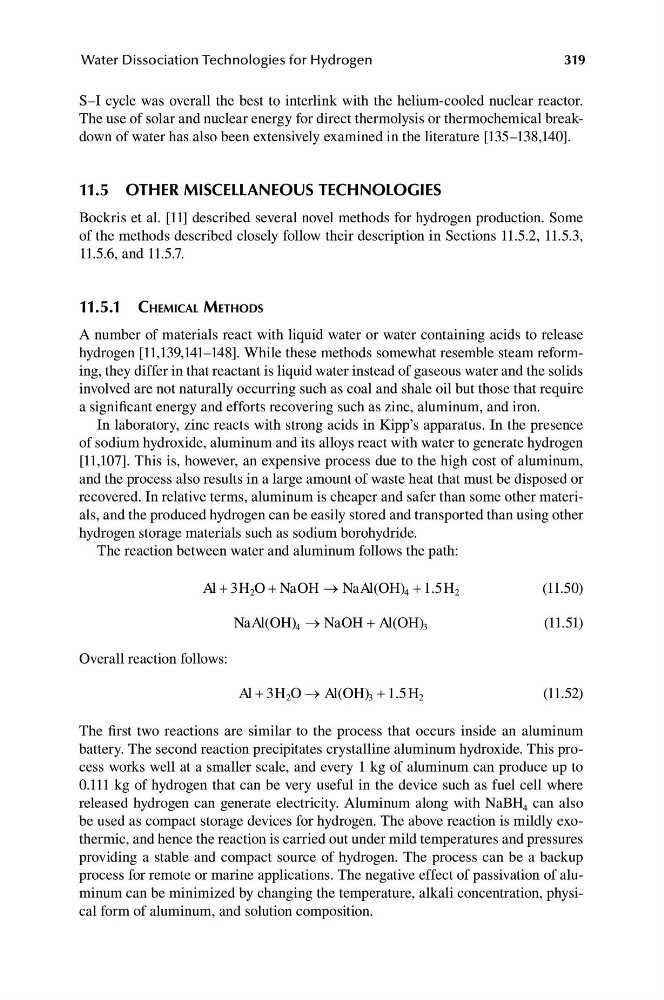
The reaction between water and aluminum follows the path:
2
4 + 1 5 H 2
Al + 3H O + NaOH → NaAl(OH)
.
(11.50)
NaAl(OH) 4 → NaOH + Al(OH) 3
(11.51)
Overall reaction follows:
Al + 3H O → Al(OH) + 1 5 H
2
3
. 2
(11.52)
The first two reactions are similar to the process that occurs inside an aluminum
battery. The second reaction precipitates crystalline aluminum hydroxide. This process works well at a smaller scale, and every 1 kg of aluminum can produce up to
0.111 kg of hydrogen that can be very useful in the device such as fuel cell where
released hydrogen can generate electricity. Aluminum along with NaBH 4 can also
be used as compact storage devices for hydrogen. The above reaction is mildly exothermic, and hence the reaction is carried out under mild temperatures and pressures
providing a stable and compact source of hydrogen. The process can be a backup
process for remote or marine applications. The negative effect of passivation of aluminum can be minimized by changing the temperature, alkali concentration, physical form of aluminum, and solution composition.
319
S–I cycle was overall the best to interlink with the helium-cooled nuclear reactor.
The use of solar and nuclear energy for direct thermolysis or thermochemical breakdown of water has also been extensively examined in the literature [135–138,140].
11.5 Other misCellaneOUs teChnOlOGies
Bockris et al. [11] described several novel methods for hydrogen production. Some
of the methods described closely follow their description in Sections 11.5.2, 11.5.3,
11.5.6, and 11.5.7.
11.5.1 ChemiCAl meThodS
A number of materials react with liquid water or water containing acids to release
hydrogen [11,139,141–148]. While these methods somewhat resemble steam reforming, they differ in that reactant is liquid water instead of gaseous water and the solids
involved are not naturally occurring such as coal and shale oil but those that require
a significant energy and efforts recovering such as zinc, aluminum, and iron.
In laboratory, zinc reacts with strong acids in Kipp’s apparatus. In the presence
of sodium hydroxide, aluminum and its alloys react with water to generate hydrogen
[11,107]. This is, however, an expensive process due to the high cost of aluminum,
and the process also results in a large amount of waste heat that must be disposed or
recovered. In relative terms, aluminum is cheaper and safer than some other materials, and the produced hydrogen can be easily stored and transported than using other
hydrogen storage materials such as sodium borohydride.
The reaction between water and aluminum follows the path:
2
4 + 1 5 H 2
Al + 3H O + NaOH → NaAl(OH)
.
(11.50)
NaAl(OH) 4 → NaOH + Al(OH) 3
(11.51)
Overall reaction follows:
Al + 3H O → Al(OH) + 1 5 H
2
3
. 2
(11.52)
The first two reactions are similar to the process that occurs inside an aluminum
battery. The second reaction precipitates crystalline aluminum hydroxide. This process works well at a smaller scale, and every 1 kg of aluminum can produce up to
0.111 kg of hydrogen that can be very useful in the device such as fuel cell where
released hydrogen can generate electricity. Aluminum along with NaBH 4 can also
be used as compact storage devices for hydrogen. The above reaction is mildly exothermic, and hence the reaction is carried out under mild temperatures and pressures
providing a stable and compact source of hydrogen. The process can be a backup
process for remote or marine applications. The negative effect of passivation of aluminum can be minimized by changing the temperature, alkali concentration, physical form of aluminum, and solution composition.