

Corn
CO 2
Inspection
and cleaning
Dextrose
Fermentation
SO 2
Steeping
Starch
conversion
Ethanol
separation
Animal feed
Cob, dust, and
byproducts
Hydrocyloning
chaff (rejects)
Cyclone separation
Water
Product
ethanol
240
Water for Energy and Fuel Production
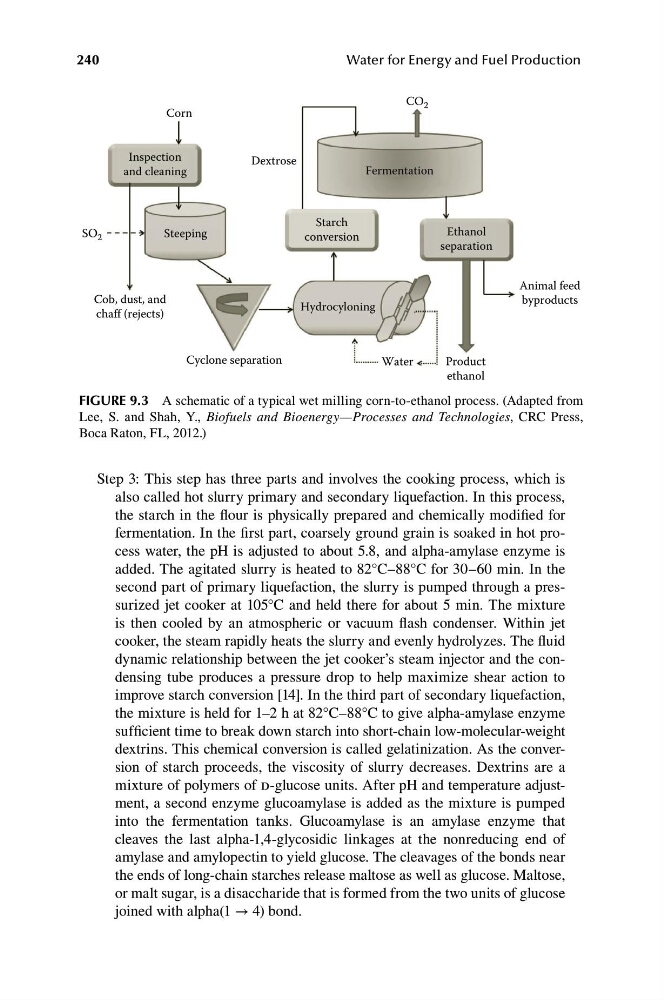
FiGUre 9.3 A schematic of a typical wet milling corn-to-ethanol process. (Adapted from
Lee, S. and Shah, Y., Biofuels and Bioenergy—Processes and Technologies, CRC Press,
Boca Raton, FL, 2012.)
Step 3: This step has three parts and involves the cooking process, which is
also called hot slurry primary and secondary liquefaction. In this process,
the starch in the flour is physically prepared and chemically modified for
fermentation. In the first part, coarsely ground grain is soaked in hot process water, the pH is adjusted to about 5.8, and alpha-amylase enzyme is
added. The agitated slurry is heated to 82°C–88°C for 30–60 min. In the
second part of primary liquefaction, the slurry is pumped through a pressurized jet cooker at 105°C and held there for about 5 min. The mixture
is then cooled by an atmospheric or vacuum flash condenser. Within jet
cooker, the steam rapidly heats the slurry and evenly hydrolyzes. The fluid
dynamic relationship between the jet cooker’s steam injector and the condensing tube produces a pressure drop to help maximize shear action to
improve starch conversion [14]. In the third part of secondary liquefaction,
the mixture is held for 1–2 h at 82°C–88°C to give alpha-amylase enzyme
sufficient time to break down starch into short-chain low-molecular-weight
dextrins. This chemical conversion is called gelatinization. As the conversion of starch proceeds, the viscosity of slurry decreases. Dextrins are a
mixture of polymers of d-glucose units. After pH and temperature adjustment, a second enzyme glucoamylase is added as the mixture is pumped
into the fermentation tanks. Glucoamylase is an amylase enzyme that
cleaves the last alpha-1,4-glycosidic linkages at the nonreducing end of
amylase and amylopectin to yield glucose. The cleavages of the bonds near
the ends of long-chain starches release maltose as well as glucose. Maltose,
or malt sugar, is a disaccharide that is formed from the two units of glucose
joined with alpha(1 → 4) bond.
CO 2
Inspection
and cleaning
Dextrose
Fermentation
SO 2
Steeping
Starch
conversion
Ethanol
separation
Animal feed
Cob, dust, and
byproducts
Hydrocyloning
chaff (rejects)
Cyclone separation
Water
Product
ethanol
240
Water for Energy and Fuel Production
FiGUre 9.3 A schematic of a typical wet milling corn-to-ethanol process. (Adapted from
Lee, S. and Shah, Y., Biofuels and Bioenergy—Processes and Technologies, CRC Press,
Boca Raton, FL, 2012.)
Step 3: This step has three parts and involves the cooking process, which is
also called hot slurry primary and secondary liquefaction. In this process,
the starch in the flour is physically prepared and chemically modified for
fermentation. In the first part, coarsely ground grain is soaked in hot process water, the pH is adjusted to about 5.8, and alpha-amylase enzyme is
added. The agitated slurry is heated to 82°C–88°C for 30–60 min. In the
second part of primary liquefaction, the slurry is pumped through a pressurized jet cooker at 105°C and held there for about 5 min. The mixture
is then cooled by an atmospheric or vacuum flash condenser. Within jet
cooker, the steam rapidly heats the slurry and evenly hydrolyzes. The fluid
dynamic relationship between the jet cooker’s steam injector and the condensing tube produces a pressure drop to help maximize shear action to
improve starch conversion [14]. In the third part of secondary liquefaction,
the mixture is held for 1–2 h at 82°C–88°C to give alpha-amylase enzyme
sufficient time to break down starch into short-chain low-molecular-weight
dextrins. This chemical conversion is called gelatinization. As the conversion of starch proceeds, the viscosity of slurry decreases. Dextrins are a
mixture of polymers of d-glucose units. After pH and temperature adjustment, a second enzyme glucoamylase is added as the mixture is pumped
into the fermentation tanks. Glucoamylase is an amylase enzyme that
cleaves the last alpha-1,4-glycosidic linkages at the nonreducing end of
amylase and amylopectin to yield glucose. The cleavages of the bonds near
the ends of long-chain starches release maltose as well as glucose. Maltose,
or malt sugar, is a disaccharide that is formed from the two units of glucose
joined with alpha(1 → 4) bond.