

Cellulose
Condensation
reactions
First order
First order
Sugars
Intermediates I
Intermediates II
Slow reaction
(minutes)
Second order
Back-mix
reactor
Back-mix
reactor
First
stage
Second
stage
HMF
Plug flow
reactor
Levulinic acid
Fast reaction
(seconds)
Slow reaction
(minutes)
Tars
Formic acid
+
Biofine Hydrolysis Process and Derivative Product Upgrading Technologies 187
The hydrolysis of cellulose can be carried out through attack by the electrophilic
hydrogen atoms in the water on the glucosidic oxygen (Figure 7.2). This is, however, a very slow reaction. The reaction can be accelerated using high temperatures
and pressures, and acid (dilute or concentrated) as a catalyst, or by highly selective
enzymes such as cellulases. The reaction path for acid-catalyzed hydrolysis is identified by Sjostrom [13] and Hayes et al. [8], and it generally involves the protonation
of the glycosidic oxygen. In this process, H + ions equilibrate between the O atoms
in the system such that there is an equilibrium concentration of protonated glucoside. The equilibrium shifts more toward the protonated form of glucoside as the
temperature increases. The protonated conjugate acid then slowly breaks down to
the carbonium ion, and after a rapid addition of water, free sugar is liberated [8].
Because sugar competes with water, a small amount of disaccharides is also produced by the reverse reaction. In general, the reaction requires a longer time, but this
can be reduced with the use of larger concentrations of acids. The temperature, pressure, time, and acid concentration can be economically optimized. The ash content
of feedstock is important because it lowers the acidity of the mixture, thus requiring
higher amount of acid making the process less economical [13,14].
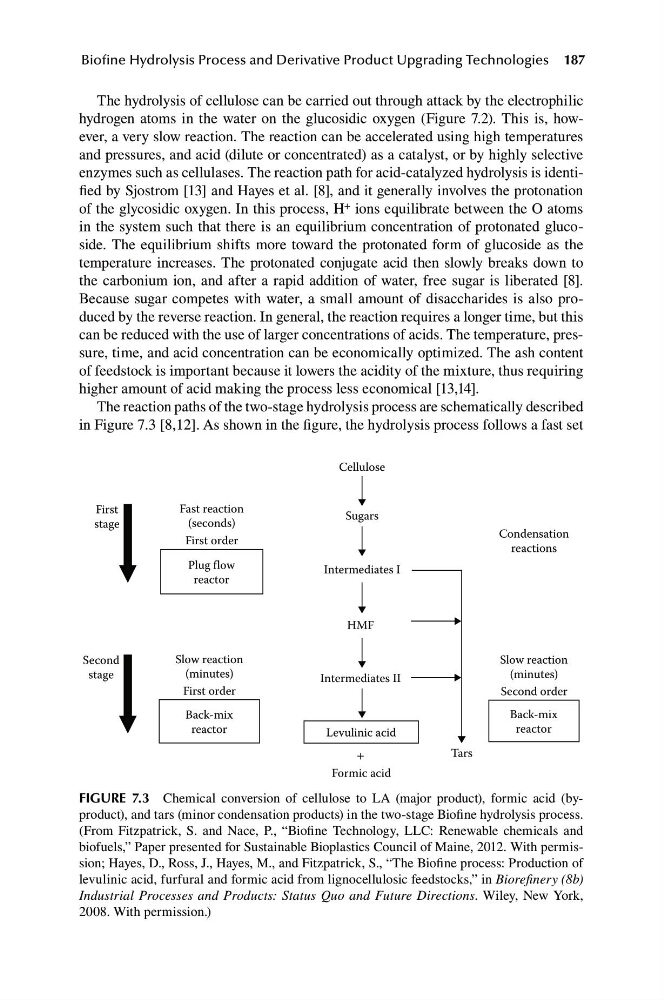
The reaction paths of the two-stage hydrolysis process are schematically described
in Figure 7.3 [8,12]. As shown in the figure, the hydrolysis process follows a fast set
FiGUre 7.3 Chemical conversion of cellulose to LA (major product), formic acid (byproduct), and tars (minor condensation products) in the two-stage Biofine hydrolysis process.
(From Fitzpatrick, S. and Nace, P., “Biofine Technology, LLC: Renewable chemicals and
biofuels,” Paper presented for Sustainable Bioplastics Council of Maine, 2012. With permission; Hayes, D., Ross, J., Hayes, M., and Fitzpatrick, S., “The Biofine process: Production of
levulinic acid, furfural and formic acid from lignocellulosic feedstocks,” in Biorefinery (8b)
Industrial Processes and Products: Status Quo and Future Directions. Wiley, New York,
2008. With permission.)
Condensation
reactions
First order
First order
Sugars
Intermediates I
Intermediates II
Slow reaction
(minutes)
Second order
Back-mix
reactor
Back-mix
reactor
First
stage
Second
stage
HMF
Plug flow
reactor
Levulinic acid
Fast reaction
(seconds)
Slow reaction
(minutes)
Tars
Formic acid
+
Biofine Hydrolysis Process and Derivative Product Upgrading Technologies 187
The hydrolysis of cellulose can be carried out through attack by the electrophilic
hydrogen atoms in the water on the glucosidic oxygen (Figure 7.2). This is, however, a very slow reaction. The reaction can be accelerated using high temperatures
and pressures, and acid (dilute or concentrated) as a catalyst, or by highly selective
enzymes such as cellulases. The reaction path for acid-catalyzed hydrolysis is identified by Sjostrom [13] and Hayes et al. [8], and it generally involves the protonation
of the glycosidic oxygen. In this process, H + ions equilibrate between the O atoms
in the system such that there is an equilibrium concentration of protonated glucoside. The equilibrium shifts more toward the protonated form of glucoside as the
temperature increases. The protonated conjugate acid then slowly breaks down to
the carbonium ion, and after a rapid addition of water, free sugar is liberated [8].
Because sugar competes with water, a small amount of disaccharides is also produced by the reverse reaction. In general, the reaction requires a longer time, but this
can be reduced with the use of larger concentrations of acids. The temperature, pressure, time, and acid concentration can be economically optimized. The ash content
of feedstock is important because it lowers the acidity of the mixture, thus requiring
higher amount of acid making the process less economical [13,14].
The reaction paths of the two-stage hydrolysis process are schematically described
in Figure 7.3 [8,12]. As shown in the figure, the hydrolysis process follows a fast set
FiGUre 7.3 Chemical conversion of cellulose to LA (major product), formic acid (byproduct), and tars (minor condensation products) in the two-stage Biofine hydrolysis process.
(From Fitzpatrick, S. and Nace, P., “Biofine Technology, LLC: Renewable chemicals and
biofuels,” Paper presented for Sustainable Bioplastics Council of Maine, 2012. With permission; Hayes, D., Ross, J., Hayes, M., and Fitzpatrick, S., “The Biofine process: Production of
levulinic acid, furfural and formic acid from lignocellulosic feedstocks,” in Biorefinery (8b)
Industrial Processes and Products: Status Quo and Future Directions. Wiley, New York,
2008. With permission.)