

H
2 and alkane selectivities
100
80
60
40
20
0
Ethylene
Glycerol
Sorbitol
Glucose
glycol
Methanol
T = 498 K
T = 538 K
T = 538 K
T = 498 K
164
Water for Energy and Fuel Production
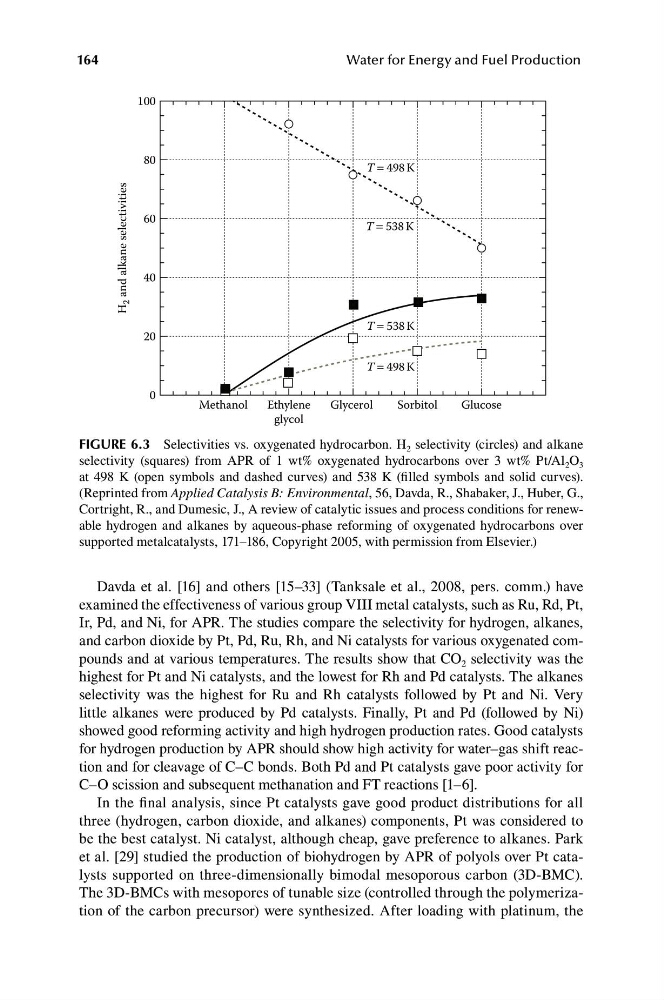
FiGUre 6.3 Selectivities vs. oxygenated hydrocarbon. H 2 selectivity (circles) and alkane
selectivity (squares) from APR of 1 wt% oxygenated hydrocarbons over 3 wt% Pt/Al 2 O 3
at 498 K (open symbols and dashed curves) and 538 K (filled symbols and solid curves).
(Reprinted from Applied Catalysis B: Environmental, 56, Davda, R., Shabaker, J., Huber, G.,
Cortright, R., and Dumesic, J., A review of catalytic issues and process conditions for renewable hydrogen and alkanes by aqueous-phase reforming of oxygenated hydrocarbons over
supported metalcatalysts, 171–186, Copyright 2005, with permission from Elsevier.)
Davda et al. [16] and others [15–33] (Tanksale et al., 2008, pers. comm.) have
examined the effectiveness of various group VIII metal catalysts, such as Ru, Rd, Pt,
Ir, Pd, and Ni, for APR. The studies compare the selectivity for hydrogen, alkanes,
and carbon dioxide by Pt, Pd, Ru, Rh, and Ni catalysts for various oxygenated compounds and at various temperatures. The results show that CO 2 selectivity was the
highest for Pt and Ni catalysts, and the lowest for Rh and Pd catalysts. The alkanes
selectivity was the highest for Ru and Rh catalysts followed by Pt and Ni. Very
little alkanes were produced by Pd catalysts. Finally, Pt and Pd (followed by Ni)
showed good reforming activity and high hydrogen production rates. Good catalysts
for hydrogen production by APR should show high activity for water–gas shift reaction and for cleavage of C–C bonds. Both Pd and Pt catalysts gave poor activity for
C–O scission and subsequent methanation and FT reactions [1–6].
In the final analysis, since Pt catalysts gave good product distributions for all
three (hydrogen, carbon dioxide, and alkanes) components, Pt was considered to
be the best catalyst. Ni catalyst, although cheap, gave preference to alkanes. Park
et al. [29] studied the production of biohydrogen by APR of polyols over Pt catalysts supported on three-dimensionally bimodal mesoporous carbon (3D-BMC).
The 3D-BMCs with mesopores of tunable size (controlled through the polymerization of the carbon precursor) were synthesized. After loading with platinum, the
2 and alkane selectivities
100
80
60
40
20
0
Ethylene
Glycerol
Sorbitol
Glucose
glycol
Methanol
T = 498 K
T = 538 K
T = 538 K
T = 498 K
164
Water for Energy and Fuel Production
FiGUre 6.3 Selectivities vs. oxygenated hydrocarbon. H 2 selectivity (circles) and alkane
selectivity (squares) from APR of 1 wt% oxygenated hydrocarbons over 3 wt% Pt/Al 2 O 3
at 498 K (open symbols and dashed curves) and 538 K (filled symbols and solid curves).
(Reprinted from Applied Catalysis B: Environmental, 56, Davda, R., Shabaker, J., Huber, G.,
Cortright, R., and Dumesic, J., A review of catalytic issues and process conditions for renewable hydrogen and alkanes by aqueous-phase reforming of oxygenated hydrocarbons over
supported metalcatalysts, 171–186, Copyright 2005, with permission from Elsevier.)
Davda et al. [16] and others [15–33] (Tanksale et al., 2008, pers. comm.) have
examined the effectiveness of various group VIII metal catalysts, such as Ru, Rd, Pt,
Ir, Pd, and Ni, for APR. The studies compare the selectivity for hydrogen, alkanes,
and carbon dioxide by Pt, Pd, Ru, Rh, and Ni catalysts for various oxygenated compounds and at various temperatures. The results show that CO 2 selectivity was the
highest for Pt and Ni catalysts, and the lowest for Rh and Pd catalysts. The alkanes
selectivity was the highest for Ru and Rh catalysts followed by Pt and Ni. Very
little alkanes were produced by Pd catalysts. Finally, Pt and Pd (followed by Ni)
showed good reforming activity and high hydrogen production rates. Good catalysts
for hydrogen production by APR should show high activity for water–gas shift reaction and for cleavage of C–C bonds. Both Pd and Pt catalysts gave poor activity for
C–O scission and subsequent methanation and FT reactions [1–6].
In the final analysis, since Pt catalysts gave good product distributions for all
three (hydrogen, carbon dioxide, and alkanes) components, Pt was considered to
be the best catalyst. Ni catalyst, although cheap, gave preference to alkanes. Park
et al. [29] studied the production of biohydrogen by APR of polyols over Pt catalysts supported on three-dimensionally bimodal mesoporous carbon (3D-BMC).
The 3D-BMCs with mesopores of tunable size (controlled through the polymerization of the carbon precursor) were synthesized. After loading with platinum, the