

Hydrothermal Processes in Subcritical Water
139
The study by Minowa and Ogi [71] indicated that the cellulose gasification depends
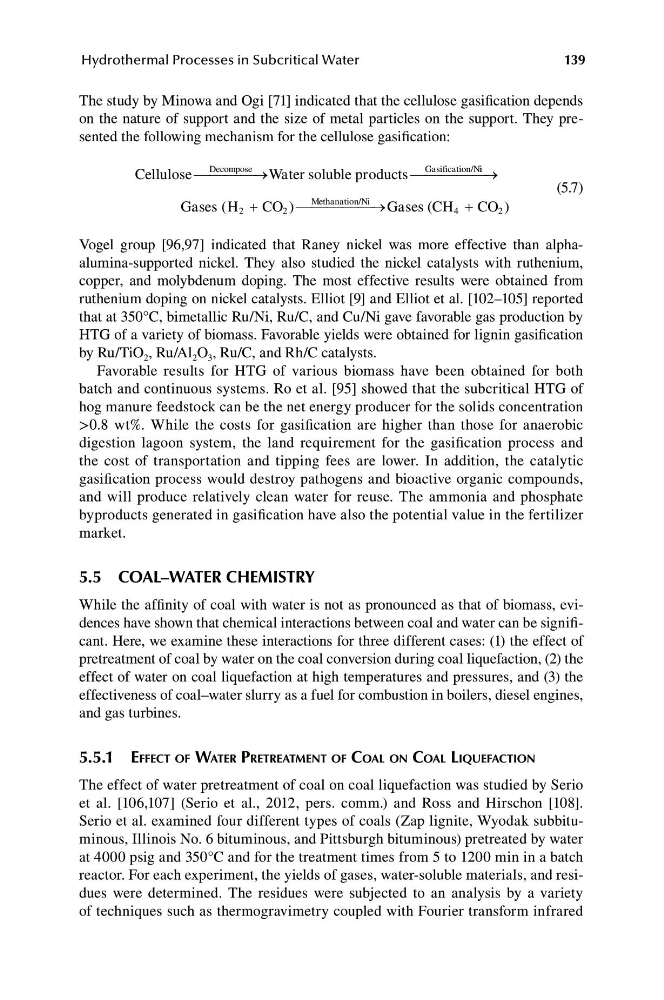
on the nature of support and the size of metal particles on the support. They presented the following mechanism for the cellulose gasification:
Cellulose
D
eco
mpose
→Water soluble products
G
asif
ication/
Ni i
→
(5.7)
Gases (H 2 + CO 2 )
M
etha
na
tion/
Ni
→Gases (CH 4 + CO 2 )
Vogel group [96,97] indicated that Raney nickel was more effective than alphaalumina-supported nickel. They also studied the nickel catalysts with ruthenium,
copper, and molybdenum doping. The most effective results were obtained from
ruthenium doping on nickel catalysts. Elliot [9] and Elliot et al. [102–105] reported
that at 350°C, bimetallic Ru/Ni, Ru/C, and Cu/Ni gave favorable gas production by
HTG of a variety of biomass. Favorable yields were obtained for lignin gasification
by Ru/TiO 2 , Ru/Al 2 O 3 , Ru/C, and Rh/C catalysts.
Favorable results for HTG of various biomass have been obtained for both
batch and continuous systems. Ro et al. [95] showed that the subcritical HTG of
hog manure feedstock can be the net energy producer for the solids concentration
>0.8 wt%. While the costs for gasification are higher than those for anaerobic
digestion lagoon system, the land requirement for the gasification process and
the cost of transportation and tipping fees are lower. In addition, the catalytic
gasification process would destroy pathogens and bioactive organic compounds,
and will produce relatively clean water for reuse. The ammonia and phosphate
byproducts generated in gasification have also the potential value in the fertilizer
market.
5.5 COal–Water Chemistry
While the affinity of coal with water is not as pronounced as that of biomass, evidences have shown that chemical interactions between coal and water can be significant. Here, we examine these interactions for three different cases: (1) the effect of
pretreatment of coal by water on the coal conversion during coal liquefaction, (2) the
effect of water on coal liquefaction at high temperatures and pressures, and (3) the
effectiveness of coal–water slurry as a fuel for combustion in boilers, diesel engines,
and gas turbines.
5.5.1 eFFeCT oF WATer PreTreATmenT oF CoAl on CoAl liqueFACTion
The effect of water pretreatment of coal on coal liquefaction was studied by Serio
et al. [106,107] (Serio et al., 2012, pers. comm.) and Ross and Hirschon [108].
Serio et al. examined four different types of coals (Zap lignite, Wyodak subbituminous, Illinois No. 6 bituminous, and Pittsburgh bituminous) pretreated by water
at 4000 psig and 350°C and for the treatment times from 5 to 1200 min in a batch
reactor. For each experiment, the yields of gases, water-soluble materials, and residues were determined. The residues were subjected to an analysis by a variety
of techniques such as thermogravimetry coupled with Fourier transform infrared
139
The study by Minowa and Ogi [71] indicated that the cellulose gasification depends
on the nature of support and the size of metal particles on the support. They presented the following mechanism for the cellulose gasification:
Cellulose
D
eco
mpose
→Water soluble products
G
asif
ication/
Ni i
→
(5.7)
Gases (H 2 + CO 2 )
M
etha
na
tion/
Ni
→Gases (CH 4 + CO 2 )
Vogel group [96,97] indicated that Raney nickel was more effective than alphaalumina-supported nickel. They also studied the nickel catalysts with ruthenium,
copper, and molybdenum doping. The most effective results were obtained from
ruthenium doping on nickel catalysts. Elliot [9] and Elliot et al. [102–105] reported
that at 350°C, bimetallic Ru/Ni, Ru/C, and Cu/Ni gave favorable gas production by
HTG of a variety of biomass. Favorable yields were obtained for lignin gasification
by Ru/TiO 2 , Ru/Al 2 O 3 , Ru/C, and Rh/C catalysts.
Favorable results for HTG of various biomass have been obtained for both
batch and continuous systems. Ro et al. [95] showed that the subcritical HTG of
hog manure feedstock can be the net energy producer for the solids concentration
>0.8 wt%. While the costs for gasification are higher than those for anaerobic
digestion lagoon system, the land requirement for the gasification process and
the cost of transportation and tipping fees are lower. In addition, the catalytic
gasification process would destroy pathogens and bioactive organic compounds,
and will produce relatively clean water for reuse. The ammonia and phosphate
byproducts generated in gasification have also the potential value in the fertilizer
market.
5.5 COal–Water Chemistry
While the affinity of coal with water is not as pronounced as that of biomass, evidences have shown that chemical interactions between coal and water can be significant. Here, we examine these interactions for three different cases: (1) the effect of
pretreatment of coal by water on the coal conversion during coal liquefaction, (2) the
effect of water on coal liquefaction at high temperatures and pressures, and (3) the
effectiveness of coal–water slurry as a fuel for combustion in boilers, diesel engines,
and gas turbines.
5.5.1 eFFeCT oF WATer PreTreATmenT oF CoAl on CoAl liqueFACTion
The effect of water pretreatment of coal on coal liquefaction was studied by Serio
et al. [106,107] (Serio et al., 2012, pers. comm.) and Ross and Hirschon [108].
Serio et al. examined four different types of coals (Zap lignite, Wyodak subbituminous, Illinois No. 6 bituminous, and Pittsburgh bituminous) pretreated by water
at 4000 psig and 350°C and for the treatment times from 5 to 1200 min in a batch
reactor. For each experiment, the yields of gases, water-soluble materials, and residues were determined. The residues were subjected to an analysis by a variety
of techniques such as thermogravimetry coupled with Fourier transform infrared