

131
Hydrothermal Processes in Subcritical Water
diminishes. At high biomass concentration, the HTL process behaves much like the
intermediate-temperature dry pyrolysis resulting in less bio-oil production.
5.3.2.3 Gas and liquid Properties
Generally, a reducing gas or a hydrogen donor stabilizes the fragmented products
of liquefaction. Reducing the environment inhibits condensation, cyclization, and
repolymerization of free radicals, thereby reducing the char formation [14,41]. The
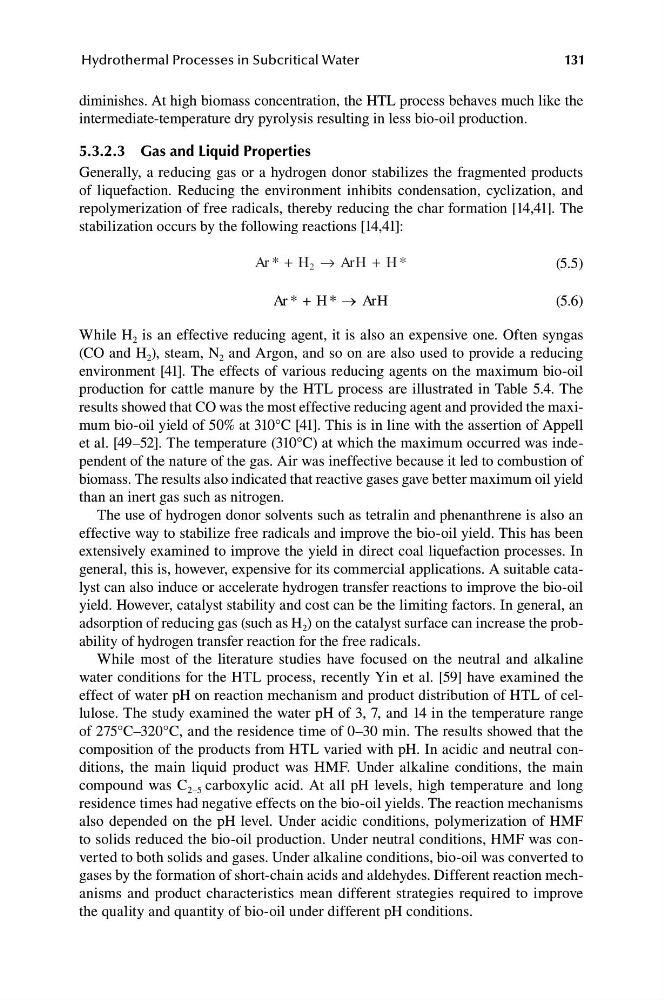
stabilization occurs by the following reactions [14,41]:
(5.5)
Ar * + H * → ArH
(5.6)
While H 2 is an effective reducing agent, it is also an expensive one. Often syngas
(CO and H 2 ), steam, N 2 and Argon, and so on are also used to provide a reducing
environment [41]. The effects of various reducing agents on the maximum bio-oil
production for cattle manure by the HTL process are illustrated in Table 5.4. The
results showed that CO was the most effective reducing agent and provided the maximum bio-oil yield of 50% at 310°C [41]. This is in line with the assertion of Appell
et al. [49–52]. The temperature (310°C) at which the maximum occurred was independent of the nature of the gas. Air was ineffective because it led to combustion of
biomass. The results also indicated that reactive gases gave better maximum oil yield
than an inert gas such as nitrogen.
The use of hydrogen donor solvents such as tetralin and phenanthrene is also an
effective way to stabilize free radicals and improve the bio-oil yield. This has been
extensively examined to improve the yield in direct coal liquefaction processes. In
general, this is, however, expensive for its commercial applications. A suitable catalyst can also induce or accelerate hydrogen transfer reactions to improve the bio-oil
yield. However, catalyst stability and cost can be the limiting factors. In general, an
adsorption of reducing gas (such as H 2 ) on the catalyst surface can increase the probability of hydrogen transfer reaction for the free radicals.
While most of the literature studies have focused on the neutral and alkaline
water conditions for the HTL process, recently Yin et al. [59] have examined the
effect of water pH on reaction mechanism and product distribution of HTL of cellulose. The study examined the water pH of 3, 7, and 14 in the temperature range
of 275°C–320°C, and the residence time of 0–30 min. The results showed that the
composition of the products from HTL varied with pH. In acidic and neutral conditions, the main liquid product was HMF. Under alkaline conditions, the main
compound was C 2–5 carboxylic acid. At all pH levels, high temperature and long
residence times had negative effects on the bio-oil yields. The reaction mechanisms
also depended on the pH level. Under acidic conditions, polymerization of HMF
to solids reduced the bio-oil production. Under neutral conditions, HMF was converted to both solids and gases. Under alkaline conditions, bio-oil was converted to
gases by the formation of short-chain acids and aldehydes. Different reaction mechanisms and product characteristics mean different strategies required to improve
the quality and quantity of bio-oil under different pH conditions.
Ar
H
A rH H
* +
+
→
2
*