

129
Hydrothermal Processes in Subcritical Water
taBle 5.5
yield of htl Products as a Function of temperature
temperature (°C)
residue (%)
Oil (%)
Ws/W (%)
Gas (%)
O/s
O/G
150
72
6
21
1
0.083
6
200
56
13
26
5
0.23
2.6
250
32
33
29
6
1.03
5.5
300
16
38
30
16
2.37
2.37
350
16
27
33
24
1.69
1.37
Source: Akhtar, A. and Amin, N., Renewable & Sustainable Energy Reviews, 15, 1615–1624, 2011. With
permission.
Note: These are the best calculations/estimations from the graphical data.
O/G, oil/gas ratio; O/S, oil/solid ratio; W, water; WS, water solubles.
Akhtar and Amin [41] compared the bio-oil productions from various studies and
showed that bio-oil production showed an optimum in each study, although the exact
location of the maximum oil production depended on the nature of the feedstock. At
temperatures above 300°C, the gas production can also increase particularly when
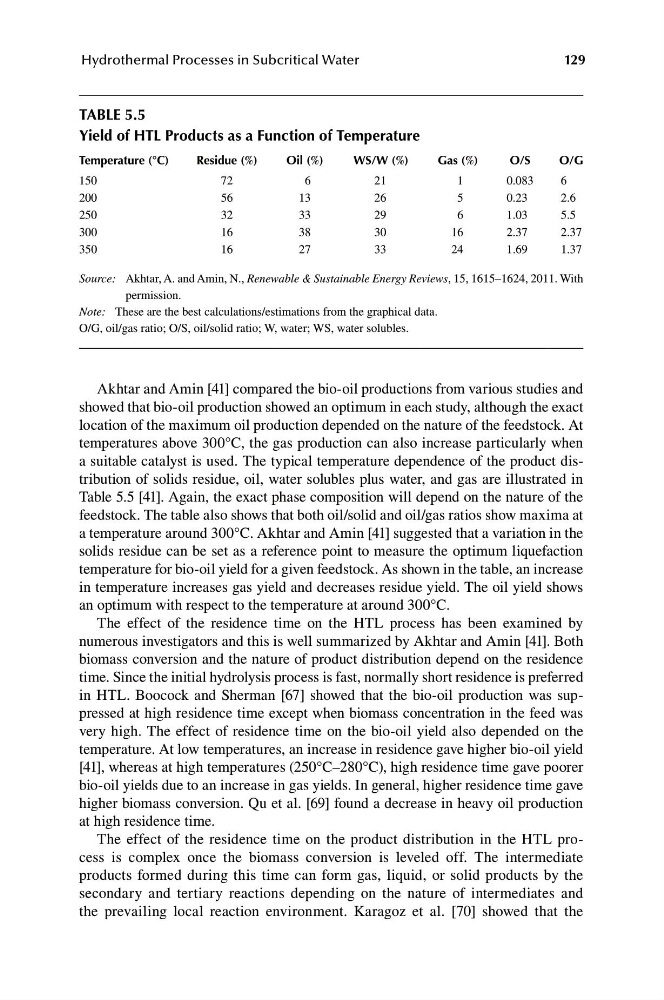
a suitable catalyst is used. The typical temperature dependence of the product distribution of solids residue, oil, water solubles plus water, and gas are illustrated in
Table 5.5 [41]. Again, the exact phase composition will depend on the nature of the
feedstock. The table also shows that both oil/solid and oil/gas ratios show maxima at
a temperature around 300°C. Akhtar and Amin [41] suggested that a variation in the
solids residue can be set as a reference point to measure the optimum liquefaction
temperature for bio-oil yield for a given feedstock. As shown in the table, an increase
in temperature increases gas yield and decreases residue yield. The oil yield shows
an optimum with respect to the temperature at around 300°C.
The effect of the residence time on the HTL process has been examined by
numerous investigators and this is well summarized by Akhtar and Amin [41]. Both
biomass conversion and the nature of product distribution depend on the residence
time. Since the initial hydrolysis process is fast, normally short residence is preferred
in HTL. Boocock and Sherman [67] showed that the bio-oil production was suppressed at high residence time except when biomass concentration in the feed was
very high. The effect of residence time on the bio-oil yield also depended on the
temperature. At low temperatures, an increase in residence gave higher bio-oil yield
[41], whereas at high temperatures (250°C–280°C), high residence time gave poorer
bio-oil yields due to an increase in gas yields. In general, higher residence time gave
higher biomass conversion. Qu et al. [69] found a decrease in heavy oil production
at high residence time.
The effect of the residence time on the product distribution in the HTL process is complex once the biomass conversion is leveled off. The intermediate
products formed during this time can form gas, liquid, or solid products by the
secondary and tertiary reactions depending on the nature of intermediates and
the prevailing local reaction environment. Karagoz et al. [70] showed that the
Hydrothermal Processes in Subcritical Water
taBle 5.5
yield of htl Products as a Function of temperature
temperature (°C)
residue (%)
Oil (%)
Ws/W (%)
Gas (%)
O/s
O/G
150
72
6
21
1
0.083
6
200
56
13
26
5
0.23
2.6
250
32
33
29
6
1.03
5.5
300
16
38
30
16
2.37
2.37
350
16
27
33
24
1.69
1.37
Source: Akhtar, A. and Amin, N., Renewable & Sustainable Energy Reviews, 15, 1615–1624, 2011. With
permission.
Note: These are the best calculations/estimations from the graphical data.
O/G, oil/gas ratio; O/S, oil/solid ratio; W, water; WS, water solubles.
Akhtar and Amin [41] compared the bio-oil productions from various studies and
showed that bio-oil production showed an optimum in each study, although the exact
location of the maximum oil production depended on the nature of the feedstock. At
temperatures above 300°C, the gas production can also increase particularly when
a suitable catalyst is used. The typical temperature dependence of the product distribution of solids residue, oil, water solubles plus water, and gas are illustrated in
Table 5.5 [41]. Again, the exact phase composition will depend on the nature of the
feedstock. The table also shows that both oil/solid and oil/gas ratios show maxima at
a temperature around 300°C. Akhtar and Amin [41] suggested that a variation in the
solids residue can be set as a reference point to measure the optimum liquefaction
temperature for bio-oil yield for a given feedstock. As shown in the table, an increase
in temperature increases gas yield and decreases residue yield. The oil yield shows
an optimum with respect to the temperature at around 300°C.
The effect of the residence time on the HTL process has been examined by
numerous investigators and this is well summarized by Akhtar and Amin [41]. Both
biomass conversion and the nature of product distribution depend on the residence
time. Since the initial hydrolysis process is fast, normally short residence is preferred
in HTL. Boocock and Sherman [67] showed that the bio-oil production was suppressed at high residence time except when biomass concentration in the feed was
very high. The effect of residence time on the bio-oil yield also depended on the
temperature. At low temperatures, an increase in residence gave higher bio-oil yield
[41], whereas at high temperatures (250°C–280°C), high residence time gave poorer
bio-oil yields due to an increase in gas yields. In general, higher residence time gave
higher biomass conversion. Qu et al. [69] found a decrease in heavy oil production
at high residence time.
The effect of the residence time on the product distribution in the HTL process is complex once the biomass conversion is leveled off. The intermediate
products formed during this time can form gas, liquid, or solid products by the
secondary and tertiary reactions depending on the nature of intermediates and
the prevailing local reaction environment. Karagoz et al. [70] showed that the