

127
Hydrothermal Processes in Subcritical Water
which in turn reacts with cellulose in the wood wastes to form oil and regenerate
sodium carbonate as
(5.4)
Vicinal hydroxyl groups in the carbohydrates undergo dehydration to form an enol
followed by its isomerization to ketone. The newly formed carbonyl group is reduced
to the corresponding alcohol with formate ion and water. The hydroxyl ion then
reacts with additional carbon monoxide to regenerate the formate ion.
The above set of basic reactions is accompanied by a multitude of side reactions
producing a whole host of intermediates. Some of the beneficial side reactions are
facilitated by the alkaline conditions. When two carbonyl groups become vicinal,
a benzylic type of rearrangement occurs, which results in a hydroxyl acid. The
hydroxyl acid readily decarboxylates causing a net effect of reducing the remainder
of the carbohydrate-derived molecule [49–52].
For the HTL process, the segments produced by hydrolysis are further degraded
by dehydration, dehydrogenation, decarboxylation, and deoxygenation. These types
of reactions result in the formation of paraffin-type structures that have less oxygen
than the original compounds.
There are several other features in this reaction mechanism. Aldol condensation
may be a part of the reaction. This can occur between a carbonyl group on one molecule and two hydrogens on another molecule, resulting in the elimination of water. In
the absence of a reducing agent such as CO or H 2 , condensation reactions dominate,
which lead to polymerization and the formation of solid-like products. The reducing agents keep the concentration of carbonyl groups low enough to produce liquid
products instead of solid products.
Appell et al. [49–52] also pointed out that hydrogen radicals formed by the addition of CO and the presence of water–gas shift reaction can react with various
carbonyl and hydroxyl groups to form paraffins and water, thus avoiding various
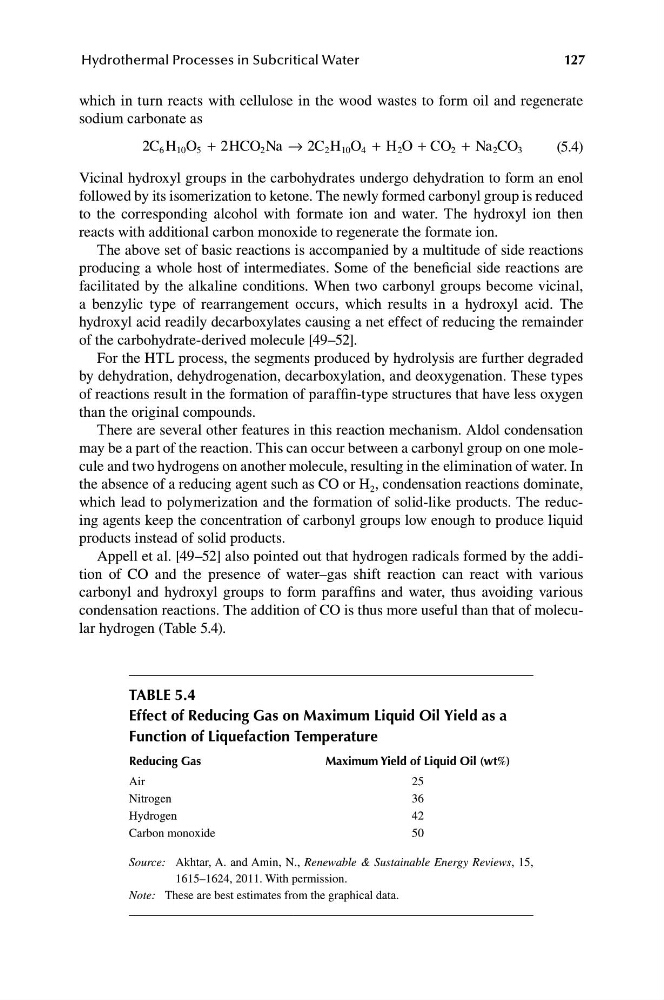
condensation reactions. The addition of CO is thus more useful than that of molecular hydrogen (Table 5.4).
taBle 5.4
effect of reducing Gas on maximum liquid Oil yield as a
Function of liquefaction temperature
reducing Gas
maximum yield of liquid Oil (wt%)
Air
25
Nitrogen
36
Hydrogen
42
Carbon monoxide
50
Source: Akhtar, A. and Amin, N., Renewable & Sustainable Energy Reviews, 15,
1615–1624, 2011. With permission.
Note: These are best estimates from the graphical data.
2
2
2
6 10 5
2
2 10 4
2
2
3
C H O
HCO Na
C H O
H O CO
Na CO
2
+
→
+
+
+
Hydrothermal Processes in Subcritical Water
which in turn reacts with cellulose in the wood wastes to form oil and regenerate
sodium carbonate as
(5.4)
Vicinal hydroxyl groups in the carbohydrates undergo dehydration to form an enol
followed by its isomerization to ketone. The newly formed carbonyl group is reduced
to the corresponding alcohol with formate ion and water. The hydroxyl ion then
reacts with additional carbon monoxide to regenerate the formate ion.
The above set of basic reactions is accompanied by a multitude of side reactions
producing a whole host of intermediates. Some of the beneficial side reactions are
facilitated by the alkaline conditions. When two carbonyl groups become vicinal,
a benzylic type of rearrangement occurs, which results in a hydroxyl acid. The
hydroxyl acid readily decarboxylates causing a net effect of reducing the remainder
of the carbohydrate-derived molecule [49–52].
For the HTL process, the segments produced by hydrolysis are further degraded
by dehydration, dehydrogenation, decarboxylation, and deoxygenation. These types
of reactions result in the formation of paraffin-type structures that have less oxygen
than the original compounds.
There are several other features in this reaction mechanism. Aldol condensation
may be a part of the reaction. This can occur between a carbonyl group on one molecule and two hydrogens on another molecule, resulting in the elimination of water. In
the absence of a reducing agent such as CO or H 2 , condensation reactions dominate,
which lead to polymerization and the formation of solid-like products. The reducing agents keep the concentration of carbonyl groups low enough to produce liquid
products instead of solid products.
Appell et al. [49–52] also pointed out that hydrogen radicals formed by the addition of CO and the presence of water–gas shift reaction can react with various
carbonyl and hydroxyl groups to form paraffins and water, thus avoiding various
condensation reactions. The addition of CO is thus more useful than that of molecular hydrogen (Table 5.4).
taBle 5.4
effect of reducing Gas on maximum liquid Oil yield as a
Function of liquefaction temperature
reducing Gas
maximum yield of liquid Oil (wt%)
Air
25
Nitrogen
36
Hydrogen
42
Carbon monoxide
50
Source: Akhtar, A. and Amin, N., Renewable & Sustainable Energy Reviews, 15,
1615–1624, 2011. With permission.
Note: These are best estimates from the graphical data.
2
2
2
6 10 5
2
2 10 4
2
2
3
C H O
HCO Na
C H O
H O CO
Na CO
2
+
→
+
+
+