

120
Water for Energy and Fuel Production
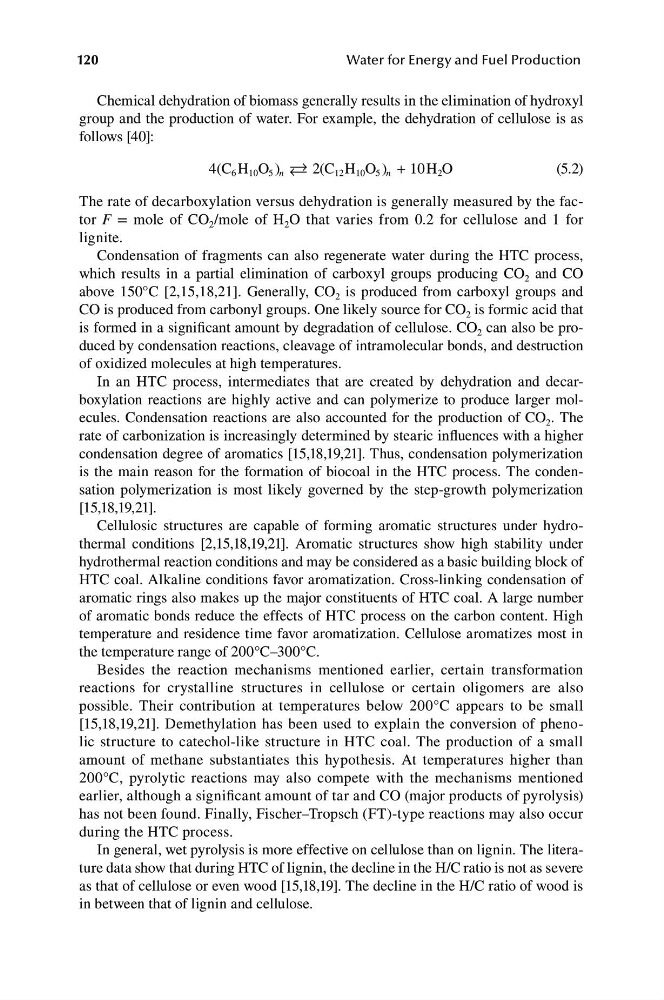
Chemical dehydration of biomass generally results in the elimination of hydroxyl
group and the production of water. For example, the dehydration of cellulose is as
follows [40]:
4(C H O ) 2(C H O ) + 10H O
(5.2)
6 10 5 n
12 10 5 n
2
The rate of decarboxylation versus dehydration is generally measured by the factor F = mole of CO 2 /mole of H 2 O that varies from 0.2 for cellulose and 1 for
lignite.
Condensation of fragments can also regenerate water during the HTC process,
which results in a partial elimination of carboxyl groups producing CO 2 and CO
above 150°C [2,15,18,21]. Generally, CO 2 is produced from carboxyl groups and
CO is produced from carbonyl groups. One likely source for CO 2 is formic acid that
is formed in a significant amount by degradation of cellulose. CO 2 can also be produced by condensation reactions, cleavage of intramolecular bonds, and destruction
of oxidized molecules at high temperatures.
In an HTC process, intermediates that are created by dehydration and decarboxylation reactions are highly active and can polymerize to produce larger molecules. Condensation reactions are also accounted for the production of CO 2 . The
rate of carbonization is increasingly determined by stearic influences with a higher
condensation degree of aromatics [15,18,19,21]. Thus, condensation polymerization
is the main reason for the formation of biocoal in the HTC process. The condensation polymerization is most likely governed by the step-growth polymerization
[15,18,19,21].
Cellulosic structures are capable of forming aromatic structures under hydrothermal conditions [2,15,18,19,21]. Aromatic structures show high stability under
hydrothermal reaction conditions and may be considered as a basic building block of
HTC coal. Alkaline conditions favor aromatization. Cross-linking condensation of
aromatic rings also makes up the major constituents of HTC coal. A large number
of aromatic bonds reduce the effects of HTC process on the carbon content. High
temperature and residence time favor aromatization. Cellulose aromatizes most in
the temperature range of 200°C–300°C.
Besides the reaction mechanisms mentioned earlier, certain transformation
reactions for crystalline structures in cellulose or certain oligomers are also
possible. Their contribution at temperatures below 200°C appears to be small
[15,18,19,21]. Demethylation has been used to explain the conversion of phenolic structure to catechol-like structure in HTC coal. The production of a small
amount of methane substantiates this hypothesis. At temperatures higher than
200°C, pyrolytic reactions may also compete with the mechanisms mentioned
earlier, although a significant amount of tar and CO (major products of pyrolysis)
has not been found. Finally, Fischer–Tropsch (FT)-type reactions may also occur
during the HTC process.
In general, wet pyrolysis is more effective on cellulose than on lignin. The literature data show that during HTC of lignin, the decline in the H/C ratio is not as severe
as that of cellulose or even wood [15,18,19]. The decline in the H/C ratio of wood is
in between that of lignin and cellulose.