

Concentrated
thermal radiation
CPC
Quartz
window
Upper cavity
T emitter
T lower cavity, top
Outlet
Emitter
plate
Lower cavity
SiC tiles
Packed bed
Steam injection
nozzle
T lower cavity, bottom
Al 2 O 3
insulation
Thermocouple
91
Steam Gasification and Reforming Technologies
Steam and particles were injected separately into the reactor cavity, permitting
the separate control of mass flow rates and stoichiometry. Steam was introduced
through several ports. The carbonaceous material feed unit was positioned on the top
of the reactor vessel with its inlet port located at the same plane as the primary steam
injection system, allowing for the immediate entrainment of particles by the steam
flow. Reactor temperature was measured at 12 separate locations by thermocouples
inserted in the Inconel walls. Both inlet and exit temperatures were also measured by
the thermocouples. The dry, slurry, and liquid feeding of raw materials were carried
out by different devices.
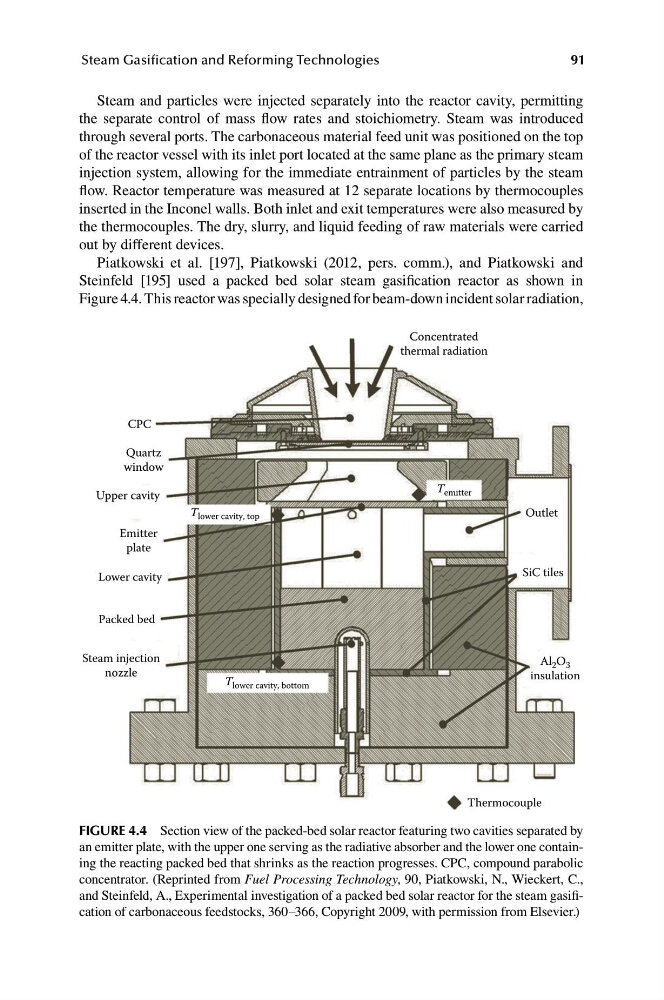
Piatkowski et al. [197], Piatkowski (2012, pers. comm.), and Piatkowski and
Steinfeld [195] used a packed bed solar steam gasification reactor as shown in
Figure 4.4. This reactor was specially designed for beam-down incident solar radiation,
FiGUre 4.4 Section view of the packed-bed solar reactor featuring two cavities separated by
an emitter plate, with the upper one serving as the radiative absorber and the lower one containing the reacting packed bed that shrinks as the reaction progresses. CPC, compound parabolic
concentrator. (Reprinted from Fuel Processing Technology, 90, Piatkowski, N., Wieckert, C.,
and Steinfeld, A., Experimental investigation of a packed bed solar reactor for the steam gasification of carbonaceous feedstocks, 360–366, Copyright 2009, with permission from Elsevier.)
thermal radiation
CPC
Quartz
window
Upper cavity
T emitter
T lower cavity, top
Outlet
Emitter
plate
Lower cavity
SiC tiles
Packed bed
Steam injection
nozzle
T lower cavity, bottom
Al 2 O 3
insulation
Thermocouple
91
Steam Gasification and Reforming Technologies
Steam and particles were injected separately into the reactor cavity, permitting
the separate control of mass flow rates and stoichiometry. Steam was introduced
through several ports. The carbonaceous material feed unit was positioned on the top
of the reactor vessel with its inlet port located at the same plane as the primary steam
injection system, allowing for the immediate entrainment of particles by the steam
flow. Reactor temperature was measured at 12 separate locations by thermocouples
inserted in the Inconel walls. Both inlet and exit temperatures were also measured by
the thermocouples. The dry, slurry, and liquid feeding of raw materials were carried
out by different devices.
Piatkowski et al. [197], Piatkowski (2012, pers. comm.), and Piatkowski and
Steinfeld [195] used a packed bed solar steam gasification reactor as shown in
Figure 4.4. This reactor was specially designed for beam-down incident solar radiation,
FiGUre 4.4 Section view of the packed-bed solar reactor featuring two cavities separated by
an emitter plate, with the upper one serving as the radiative absorber and the lower one containing the reacting packed bed that shrinks as the reaction progresses. CPC, compound parabolic
concentrator. (Reprinted from Fuel Processing Technology, 90, Piatkowski, N., Wieckert, C.,
and Steinfeld, A., Experimental investigation of a packed bed solar reactor for the steam gasification of carbonaceous feedstocks, 360–366, Copyright 2009, with permission from Elsevier.)